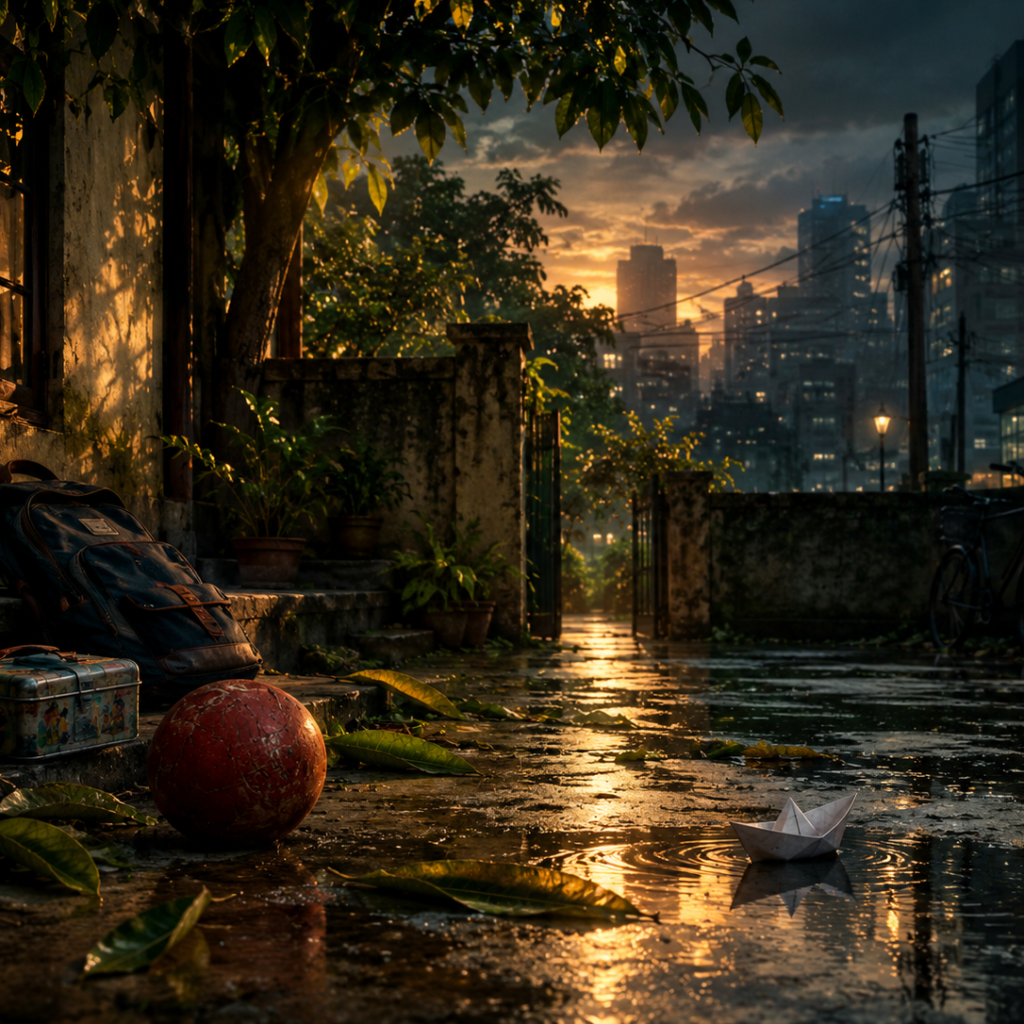
I have never trusted nostalgia.
It is too well dressed.
It arrives smelling of rain, carrying old photographs, soft music, forgotten afternoons, the taste of some childhood sweet whose name has been lost but whose sweetness apparently survived the decades. It asks you to believe that you were happier before you understood the world.
I don’t believe that.
I don’t believe the child was wiser.
I don’t believe the past was kinder.
I don’t believe growing older is some elaborate punishment inflicted upon us by time.
We were simply smaller then.
The world had not yet learned how much we could carry.
That is all.
And yet—
There are things I remember.
Not the grand things. Not birthdays or ceremonies or school prizes or the days adults thought deserved photographs. Those have blurred into dates and names and faces I sometimes need to concentrate to recover.
It is the insignificant things that remain.
A summer afternoon when the ceiling fan seemed to move the heat around rather than remove it. The sound of someone calling from another room. A glass of water that tasted impossibly cold because thirst had not yet become something we scheduled around work. The particular impatience of waiting for the rain to stop when there was nowhere important to be.
The ridiculous luxury of having an entire afternoon.
Do you understand what that was?
An afternoon with no obligation attached to it.
No appointment.
No notification.
No unfinished work sitting quietly inside the skull.
No invisible list of things that should have been done already.
Just time.
An enormous, careless quantity of it.
We wasted it magnificently.
And perhaps that is why I remember it.
We played until somebody called us home.
We fought and forgot why.
We built kingdoms out of things that had no value.
A cardboard box could become a house. A stick could become a sword. A bedsheet could become a fortress. A patch of ground could become another country.
We possessed an extraordinary ability to manufacture worlds from almost nothing.
Then adulthood arrived and taught us the opposite lesson.
Now we need money to make a room beautiful.
We need equipment to exercise.
We need reservations to travel.
We need calendars to meet people we love.
We need holidays to rest.
We need photographs to prove that we were somewhere.
We have become wonderfully efficient at purchasing the things we once created for free.
And still, somehow, we are tired.
I don’t say this as an accusation.
I am tired too.
I know what it is to measure a day by the number of things it demanded from me rather than by the number of things it gave.
I know what it is to wake up already negotiating with the hours.
Work.
Responsibility.
Bills.
Promises.
People.
Plans.
The small emergencies that never become important enough to be called emergencies, yet somehow consume an entire evening.
Adulthood does not usually arrive with a dramatic announcement.
It accumulates.
One responsibility at a time.
One postponed pleasure.
One “not today.”
One “maybe next month.”
One “after this is over.”
And then, one ordinary evening, you realise that you have become very good at surviving days you once would have considered boring.
That is the cruelty of it.
Not that childhood disappears.
That we become too occupied to notice what adulthood has taken.
I miss the stupid things.
There.
I said it.
I miss eating something simply because it tasted good.
I miss running outside without calculating distance.
I miss lying down without wondering whether I should be doing something else.
I miss being fascinated by insignificant discoveries.
A strange insect.
A cloud shaped like something.
A coin found on the road.
A particularly beautiful stone.
A secret understood only by two children and therefore infinitely more important than every adult fact in existence.
I miss how quickly an evening could become an event.
Someone would appear at the door.
“Come outside.”
And that was enough.
No explanation.
No planning.
No coordination.
Just come outside.
There was always somewhere to go when the world was young.
Now there are places everywhere, and somehow fewer destinations.
Perhaps that is what age really does.
It does not take away wonder.
It teaches us to demand a reason for it.
We become selective.
We ask whether something is useful.
Whether it is productive.
Whether it is worth the money.
Whether it fits into the schedule.
Whether tomorrow’s responsibilities permit it.
And slowly, quietly, we stop doing things simply because they make the day feel alive.
That is the part I resent.
Not growing older.
I can respect age.
Age has teeth.
It has taught me boundaries, discernment, endurance. It has stripped away several beautiful lies and replaced them with truths I would not surrender now.
I do not want to become a child again.
I want what the child knew without knowing it.
The ability to be entirely inside a moment.
The ability to let something small be sufficient.
A mango eaten over the sink.
Wet feet after walking through rain.
The smell of a schoolbag after a long day.
A favourite song coming from another room.
The first cool breeze after weeks of heat.
The sound of someone laughing when they had forgotten to be careful.
The smell of books.
The anticipation before opening something wrapped.
The strange importance of a particular pen.
A favourite corner of a house.
The first evening of summer vacation.
A power cut turning the entire neighbourhood into darkness.
Candles.
Stories.
Mosquitoes.
Sweat.
Laughter.
Somehow, even the inconveniences were allowed to become memories.
Now we complain about inconvenience as though life has violated a contract.
We want everything smooth.
Everything available.
Everything immediate.
And then we wonder why so little feels memorable.
Memory is a strange creature.
It does not preserve what we tell it to preserve.
It chooses.
It keeps the colour of a wall but forgets the conversation.
It remembers the smell of rain but not the date.
It remembers how someone’s voice sounded from another room.
It remembers the warmth of sunlight falling across a floor.
It remembers the feeling of waiting.
Sometimes I think memory is less interested in events than in atmosphere.
Perhaps that is why the smallest pleasures survive.
They had no ambition.
They did not announce themselves.
They did not know they were going to become important.
A childhood afternoon never stood before us and said, “Remember me.”
It simply happened.
And years later, when adulthood has covered everything beneath its machinery, some forgotten afternoon rises quietly from underneath.
Not asking to be restored.
Not asking us to return.
Just reminding us:
You were here.
You once had this.
You were capable of being happy without needing to explain why.
I used to think that was weakness.
Perhaps I still do.
I have no interest in romanticising innocence. Innocence is easily broken, easily manipulated, and often far too expensive when the world decides to collect its debts.
But simplicity is different.
Simplicity is not ignorance.
It is the absence of unnecessary weight.
And perhaps that is what we lose.
Not youth.
Weightlessness.
The ability to spend an hour watching rain without feeling guilty about the hour.
The ability to eat something delicious without calculating what it means.
The ability to sit beside someone without needing the conversation to accomplish anything.
The ability to walk somewhere simply because the road looked interesting.
The ability to be bored.
God, we were good at being bored.
And boredom had space inside it.
Space for imagination.
Space for mischief.
Space for impossible thoughts.
Space for becoming someone else for an afternoon.
Now even our boredom is occupied.
We fill every silence.
We reach for screens.
We answer messages.
We consume something.
We scroll.
We listen.
We watch.
We keep the mind constantly fed because somewhere along the way we became frightened of discovering what might emerge from an empty hour.
Perhaps we should be less frightened.
Perhaps some things need emptiness to remain green.
That is what memories are to me now.
Not windows into a better past.
Green things.
Small patches of life that somehow escaped the winter.
They remain untouched by promotions, disappointments, salaries, responsibilities, arguments, deadlines, failures, victories, and all the other machinery that adulthood insists on attaching to existence.
A child running home because it is getting dark.
A hand holding a stolen mango.
Bare feet on a floor.
Rain against tin.
A voice calling your name.
The smell of dinner.
The promise that tomorrow would be long.
I cannot go back.
I don’t want to.
Let the past remain where it is.
Let those afternoons keep their dust.
Let those houses keep their old walls.
Let the people in those memories remain exactly as they were, before time changed their faces and circumstances changed their voices.
I don’t want to resurrect them.
I only want to remember.
Because perhaps remembering is not surrender.
Perhaps it is defiance.
The world has taken many things from us.
It has made us practical.
It has made us cautious.
It has made us tired.
It has made us useful.
Fine.
Let it.
But there are still places inside us that refuse to become efficient.
There are still memories that have no economic value.
There are still pleasures that cannot be monetised, scheduled, optimised, or explained.
There is still rain.
Still sunlight.
Still the smell of earth.
Still laughter from another room.
Still the unreasonable sweetness of fruit eaten with bare hands.
Still evenings that do not need an occasion.
Still roads that can be walked without a destination.
And somewhere beneath everything adulthood has built around us, the old green things remain.
Not waiting for us to become children again.
Waiting only for us to stop for a moment.
And notice that they never died.