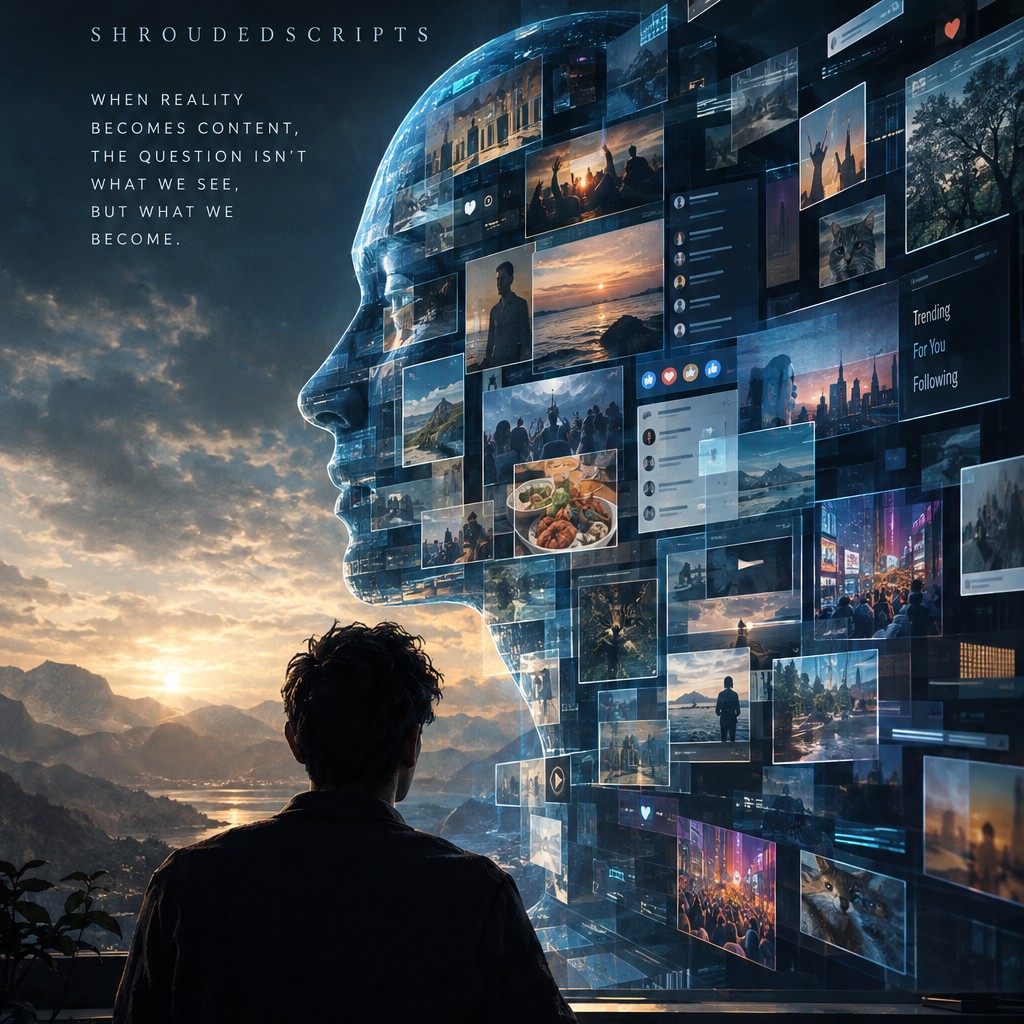
There is a difference between observing a change and understanding what has changed.
The first is easy.
The second is usually delayed.
We have spent the better part of two decades observing the expansion of digital media. We have measured its speed, its reach, its economic value. We have studied attention spans, engagement, addiction, virality, misinformation and influence. We have argued about whether screens are making us more connected or more isolated.
Most of these arguments begin with the same assumption:
That the medium is a tool.
That we are the users.
That the world remains where it has always been, while we occasionally enter another place to communicate about it.
The assumption is becoming difficult to maintain.
The important change may not be what technology has allowed us to see.
It may be what technology has taught us to consider visible.
There was a time when an event happened first and was represented afterward.
A wedding occurred.
Someone photographed it.
A journey was taken.
Someone wrote about it.
A thought appeared in someone’s mind.
Perhaps it was spoken.
Perhaps it was forgotten.
The representation came after the experience.
The distinction was not absolute. Human beings have always performed for one another. We have always told stories, exaggerated memories, constructed identities and selected which portions of ourselves to reveal.
But there was still a useful separation between the event and its representation.
Then we began calling representations content.
The word was efficient.
Almost perfectly neutral.
An article was content. A photograph was content. A video was content. A song was content. An advertisement was content. A joke was content.
The terminology seemed harmless because it described a technical reality.
Content was what went inside the container.
The container might be a website, a platform, a channel, a screen.
But the relationship between a container and what it contains is rarely neutral.
A container imposes boundaries.
It has dimensions.
It has an opening.
It has a capacity.
It determines what can fit and what cannot.
Most importantly, it determines shape.
Pour water into a glass and the water does not retain some abstract, original geometry while waiting to leave. It assumes the shape available to it.
The glass does not need to command the water.
Its walls are sufficient.
The same principle can be applied to information.
A platform designed for short messages encourages short messages.
A platform designed around images encourages visual communication.
A platform governed by immediate reactions rewards things that produce immediate reactions.
A system that measures attention gives an advantage to whatever can capture attention.
No ideology is required.
No conspiracy is required.
The structure is enough.
This is where the matter becomes more interesting than the familiar argument that technology has made people less authentic.
Perhaps authenticity is not the central problem.
Perhaps the more precise question is this:
What happens when experience begins adapting itself to the container before experience has even occurred?
The distinction is small.
It is also consequential.
A person standing before a landscape may no longer encounter only the landscape.
There may be, simultaneously, an image of the landscape.
There may be an imagined audience for that image.
There may be a question about whether the image is worth sharing.
There may be an expectation concerning how such a landscape is supposed to look.
There may be a memory of other landscapes previously encountered through the same medium.
The physical landscape remains unchanged.
But the experience of it has acquired another layer.
The observer is no longer merely observing.
He is also evaluating the possibility of representation.
The sunset becomes photographable before it becomes memorable.
The meal becomes documentable before it becomes enjoyable.
The journey becomes narratable before it has finished.
The thought becomes publishable before it has matured.
This does not mean that the experience is false.
That distinction is important.
A person may genuinely enjoy the sunset while photographing it.
A person may genuinely love another person while sharing a photograph of them.
A person may genuinely care about an injustice while posting about it.
The presence of representation does not invalidate the experience.
It changes its geometry.
The experience now exists simultaneously in two spaces.
There is the space in which it happens.
And there is the space in which it can circulate.
Increasingly, the second space influences the first.
This is the reversal worth noticing.
At first, we created content from experience.
Then we began creating experiences that could become content.
The difference is subtle enough to escape detection.
Consider the photograph.
Photography once required a certain deliberateness. Film had limited exposures. Development took time. Photographs were objects with physical boundaries. A photograph represented an event that had already happened.
The contemporary image is different.
It is almost frictionless.
There is little cost to producing one, little cost to storing one, little cost to transmitting one.
The result is not merely more photography.
It is a different relationship with visibility.
We can now preserve almost anything.
And therefore we can begin to feel that anything not preserved has somehow been lost.
This is an unusual development.
Forgetting used to be part of existence.
Most conversations disappeared.
Most journeys left no record.
Most meals were eaten and vanished.
Most ordinary afternoons survived only in the imperfect architecture of memory.
That did not make them less real.
Reality did not require documentation.
But the archive has expanded so dramatically that undocumented experience can begin to feel incomplete.
The photograph becomes evidence.
The post becomes confirmation.
The timestamp becomes proof.
The digital record increasingly stands between the event and our confidence that the event mattered.
This creates another transformation.
We have begun to confuse permanence with significance.
They are not the same.
Some of the most significant experiences in a human life may leave no usable record.
A conversation may be forgotten word for word while changing the direction of a person’s life.
A place may exist only in memory.
A moment of understanding may never be written down.
A private grief may have no audience.
An act of kindness may disappear without recognition.
None of these things become less real because they cannot be retrieved by search.
In fact, their resistance to retrieval may be part of what made them intimate.
The digital environment has a different preference.
It favours what can be stored.
What can be indexed.
What can be retrieved.
What can be compared.
What can be recommended.
What can be measured.
This creates a strange flattening.
A scientific discovery can become content.
A political catastrophe can become content.
A private confession can become content.
A joke can become content.
A child’s birthday can become content.
A death can become content.
The container does not necessarily distinguish between their moral or emotional weight.
It asks a simpler question:
Can this be carried?
If the answer is yes, it enters.
Once inside, it becomes part of the same machinery.
This does not mean that everything becomes equally important.
It means that everything becomes formally comparable.
A tragedy can appear immediately beside a comedy.
A philosophical argument can be followed by a cooking video.
A war can be separated from an advertisement by the movement of one thumb.
The sequence is determined not by human significance but by the architecture of circulation.
This is perhaps the first serious indication that the container is no longer merely containing.
It is arranging.
And arrangement changes perception.
Human beings have always understood things through context.
Remove context and meaning changes.
Place two unrelated events beside one another and the mind begins searching for a relationship.
Repeat an image often enough and familiarity begins to resemble truth.
Place everything inside one continuous stream and the boundaries between categories begin to weaken.
The sacred and the trivial can occupy adjacent positions.
The private and the public can become visually indistinguishable.
The important and the irrelevant can compete for the same fraction of attention.
The system does not have to declare that they are equal.
It merely has to place them together.
There is another consequence.
We have become both inhabitants and spectators of our own lives.
A person can experience an event while simultaneously imagining how the event will appear to others.
This is not entirely new.
Human beings have always possessed self-consciousness.
We have always adjusted ourselves according to the gaze of others.
But the contemporary gaze is different in one important respect.
It is persistent.
It can be quantified.
It can be repeated.
And it can be internalised.
There does not have to be an actual audience in the room.
The possibility of an audience is sufficient.
A person may begin editing himself before anyone has asked him to.
This is how systems become environments.
They no longer need to be consciously entered.
Their assumptions become part of ordinary behaviour.
The person does not think, I am now producing content.
He simply thinks, This would make a good post.
That sentence is more important than it appears.
Because the question has changed.
The question is no longer merely:
What am I experiencing?
It becomes:
What can this experience become?
The difference is almost invisible.
But it moves the centre of attention from existence to representation.
This may also explain the peculiar sensation that some contemporary experiences arrive already formatted.
Opinions become statements.
Experiences become stories.
Journeys become galleries.
Relationships become announcements.
Grief becomes a photograph with words beneath it.
Identity becomes a collection of selected fragments.
Again, none of this is necessarily dishonest.
The individual may mean every word.
The photograph may be genuine.
The emotion may be sincere.
The problem is structural.
A format does not have to falsify its contents in order to influence them.
It only has to make certain shapes easier than others.
Certainty is easier to communicate than uncertainty.
Outrage is easier to circulate than hesitation.
Beauty is easier to display than complexity.
A conclusion is easier to share than an unfinished thought.
The container does not forbid ambiguity.
It simply gives ambiguity poor circulation.
Eventually, the inhabitants learn.
They begin shaping themselves accordingly.
This is why the phrase content creator is more revealing than it initially sounds.
The person is no longer merely communicating.
He is manufacturing material suitable for the environment.
And once human beings become skilled at manufacturing material for an environment, the environment begins receiving an increasingly refined version of humanity.
Not humanity as it exists.
Humanity as it fits.
That distinction deserves attention.
Because perhaps the great transformation of the digital age is not that reality has been replaced by simulation.
That claim is too simple.
Reality remains stubbornly physical.
Bodies still become tired.
People still age.
Rain still falls without requiring a camera.
Death still occurs outside the notification system.
The world has not disappeared.
Something else has happened.
The representation of the world has become so pervasive that representation increasingly participates in determining what portions of the world receive attention.
Visibility has become a form of selection.
And selection has consequences.
What is repeatedly shown becomes familiar.
What is familiar becomes culturally legible.
What is legible becomes easier to reproduce.
What is reproduced becomes normal.
The process does not require a central authority.
It requires only repetition.
This is why the problem cannot be reduced to social media.
The technology is only the latest container.
The deeper question concerns the human tendency to adapt to containers without noticing that adaptation.
A room changes behaviour.
A uniform changes behaviour.
A classroom changes behaviour.
A prison changes behaviour.
A marketplace changes behaviour.
A language changes behaviour.
A medium changes behaviour.
The walls do not need to speak.
They only need to remain.
So perhaps the question we should be asking is not whether the digital world is real.
It plainly is.
Nor whether online experiences are authentic.
Some are.
The more uncomfortable question is whether we have begun designing ourselves according to the requirements of the environments through which our experiences circulate.
If so, the problem is not that we have entered a false world.
It is that we may be carrying the geometry of that world back with us.
We begin to think in fragments because fragments travel well.
We begin to prefer immediate conclusions because conclusions travel better than uncertainty.
We begin to document experiences because undocumented experiences seem strangely incomplete.
We begin to measure attention because the system measures attention.
We begin to watch ourselves living.
And eventually, perhaps, we begin living in ways that remain easy to watch.
There is nothing particularly dramatic about this.
No machine has taken control.
No boundary has visibly collapsed.
The transformation is quieter.
A person takes a photograph.
Then another.
A thought becomes a post.
A moment becomes a story.
A life becomes an archive.
An archive becomes a profile.
A profile becomes a representation.
The representation becomes the version most frequently encountered.
And the version most frequently encountered begins to feel like the person.
At that point, the distinction between inhabitant and content becomes difficult to locate.
Perhaps that is the part that should concern us.
Not that we have built machines capable of containing human experience.
We have always built containers for experience: books, paintings, photographs, monuments, stories.
The difference is that this container is interactive.
It does not merely receive.
It responds.
It ranks.
It selects.
It returns.
It teaches.
And because it teaches through repetition rather than instruction, its lessons can become invisible.
We may never be told what shape to take.
We may simply discover that some shapes receive more space.
So we adapt.
Water does not need to understand the glass.
It only needs to encounter its walls.
And perhaps that is the final observation.
We believed we were pouring reality into a new container.
We did not notice that the container had begun defining the shape of what we poured.
The world remains outside.
The screen remains inside our hands.
The distinction is still technically intact.
But the question is no longer where the container is.
The question is what has happened to the contents.
Because perhaps we did not merely turn reality into content.
Perhaps, slowly and without instruction, we learned to become content ourselves.