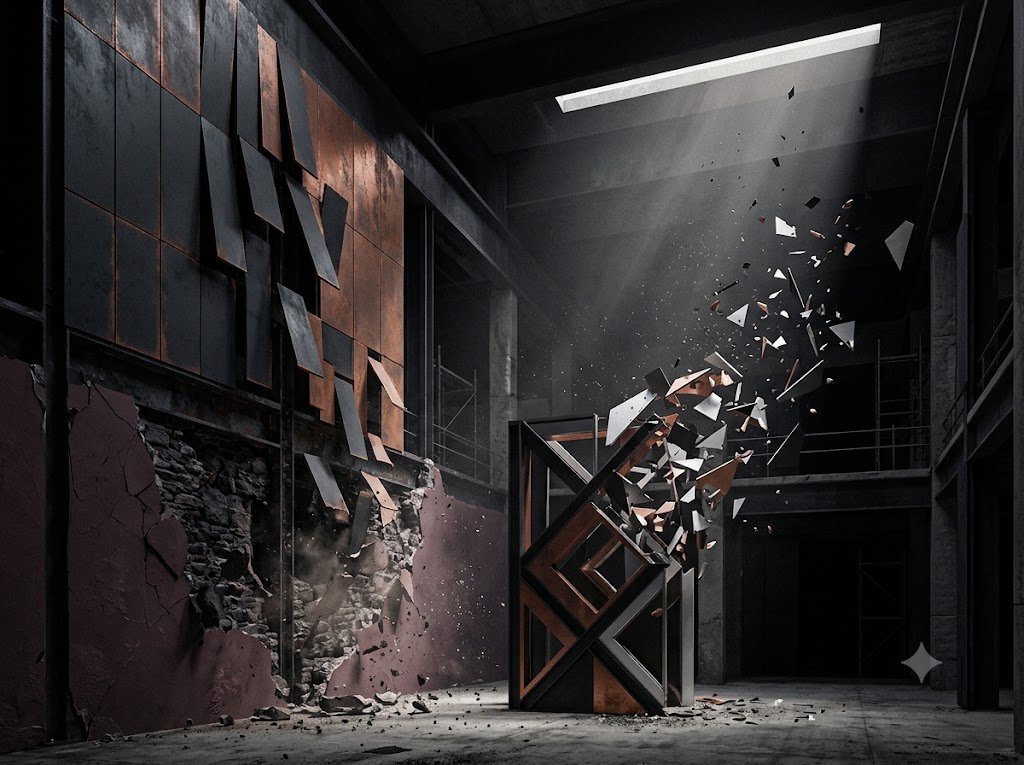
I have never understood the obligation to preserve something simply because it has survived.
Age does not confer authority. A locked room is not sacred because nobody has opened it. An arrangement of objects is not a promise that the arrangement must continue. Sometimes a thing has reached the end of its usefulness. Sometimes it has only become familiar enough that nobody questions the cost of keeping it intact.
Entropy interests me because it does not require a ceremony. The structure begins to change under the conditions already present. Heat moves. Surfaces weather. The carefully maintained boundary becomes expensive to maintain. The system continues whether anyone approves of the result or not.
There is a difference between destroying something out of anger and deciding that it no longer deserves your labour. I wanted to work in the space between those acts.
Nothing here is being asked to forgive me. Nothing is being asked to remain.
Poem: No Preservation Clause
I opened the room at noon.
The lock came away
with less resistance than expected.
I set it on the floor.
Inside, everything had been arranged
to suggest permanence:
the shelves level,
the labels facing outward,
the iron cases resting
on their designated squares.
I began with the labels.
Paper separates easily
when nobody has handled it
for several years.
The glue had dried.
The corners lifted
under the pressure of a thumb.
Then the shelves.
One screw refused to turn.
I applied more force.
The metal surrendered its thread,
and the bracket shifted
three millimetres from its position.
That was enough.
I removed the cases
and left them open.
Dust settled into the hinges.
The room’s sealed air
found a passage through the door.
By afternoon,
the sunlight had reached
the part of the floor
that had not been exposed
since the shelves were built.
The difference was almost indecent.
I did not put the cases back.
I did not replace the lock.
There are people who would call this waste.
They would point to the materials,
the years of careful maintenance,
the names recorded on paper,
the order that had survived
its makers.
They would be correct
about the materials.
The door remained open overnight.
By morning, moisture had entered
through a crack in the outer wall.
The metal smelled different.
A few sheets had curled at the edges.
Nothing had crossed a line
that the weather could recognise.
I stood in the doorway
until the light changed.
Then I left the key
where the lock had been.
Backstory / Analysis
The room is deliberately unspecified. I did not want it to become a museum, an institution, or a recognisable symbol of authority. Any of those choices would give the reader a convenient target. The room works better as an arrangement whose continued existence has become an assumption. Its contents have labels, the shelves have designated positions, and even the lock participates in the claim that the system should remain unchanged.
The speaker does not attack the room. She tests its construction. The screw refuses to turn; more force is applied; the thread fails. Three millimetres become the first measurable departure from the original arrangement. I wanted the physical detail to carry the event rather than an announcement of its significance.
The labels come first because they govern recognition. Once they separate from the objects, the room begins losing not only its structure but also part of the system by which its contents were understood. The subsequent opening of the cases and the arrival of moisture are ordinary material processes. No supernatural force is needed to make the room different by morning.
The line about the materials is intentionally narrow. The people who object to the dismantling may be correct that the materials have value, that maintenance has been invested, and that the arrangement has endured. Those facts do not settle the question of whether preservation is still warranted.
I gave the speaker no triumphant exit. She leaves the key behind, but even that gesture does not resolve the room into a lesson. The key once belonged to a mechanism that enforced a boundary. The mechanism is gone.
Its former purpose does not follow it into the dust.