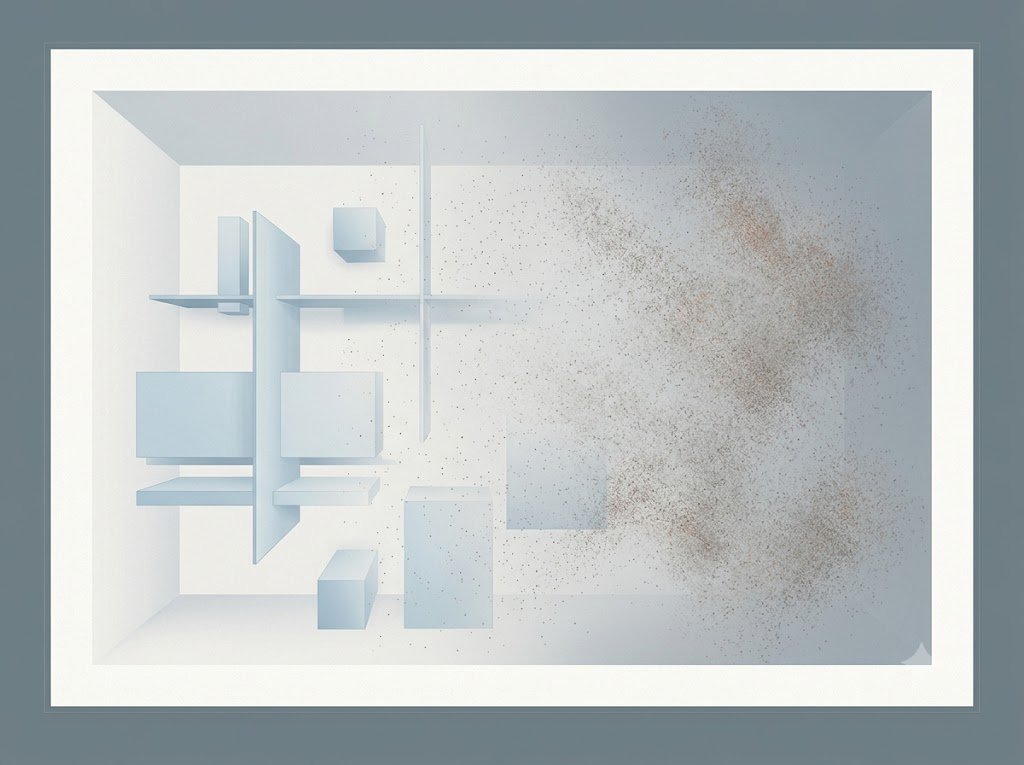
Entropy is frequently presented as a synonym for disorder. The shorthand is convenient, but it conceals more than it explains. A disordered desk and a uniform distribution of thermal energy are not the same phenomenon, even if both can be described as losses of a particular kind of arrangement.
For this poem, I began with a simpler question: what happens to a distinction when the conditions that sustain it disappear?
I have watched people approach this question differently. One attempts to catalogue the details before they vanish. Another may alter the system deliberately, with little interest in what can be recovered. Between these approaches lies an observable process that requires neither witness nor permission.
I wanted the poem to proceed as a sequence of measurements. Not because measurement makes the result less consequential, but because the result does not depend on the observer’s preference. The final statement should therefore describe what is left, rather than argue with the fact that something has changed.
Poem: State Description
Initially, the system contains
two distinguishable regions.
A temperature difference exists.
Energy is available to flow.
The boundary is not a wall,
though it behaves like one
under the present conditions.
At (t_0),
the distribution is uneven.
At (t_1),
the difference has decreased.
No single particle records
the original arrangement.
Each follows the local conditions,
interacts, transfers energy,
continues.
The process requires no knowledge
of the state from which it began.
A mark remains on the surface
where a vessel once stood.
The mark is measurable,
provided the surface is dry
and the light is adequate.
At another time,
its contrast with the surrounding material
falls below the available resolution.
This does not imply
that the material has ceased to exist.
Only the distinction
has become difficult to specify.
Consider the closed room.
The clock continues to advance.
The walls exchange heat
with the air they contain.
The air exchanges heat
with the objects inside it.
The process is not accelerated
by naming it.
Nor is it interrupted
by recording the temperature.
At equilibrium,
macroscopic differences cease
to provide a useful direction
for further thermal transfer.
The equations remain available.
The measurements retain their units.
The room retains its volume.
What they cannot recover
is the earlier distribution
from the final state alone.
There is no missing component
to locate.
No final movement
to be witnessed.
The system reaches equilibrium.
The distinction is gone.
Backstory / Analysis
I chose a state-description format because it limits the speaker’s authority. The poem records conditions, intervals, and changes without granting the observer a privileged position outside the system. A measurement is useful, but the person making it is also subject to time, temperature, and the limitations of available instruments.
The repeated temporal markers establish a sequence without turning it into a narrative of progress. Nothing in the poem is moving towards a moral conclusion. The unequal distribution changes; the observer registers the change; the original arrangement becomes progressively less available as a description of the present.
The image of the vessel’s mark performs a similar function on a smaller scale. It is measurable while the contrast remains sufficient. The relevant threshold belongs partly to the material and partly to the method of observation. Once the difference falls below that threshold, the mark has not necessarily vanished in an absolute physical sense. It has become indistinguishable under the conditions of measurement.
This distinction matters. Thermodynamic entropy is not simply a numerical score for untidiness, and equilibrium is not the assertion that every microscopic detail has ceased to exist. The poem uses a macroscopic description, where the loss of a measurable gradient can be sufficient to establish the end of a useful process.
The last two lines were retained in their plain form because another metaphor would have weakened them. The poem has already supplied the apparatus, the intervals, and the observations. The ending requires no additional interpretation.
A system does not need to understand its final state for that state to obtain.