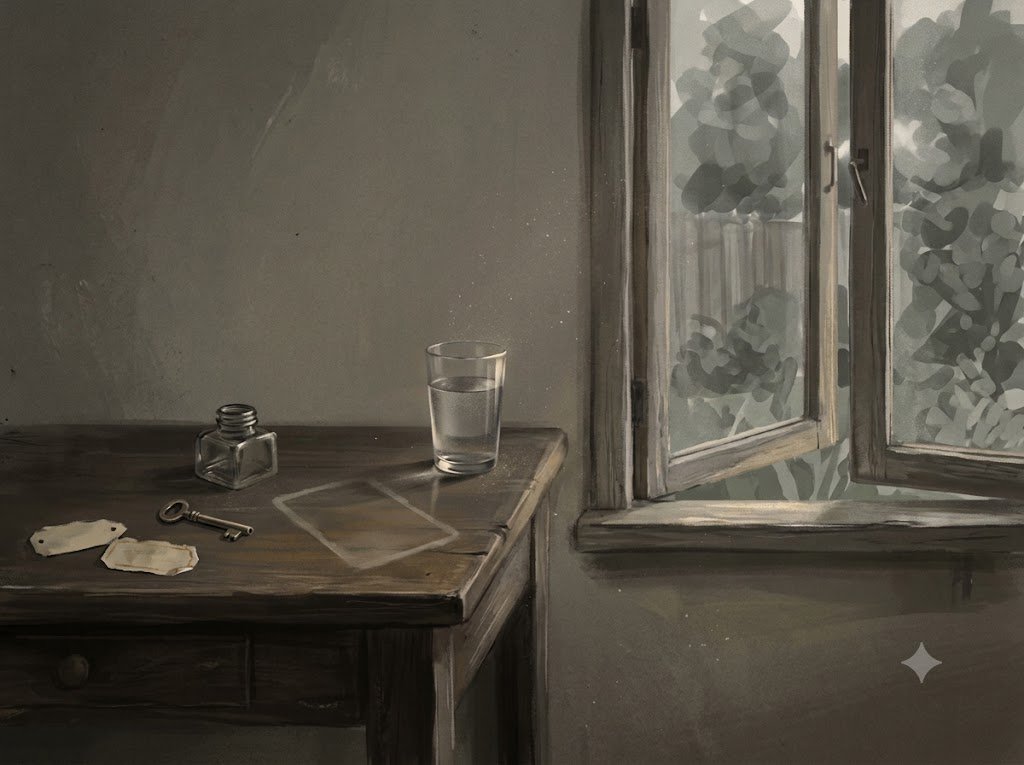
There are things one remembers because they mattered, and things one remembers because nobody thought to keep them.
The pale mark left by a flowerpot on the windowsill. The precise arrangement of books before someone borrowed the third one and never returned it. The small crack in a cup that widened over several winters, almost imperceptibly, until one morning it was simply no longer possible to drink from it.
I wanted to write about entropy through these ordinary departures. Not the grand collapse of a building, nor the last hours of a dying star, but the smaller business of things becoming less distinguishable from everything around them. There is a peculiar difficulty in making an inventory of such losses. The act of recording a thing takes time, and the thing does not necessarily wait for you to finish.
Perhaps that is why the list has no final entry.
Poem: A List of What Remains
The blue bowl has lost one corner.
I have written this down
because the missing piece
was small enough to overlook.
The table remembers four legs,
though one now rests
against the kitchen wall.
I have kept the screw
in a paper envelope,
its purpose written outside.
The envelope has softened.
The ink is beginning
to surrender the name of the screw.
In the drawer,
three buttons no longer belong
to anything in this house.
One is still warm in colour,
another has turned the shade
of old bone.
There was a photograph
with a white border.
The faces were clear once.
Now the youngest face
has become a pale interruption
between two others
I can still identify.
I have recorded the date
on the back.
The back is coming loose.
Outside, rain has entered
the wall through a narrow seam.
A patch of paint has lifted
without announcing itself.
Beneath it, the older colour
waits in fragments,
too little of it to name.
I make room in the notebook
for what will come next.
The pencil shortens.
The page takes the pressure
of a hand that has been here
too long.
By evening,
the list contains everything
I could think to save.
On the windowsill,
the pale ring left by the bowl
is almost indistinguishable
from the dust around it.
I leave the notebook open.
Backstory / Analysis
The poem began as an inventory, although I was never entirely certain what was being inventoried. Objects, certainly. But also the relationships that make an object legible: a screw belongs to a table, buttons to a garment, a face to a name. Remove enough of those connections and the object may survive physically while becoming difficult to understand.
Entropy gave me a way to think about this without treating decay as an event that must announce itself. In a physical system, the redistribution of energy and the loss of useful differences are not necessarily dramatic. A surface cools. A mark fades. Materials weather. The changes are real even when they offer no convenient moment at which to say that something has ended.
I used the first-person inventory to create the appearance of control. The speaker writes down dates, retains small parts, and makes room for future entries. Each act of preservation seems reasonable in isolation. Together, they reveal a modest problem: the record is subject to the same conditions as the things it records. Paper softens. Ink fades. The pencil becomes shorter.
The disappearing screw’s name is an early warning, but I wanted the poem to resist drawing attention to it. The photograph, the wall, and finally the ring on the windowsill extend the same process without repeating the same image.
The ending leaves the notebook open. It does not claim that the speaker has failed, or that remembering is pointless. The notebook remains useful for as long as somebody can read it.
There is simply dust on the page now, too.