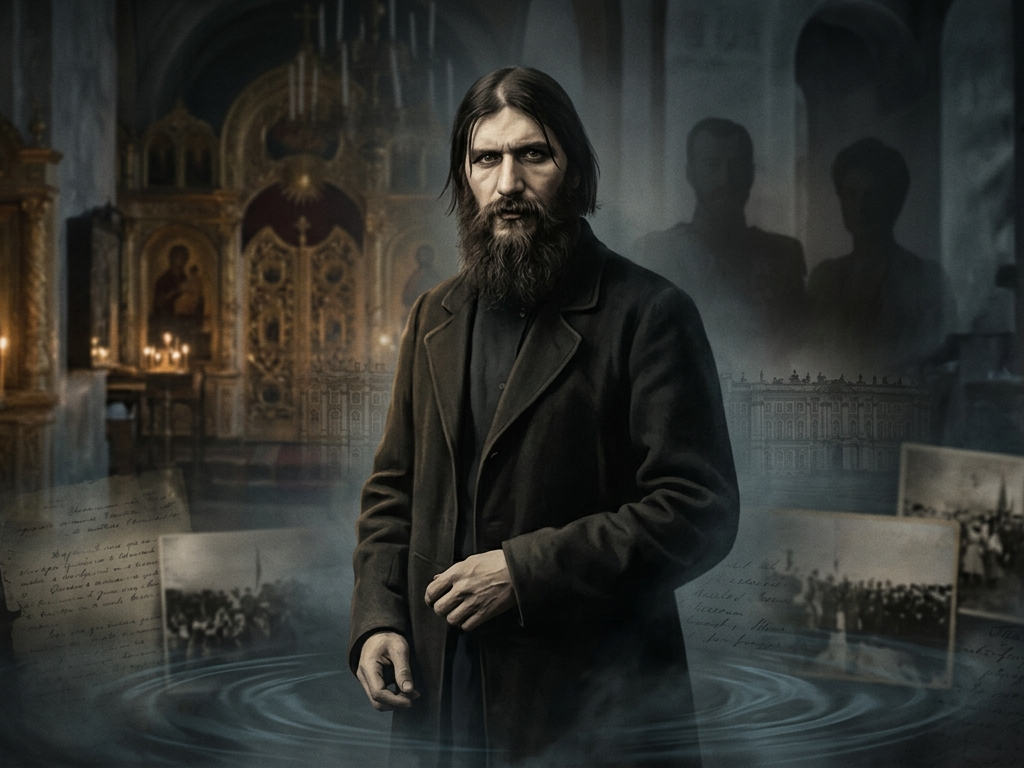
There are men whom history remembers because they changed it.
There are men whom history remembers because history changed around them.
And then there are the rarer creatures—the ones who seem to have wandered out of some unfinished dream and into the machinery of reality, leaving fingerprints on both.
Grigori Yefimovich Rasputin was one of those.
I do not believe in miracles.
I say this without apology.
I have always found the universe more beautiful without a hidden hand arranging the furniture. I prefer stars to angels, probability to prophecy, evolution to divine choreography. Give me a cold equation, an indifferent galaxy, a dying sun—and I will gladly sit beneath it and call the darkness honest.
And yet Rasputin troubles me.
Not because I believe the stories.
Precisely because I don’t.
That is the problem.
If he had been a demon, the matter would be easy. If he had possessed supernatural powers, if he had truly hypnotised kings and healed the dying by touching their foreheads, if poison had flowed through his veins like water and bullets had merely inconvenienced him, then I could place him safely inside the cabinet labelled Myth.
But the historical Rasputin is much stranger.
He was real.
A Siberian peasant. A wanderer. A deeply religious man who was never actually a monk, despite the title that history has lazily attached to him. A husband. A father. A pilgrim. A drinker. A man with an appetite for women and influence. A charismatic religious figure who somehow crossed the enormous distance between a Siberian village and the private chambers of the Romanovs.
There is no magic in that sentence.
And still it sounds like magic.
He was born in Pokrovskoye, in western Siberia, in 1869, to a peasant family. He was not born beneath an eclipse. No comet marked the sky. No priest announced that the child would one day sit beside an emperor.
He was simply born.
That is what makes the later story so difficult to comprehend.
Somewhere between the mud of Siberia and the marble corridors of St Petersburg, Grigori Yefimovich became Rasputin.
Or perhaps the world decided to make him Rasputin.
He became a wandering religious figure, a strannik, and eventually acquired a reputation for spiritual insight. He travelled to St Petersburg and entered circles of aristocrats and churchmen fascinated by mysticism. Russia at the time was already a country with a hunger for holy men, visions, spiritualism and strange forms of religious experience. Rasputin did not create that hunger.
He merely walked into it.
And then he met the Romanovs.
I often imagine that meeting as the true beginning of the legend.
Not because a peasant met a Tsar.
Because a frightened mother met a man who seemed capable of helping her son.
Alexei, the Tsarevich, had haemophilia—a disease that turned an ordinary bruise into a matter of terror and made the imperial succession itself feel like a fragile glass ornament. His mother, Alexandra, lived with the knowledge that her son could die from something as trivial as an accident.
Then came Rasputin.
And sometimes the most powerful magic in human history is simply arriving at the exact moment someone is desperate enough to believe you.
There were episodes in which Alexei improved while Rasputin intervened or prayed. Alexandra became convinced that he possessed a special spiritual gift. Whether he actually possessed one is another matter entirely.
I don’t think he did.
There is no scientific evidence for supernatural healing.
But I also don’t think that makes the story simple.
A frightened child can be calmed. A frightened mother can be calmed. Doctors can sometimes do too much. Nature sometimes reverses itself without asking permission. Bleeding can stop. Bodies can recover.
And then the human mind does what it has always done.
It finds a cause.
If the recovery comes after Rasputin, Rasputin must have caused it.
If the impossible happens twice, he must be chosen.
If it happens three times, perhaps God has sent him.
And once Alexandra believed that, the rest of the story became almost inevitable.
Faith does not require evidence once it has found something to protect.
So Rasputin entered the Romanov household not as a conqueror, but as a comfort.
That distinction matters.
The popular Rasputin is often imagined as a sinister puppet-master dangling the Tsar from invisible strings.
The historical man appears to have been something much more human.
He was influential.
He had access.
He gave advice.
He cultivated relationships.
He became involved in appointments and political affairs.
But influence is not omnipotence.
Russia did not become a dictatorship of one Siberian peasant.
Nicholas II remained responsible for his own decisions. The empire’s problems were vastly larger than Rasputin. War, economic disruption, political paralysis, social unrest, military catastrophe, shortages, inequality, institutional weakness—the Russian Empire was already carrying a mountain on its back.
Rasputin did not build the mountain.
He became its face.
That may have been even more dangerous.
Because sometimes a collapsing system needs a villain.
A villain gives chaos a name.
And Rasputin was almost too perfect.
He was foreign to the aristocracy without being foreign to Russia. He was religious without being respectable. He was intimate with the imperial family without belonging to the aristocracy. He drank. He pursued women. He spoke like a peasant. He possessed a peculiar confidence. He seemed comfortable around people who should have been impossibly above him.
And the aristocracy hated the sight of him.
Imagine it.
You have inherited your title.
Your family has owned estates for generations.
You speak French.
You wear uniforms covered in medals.
And then a dirty Siberian wanderer walks into the palace and whispers into the ear of the Empress.
There is something almost poetic about the insult.
So stories grew.
He was a sexual predator.
A secret cultist.
A Khlyst.
A German agent.
A manipulator.
A charlatan.
The lover of the Tsarina.
The power behind the throne.
The Holy Devil.
The Mad Monk.
Some of these stories had pieces of reality embedded within them. Rasputin’s private behaviour was hardly saintly. His drinking and sexual relationships were real enough. His political networking was real. His influence over Alexandra was real.
But the further the story travelled from the palace, the larger Rasputin became.
Soon the man was disappearing beneath the monster.
That is one of the oldest tricks of history.
Take a human being.
Add fear.
Add politics.
Add sex.
Add religion.
Add a collapsing empire.
Add newspapers.
Then wait.
Eventually you no longer have a man.
You have an omen.
By the final years of the Romanov regime, Rasputin had become a symbol of everything that people believed was wrong with the monarchy.
And symbols are dangerous because they don’t need to be accurate.
They only need to be useful.
A poster showing Rasputin controlling Nicholas and Alexandra could say more than a hundred pages of political argument.
The message was simple:
Russia is being ruled from the shadows.
The empire is diseased.
The throne is compromised.
The Tsar is weak.
The Empress is under the spell of a peasant.
Whether all of that was literally true was almost irrelevant.
People believed it.
And belief has consequences.
Then came the night.
December 1916.
Rasputin entered the Moika Palace of Prince Felix Yusupov.
The story that followed has become one of the great pieces of historical theatre.
Poison.
Bullets.
Blows.
Escape.
More bullets.
A river.
A man who simply would not die.
It is almost embarrassingly perfect as a legend.
The evil mystic refuses to die because evil itself refuses to die.
But history is rarely so elegant.
The famous version of Rasputin’s death comes substantially from the memoirs of Yusupov and other conspirators, written after the event. The story grew with the telling.
Modern forensic examination of the surviving evidence paints a much less supernatural picture. A post-mortem photograph appears to show a contact gunshot wound to the forehead, inconsistent with the famous story of Rasputin fleeing across a courtyard while being shot from a distance. The available evidence also does not establish that poison caused his death, and the forensic assessment argues that he was already dead before his body entered the river.
There is something almost disappointing about that.
And yet I find it strangely beautiful.
Because the myth is not destroyed by the truth.
It is transformed.
The man did not need to survive poison.
He only needed people to believe that he had.
The man did not need to crawl from the palace after death.
He only needed someone to tell the story.
And someone did.
Then someone printed it.
Then someone read it.
Then someone remembered it.
And now, more than a century later, Rasputin is still walking.
Not through the streets of Petrograd.
Through us.
That is the real immortality.
Not biological.
Narrative.
I sometimes wonder whether Rasputin understood this himself.
Perhaps he did.
He lived among people who believed that the world was full of signs.
He understood that appearances could become truths if enough people accepted them.
He understood intimacy.
He understood fear.
He understood that a desperate person does not always want the truth.
Sometimes they want the possibility that the truth might be kinder than reality.
Alexandra wanted her son to live.
Rasputin gave her something medicine could not always give her:
hope.
Perhaps that was his greatest power.
Not healing.
Not prophecy.
Hope.
And hope can make a human being extraordinarily powerful.
It can also make them dangerous.
There is another story, perhaps the most beautiful of all the Rasputin stories, concerning a letter supposedly written shortly before his death.
In it, Rasputin allegedly warned Nicholas that if he were killed by aristocrats, the Romanov family would perish within two years.
Then came 1917.
The monarchy collapsed.
Then came 1918.
Nicholas, Alexandra and their children were executed.
Nineteen months.
The prophecy appears to have come true.
I want to believe this story.
That is precisely why I don’t.
The document’s authenticity is disputed. It may have been altered, embellished or forged after the fact. The coincidence is extraordinary, but extraordinary coincidence is not proof of prophecy.
And here, again, the believer and the non-believer inside me stare at one another across a table.
The believer whispers:
Look.
The sceptic answers:
Coincidence.
The believer says:
But look how perfectly it happened.
The sceptic replies:
Perfectly is a word humans invented after the event.
And yet—
I look again.
Because I am not immune to mystery merely because I reject superstition.
That is something I have learned slowly.
Scepticism is not the same as cynicism.
To say, “I do not know” is not to say, “There is nothing here.”
Sometimes there is something here.
We simply do not know what it is.
That, perhaps, is Rasputin’s true territory.
The space between explanation and wonder.
He occupies it beautifully.
We know he existed.
We know where he was born.
We know he entered the Romanovs’ world.
We know Alexandra trusted him.
We know Alexei suffered from haemophilia.
We know Rasputin’s reputation grew enormously.
We know he acquired political influence.
We know enemies wanted him removed.
We know he was murdered.
We know the story of his death was embellished.
We know that the Romanov dynasty collapsed soon afterward.
And yet, around these facts, there is a darkness in which legends continue to grow.
The Holy Devil.
The Mad Monk.
The healer.
The seducer.
The prophet.
The traitor.
The immortal.
The fraud.
Perhaps the strangest thing is that all these Rasputins can coexist.
Because the historical man was not a clean equation.
He was contradictory.
Religious and debauched.
Charismatic and manipulative.
Compassionate and self-serving.
Powerful and powerless.
Loved and hated.
Trusted and feared.
A man who may have genuinely comforted a dying child while simultaneously becoming entangled in the corrupt machinery of an empire.
That is much more interesting to me than a supernatural Rasputin.
Because monsters are easy.
Men are difficult.
A monster explains itself.
A man does not.
And perhaps that is why the old photographs bother me.
Not the caricatures.
Not the theatrical paintings.
The photographs.
There he is.
Looking directly into the camera.
A face that has been turned into a symbol so many times that we forget it once belonged to somebody who woke up hungry, walked through snow, drank too much, prayed, laughed, lied, loved, desired, feared, aged.
A human face.
That is all.
And somehow, not all.
I look at him and think of the strange arrogance of history.
We imagine that because we know how his story ended, we understand the man.
We don’t.
We know the ending.
We know the mythology.
We know the photographs.
We know the names of the people around him.
But the interior of another human being is always a locked room.
Especially one who lived more than a century ago.
Perhaps Rasputin was a fraud.
Perhaps he believed his own miracles.
Perhaps he was simply an unusually charismatic religious wanderer who discovered that desperate people were willing to elevate him.
Perhaps he possessed an extraordinary instinct for human psychology.
Perhaps his apparent healing successes were coincidence, timing, calming influence and the natural course of disease.
Perhaps his political influence was significant but vastly exaggerated by people who needed him to explain a failing empire.
Perhaps his death was simply a political murder dressed afterward in the costume of an epic.
These explanations satisfy the rational mind.
Mostly.
But then the old story returns.
A peasant from Siberia walks into the palace.
A sick child improves.
An Empress believes.
An empire whispers.
Aristocrats become frightened.
A man dies.
A legend refuses to.
And somewhere beneath all of that, the real Rasputin keeps staring back at us.
Not a saint.
Not a devil.
Not a magician.
Not an immortal.
A man.
Which is somehow more frightening.
Because if Rasputin was supernatural, then we can dismiss him.
But if he was merely human—merely charismatic, persuasive, opportunistic, religious, flawed, fortunate, dangerous and perfectly timed—then there is no mystery in his power.
And that means the same power belongs to us.
That is the thought I would rather not have.
I prefer my universe cold.
I prefer stars that do not listen.
I prefer gravity to prophecy.
I prefer evidence to miracles.
Still, when I close the books and the room becomes quiet, I sometimes picture that Siberian face emerging from the darkness of history.
And for one irrational second, I understand why people believed.
Not because I think Rasputin was magical.
But because I understand something much stranger:
A sufficiently charismatic human being can become supernatural in the minds of other human beings.
And once that happens, reality itself begins to bend around the belief.
The man dies.
The story survives.
The story grows.
The story acquires eyes.
And a hundred years later, it looks at us.
I still don’t believe in miracles.
But I have learned to be careful around men who make other people believe in them.
Especially when an empire is already beginning to crack.
Especially when a mother is desperate.
Especially when everyone is looking for a saviour.
Because sometimes the most supernatural thing in the world is not a miracle.
It is a human being—
believed in too completely.