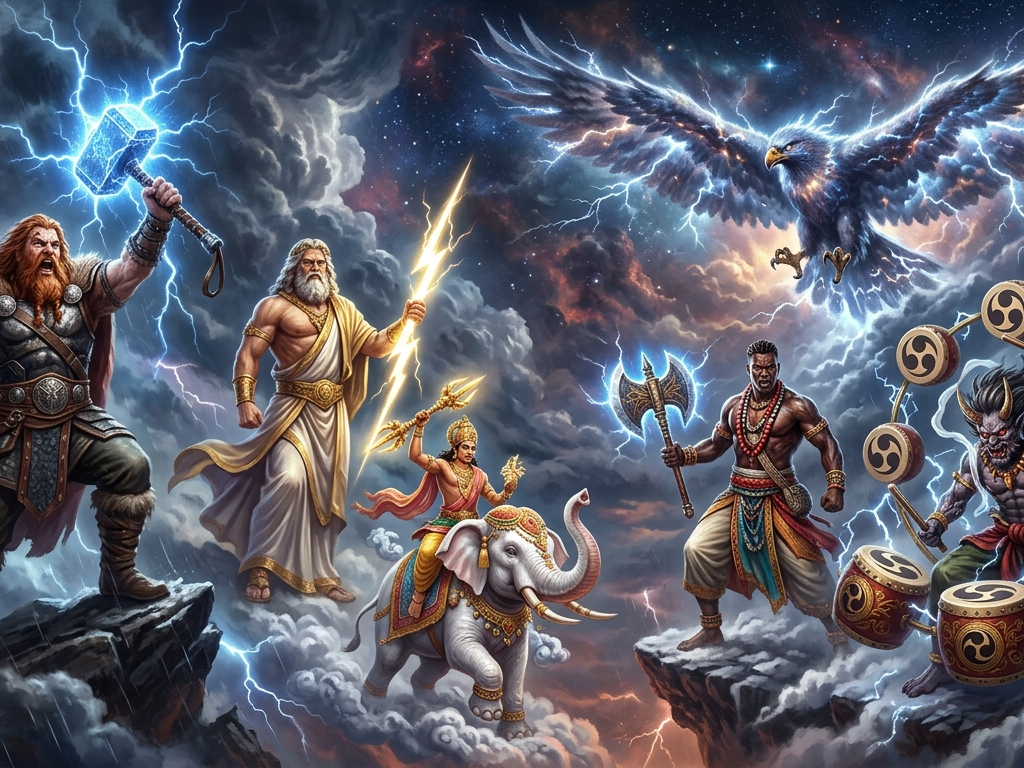
There are moments when the sky suddenly becomes a theater.
The clouds gather like silent conspirators, the wind withdraws its earlier softness, and the air thickens with a tension that even animals seem to understand. Then the first crack arrives. Not sound exactly, but a rupture in the silence. A violent syllable spoken by the heavens themselves.
Thunder.
Before humanity invented cities, before it wrote its first poems on clay tablets, before it learned to domesticate wheat and barley, thunder already ruled the imagination of our ancestors. It was the voice that descended from the sky without warning, shaking forests, rivers, mountains, and fragile human bodies alike.
And so humans did what humans always do when confronted with something overwhelming.
They gave it a face.
They gave it a personality.
They gave it a god.
From the frozen fjords of Scandinavia to the humid forests of Mesoamerica, from the plains of the Vedic tribes to the temples of Greece and the sacred groves of the Slavs, humanity invented thunder gods with remarkable consistency. Yet each culture painted its storm with different colors.
I often wonder about this peculiar habit of the species. Faced with the same sky, humans produced an entire gallery of divine personalities. Some thunder gods are kings. Some are warriors. Some are judges. Some are chaotic tricksters of weather.
The sky spoke one language.
Humans answered with many.
The First Fear: Thunder Before History
Long before written mythologies appeared, thunder had already established itself as a cosmic authority in the human mind.
Imagine the earliest humans standing beneath an open sky tens of thousands of years ago. No walls. No electricity. No scientific explanations. Only the enormous dome of the atmosphere and the occasional explosive roar that could split the horizon.
Lightning could ignite forests. It could strike trees, animals, sometimes people. It was a weapon that fell from nowhere.
Naturally, early human cognition interpreted thunder as intentional. Something powerful must be producing this noise. Something unseen but deliberate.
In this sense, thunder gods were not merely inventions. They were early cognitive strategies. The mind sought agency behind chaos.
The storm became a personality.
Anthropologists believe that many prehistoric cultures already imagined sky spirits or storm beings long before formal mythologies appeared. Although their names have vanished into time, the psychological template remained.
Later civilizations simply refined the archetype.
They named him.
They armed him.
They built temples for him.
Indra: The Warrior of the Vedic Storm
One of the earliest thunder gods preserved in written human memory appears in the ancient hymns of the Rigveda, composed roughly around 1500 BCE.
His name is Indra.
Indra is not merely a weather god. He is a warrior.
The hymns describe him wielding the Vajra, a thunderbolt weapon capable of shattering mountains. His greatest myth tells of a battle against the serpent-demon Vritra, a cosmic dragon who imprisoned the world’s waters. Indra slays the monster with his lightning weapon, releasing rivers and rain upon the earth.
This story reveals something fascinating about the earliest thunder mythologies. Thunder gods were not simply noise-makers of the sky. They were cosmic problem solvers.
Storm equals rain.
Rain equals survival.
In agricultural societies, thunder was not merely frightening. It was hopeful. It meant clouds were pregnant with water.
Thus Indra becomes both destroyer and savior. The storm that terrifies also nourishes the fields.
I find this duality elegant. Thunder is violence, yet it brings life.
Human myth understood this contradiction very early.
Zeus: Thunder as Authority
A few centuries later, in the mountainous landscapes of Greece, thunder evolved into something more political.
Enter Zeus.
Unlike Indra, whose mythology revolves around heroic combat, Zeus represents sovereignty. He is not merely a storm god. He is the king of the Olympian gods.
His weapon, the thunderbolt, is less a battlefield tool and more a symbol of authority. It enforces cosmic law.
If Indra feels like a warrior-general of the sky, Zeus feels like a monarch.
When he throws lightning, it is not always about battle. Sometimes it is punishment. Sometimes it is divine judgment. Sometimes it is simply a reminder that the sky belongs to him.
The Greeks projected their political imagination onto the heavens. Their gods resembled aristocrats with dramatic personalities and complicated moral lives.
Thunder therefore became the signature of divine rulership.
Power crackled across the clouds.
Jupiter: The Roman Echo
The Romans, pragmatic architects of empire, adopted much of Greek mythology but gave it their own civic discipline.
Thus Jupiter emerged as the Roman counterpart to Zeus.
But Jupiter felt different.
Roman religion was less theatrical and more institutional. Jupiter represented law, oath, and state authority. His thunder was associated with divine approval of political power.
When lightning struck certain places, Roman priests interpreted it as celestial communication. The gods were voting on human decisions.
Thunder, therefore, became part of governance.
The sky itself participated in politics.
I cannot help smiling at this idea. Humans looked at a storm and imagined parliament.
Thor: The Thunderer of the North
If Zeus represents kingship, then Thor represents raw strength.
Thor emerges from the rugged landscapes of Norse mythology, where survival depended on endurance rather than political finesse. He wields the legendary hammer Mjölnir, a weapon capable of leveling mountains and summoning lightning.
Unlike Zeus, Thor is not the ruler of the gods. That role belongs to Odin.
Thor is something else entirely.
He is the protector.
Farmers, warriors, travelers, and common folk prayed to Thor for safety. His thunder was seen as the sound of his hammer striking giants who threatened the cosmic order.
Thor therefore embodies the thunder god as guardian. Not distant king, not cosmic judge, but defender of humanity against chaos.
The personality of thunder changes again.
In Scandinavia, the storm becomes muscular.
Perun: The Slavic Thunder King
In the forests and river valleys of Eastern Europe, the Slavic tribes worshipped Perun.
Perun wielded an axe or hammer and ruled over storms, lightning, and war. His sacred trees were oaks, often struck by lightning, reinforcing the belief that thunder was his weapon striking the earth.
Interestingly, Perun fought an enemy named Veles, a serpent-like being associated with the underworld and water.
Once again, the dragon versus thunder god motif appears.
Indra vs Vritra.
Zeus vs Typhon.
Thor vs Jörmungandr.
Perun vs Veles.
Different cultures, same mythic geometry.
I suspect that humans were unknowingly repeating a psychological pattern: storm gods fighting serpents that represent chaos, drought, or darkness.
Thunder defeats the dragon.
Rain returns.
The world continues.
Taranis: The Celtic Wheel of Thunder
Among the ancient Celts, the thunder god took on an unusual symbol.
His name was Taranis.
Instead of a hammer or lightning spear, Taranis was often depicted holding a wheel. Scholars believe the wheel represented the rolling thunder across the sky, echoing the rumbling sound of a chariot.
Imagine the sky as a colossal war-chariot rolling above the earth.
Thunder becomes motion.
Storm becomes travel.
Even the sound of thunder begins to resemble wheels across the heavens.
It is a poetic interpretation, and I rather enjoy the imagery. The storm becomes a celestial vehicle crossing the horizon.
Thunder Beyond Europe
Thunder gods were never confined to Indo-European mythologies.
Human imagination everywhere confronted the same storms.
In China, the thunder deity Lei Gong appears as a fierce figure with claws, wings, and a hammer used to produce thunder. He punishes evil humans, acting almost like a supernatural inspector of morality.
In Japan, the thunder spirit Raijin creates thunder by beating enormous drums. His imagery is dramatic: a wild figure surrounded by drums floating in the sky.
Thunder becomes percussion.
The sky becomes an orchestra.
Across the ocean, Indigenous North American cultures imagined the magnificent Thunderbird. This colossal bird creates thunder with the beating of its wings and lightning from its eyes.
Here the storm is not a warrior or king.
It is a creature.
A living sky.
Shango: Thunder as Justice
In the Yoruba traditions of West Africa appears one of the most charismatic thunder deities: Shango.
Shango is associated with lightning, fire, drumming, and kingship. His weapon is a double-headed axe, symbolizing explosive energy.
But Shango is not merely a weather deity.
He represents justice.
Lightning striking the earth could be interpreted as punishment for wrongdoing. The storm becomes moral.
The sky becomes a courtroom.
Again humanity reveals something fascinating about itself. Every culture projected its deepest concerns into the storm. Agriculture, kingship, warfare, justice, protection.
Thunder became whatever society most valued.
Why Thunder Gods Look So Similar
I find the similarities between thunder gods almost suspiciously neat.
Across continents that never contacted each other, the same patterns repeat:
A sky god.
A lightning weapon.
A battle against a serpent or chaos monster.
A role as protector or judge.
Why?
There are several reasons.
First, thunder is universally dramatic. It demands explanation. Human brains instinctively search for intentional forces behind powerful events.
Second, storms are tied to rainfall, which means agriculture. Agricultural societies naturally elevate storm gods to positions of importance.
Third, lightning resembles weapons. Spears, axes, bolts. Ancient people interpreted lightning using the technology they understood.
Thus lightning becomes a thrown weapon from heaven.
The imagination simply completed the picture.
The Psychological Storm
But perhaps the most interesting reason lies deeper.
Thunder gods represent humanity’s relationship with power.
The storm is uncontrollable.
It arrives without warning. It shakes mountains and terrifies animals. It reminds humans that nature remains infinitely stronger than civilization.
So humans gave that power a personality.
If the storm has a god, then the storm has intentions.
And if the storm has intentions, then maybe those intentions can be understood, appeased, prayed to, or bargained with.
Mythology therefore becomes a psychological negotiation with chaos.
The Thunder Still Speaks
Modern humans no longer believe Thor is striking giants when thunder rolls across the sky. Meteorology has replaced mythology.
We know about electrical charges in clouds, ionized air channels, atmospheric pressure gradients.
Science has explained the mechanism.
Yet when thunder explodes above a dark horizon, even today something ancient stirs in the human nervous system.
For a brief moment, we feel small again.
I suspect that deep within the human mind, the thunder gods are not truly gone. They have merely become quiet stories rather than living beliefs.
But the sky still performs the same drama it performed ten thousand years ago.
Clouds gather.
Lightning fractures the dark.
And somewhere inside the imagination, a hammer still falls.