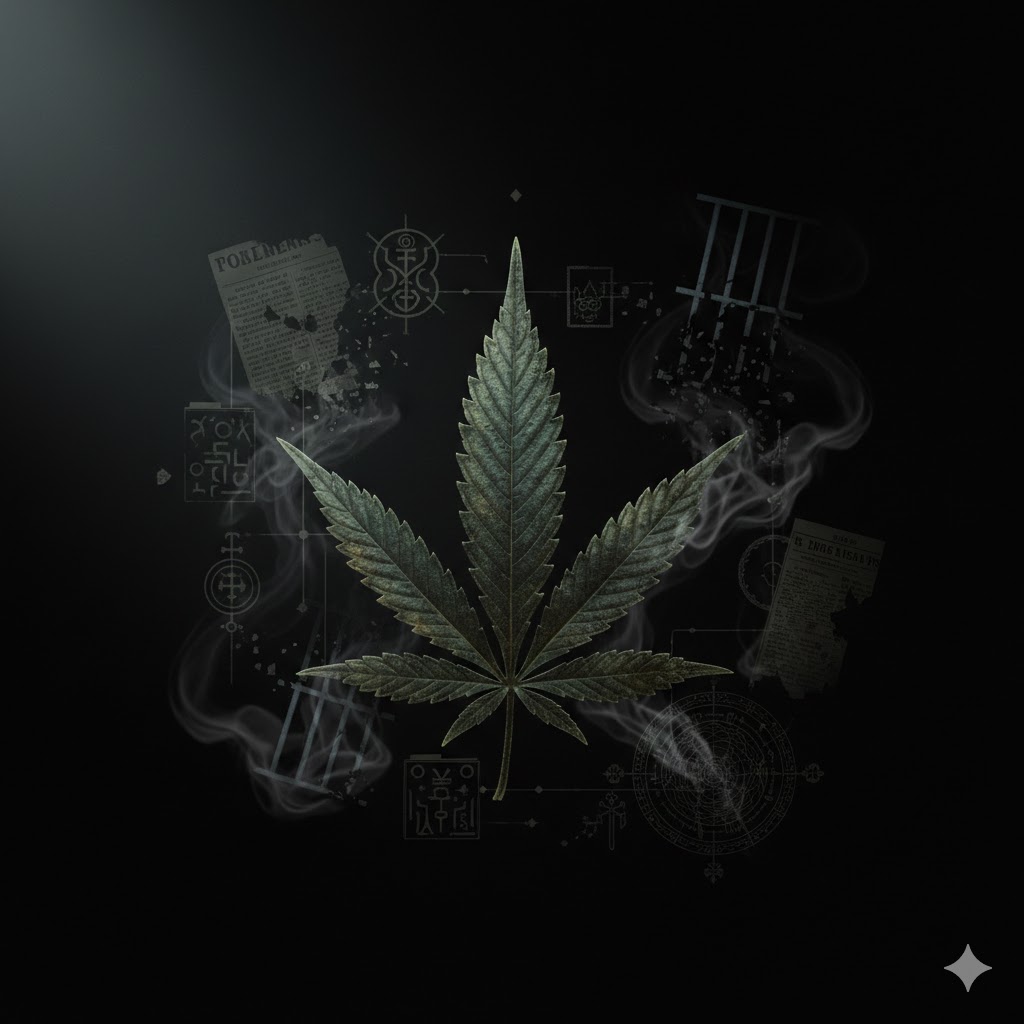
Marijuana does not enter history politely. It does not knock. It does not ask to be studied, taxed, classified, or forgiven. It grows. Quietly. Indifferently. Photosynthesizing sunlight while humans argue about what thoughts are permissible to have while alive.
If history were honest, cannabis would not be introduced as a drug. It would be introduced as a witness.
It was already here when civilization began arranging itself into hierarchies. Long before laws, long before prisons, long before the idea that consciousness itself might require supervision. Archaeological traces place cannabis among humanity’s earliest companions. Not exalted. Not feared. Simply present. In ancient China, hemp was a utilitarian marvel. Rope strong enough to bind ships, paper durable enough to preserve memory, fabric resilient enough to clothe labor. Shen Nung’s medical texts mention it without melodrama, one plant among many that could soothe pain, quiet inflammation, and soften the body’s protest against age.
India took a different route. Cannabis was not merely consumed; it was contextualized. Bhang during festivals, ganja carried by ascetics who had opted out of worldly clocks. Smoke rising not as escape but as ritual punctuation. A pause. A threshold. The plant became symbolic not of indulgence but of renunciation, a way to loosen the ego’s grip so something quieter might speak. In these traditions, cannabis was neither miracle nor menace. It was a tool for altering perspective, not erasing responsibility.
Across the Middle East and Africa, cannabis traveled with traders and pilgrims, absorbed into local customs without panic. It did not arrive as rebellion. It arrived as habit. As medicine. As something to be used carefully, sometimes joyfully, sometimes spiritually. There were no headlines because there was no hysteria. A plant does not cause a moral crisis until someone decides morality needs policing.
The Americas met cannabis late, and not on their own terms. It arrived folded into the chaos of colonial expansion, carried by enslaved Africans, migrant laborers, and imperial trade routes. For centuries it remained peripheral, a quiet companion rather than a cultural force. Hemp was cultivated legally. Cannabis tinctures sat on pharmacy shelves. There was no grand narrative attached to it. No moral symbolism. No enemy image.
That came later, when time itself became monetized.
The industrial age reshaped not only labor but acceptable states of mind. Productivity became virtue. Efficiency became ethics. Any substance that encouraged slowing down, introspection, or nonlinear thinking became suspect. Cannabis does not sharpen the whip. It dulls the urgency. It invites the mind to wander instead of march. For systems built on extraction and obedience, this was intolerable.
The effects of cannabis were never mysterious, only inconvenient. Time stretches. Sensory perception sharpens. Thoughts branch sideways instead of forward. Memory becomes fluid. For some, this produces calm. For others, discomfort. Cannabis does not impose a feeling. It amplifies whatever is already present. Anxiety becomes louder. Curiosity becomes deeper. The plant does not add content. It changes volume.
This variability made cannabis difficult to domesticate. It did not behave like alcohol, which predictably numbs and disinhibits. It did not behave like caffeine, which energizes and focuses. Cannabis exposed rather than suppressed. Western medicine, obsessed with standardization, grew uneasy. Dosage varied. Reactions differed. Profits were unreliable. Meanwhile, pharmaceutical companies refined substances that could be patented, prescribed, and controlled.
The cultural narrative shifted when the plant acquired a new name and a new enemy. “Marijuana” entered American discourse not as a neutral descriptor but as a linguistic weapon. It sounded foreign. Dangerous. Other. Newspapers began associating it with Mexican immigrants, Black jazz musicians, and working-class communities already targeted by surveillance. The plant became a proxy. Criminalizing cannabis became a way to criminalize people.
Fear followed quickly. Violence was blamed on marijuana without evidence. Madness was attributed to it without science. Harry Anslinger, head of the Federal Bureau of Narcotics, built a career on hysteria, spinning anecdotal horror into national policy. His speeches were less about chemistry than control. Cannabis, he claimed, turned users into criminals, deviants, animals. The fact that these claims were demonstrably false mattered less than the fear they generated.
Propaganda filled the gaps where evidence failed. Films like Reefer Madness did not educate. They performed panic. Teenagers smoked once and descended into insanity, murder, sexual transgression, and jazz-fueled chaos. The absurdity was so extreme it bordered on parody, yet it was presented as truth. This was not about public health. It was about narrative discipline.
Thus began the war on drugs, a war declared not on substances but on states of consciousness deemed unacceptable. Cannabis was an easy target. It was visible. It was symbolic. It was associated with communities already marked as dangerous or disposable. Arrest statistics ballooned. Prisons filled. Families fractured. None of this reduced harm. It simply redistributed it.
The hypocrisy was structural. Alcohol, statistically far more destructive, remained legal, celebrated, advertised. Cigarettes were normalized despite their lethality. Meanwhile, possession of a plant could derail a life permanently. Enforcement was uneven. Wealth insulated users. Poverty magnified punishment. The law did not fall equally. It fell predictably.
When the Vietnam War escalated and youth culture fractured, cannabis took on a new role. It became emblematic of dissent. To smoke was to refuse unquestioning participation. It was not just intoxication. It was defiance. Hunter S. Thompson would later capture this moment with brutal clarity: a government waging chemical war abroad while waging moral war at home, criminalizing introspection while glorifying violence.
Culture responded in waves. The seventies laughed. Stoner comedies defanged paranoia through humor. Cheech and Chong turned surveillance into slapstick. Reggae reframed cannabis as sacrament, a way of resisting Babylon through altered consciousness. Then came the backlash. The eighties tightened the noose with slogans and moral absolutism. “Just Say No” replaced nuance with obedience. Users were depicted as lazy, unmotivated, broken. The complexity of human psychology was flattened into caricature.
Science, largely ignored, continued its quiet work. The discovery of the endocannabinoid system destabilized decades of rhetoric. The human body, it turned out, contains receptors specifically designed to interact with cannabinoids. These receptors regulate mood, appetite, pain, inflammation, memory. Cannabis was not foreign. It was familiar. Evolutionarily embedded. This did not make it harmless, but it made it comprehensible.
Medical use reopened the conversation. Patients with chronic pain, epilepsy, and degenerative illnesses forced lawmakers to confront the human cost of prohibition. Slowly, grudgingly, legalization crept in. Not through moral reckoning, but through economics. Tax revenue proved persuasive. Cannabis dispensaries replaced alleyways. The plant was sanitized, branded, monetized.
Yet the war did not end cleanly. Criminal records persisted. Incarcerated individuals remained behind bars for acts now considered legal elsewhere. Communities disproportionately targeted by enforcement did not automatically benefit from legalization. The same system that punished cannabis now profited from it. The contradiction remained unresolved.
Today, marijuana exists in a strange liminal space. Part medicine, part commodity, part cultural Rorschach test. In some places it is normal. In others, still forbidden. It is praised, mocked, moralized, misunderstood. The plant itself has not changed. Only the stories told about it have.
Cannabis has been sacred and profane, scapegoat and cash crop, demon and cure. It has survived every narrative imposed upon it. The question is not what the plant does to us. The question is why we are so desperate to control how people feel, think, and perceive.
In the end, marijuana was never the anomaly. It was the litmus paper. Dip it into any era and it changes color, revealing what that culture fears, controls, or quietly desires. The plant stays mostly the same. What mutates is us. Our laws, our punishments, our hypocrisies. We keep pretending the debate is about a drug, when it has always been about permission: who is allowed to alter their inner weather, who must remain lucid, productive, obedient. Cannabis simply sits there, green and indifferent, reflecting our collective anxiety back at us, leaf by leaf.