There are places in every town that slowly drift out of the world.
They are not demolished. They are not repaired. They simply remain standing long enough for memory to loosen its grip on them. Windows gather dust. Doors warp. Names fade from signboards until even language abandons them.
The abandoned art shop at the end of Millstone Lane had entered that quiet stage of forgetting.
The wooden sign above its door had once displayed a cheerful name in gold paint. Only faint scratches remained now. Wind had eaten the color year by year. Rain had softened the edges of the letters until they dissolved into the wood itself. People who passed the lane rarely noticed the building anymore. It stood like a tired witness to a story that no longer wished to be told.
But children sometimes notice what adults stop seeing.
Arin noticed.
He was eleven years old and possessed the patient eyes of someone who loved colors more than conversation. He walked home from school each afternoon with his sketchbook pressed under his arm. The pages inside were filled with trees, rivers, birds, and quiet landscapes imagined from memory or dreams. The boy rarely drew people. People moved too much and spoke too loudly.
Trees were better companions.
They stood still.
They listened.
The art shop had been closed for years, perhaps longer than Arin had been alive. Yet on a grey afternoon in early autumn, he noticed something strange while passing the lane.
The door was not fully closed.
It rested slightly open, just enough for darkness to breathe through the narrow gap.
The street around the shop was empty. Wind rolled a few dry leaves along the pavement, pushing them lazily against the step. The boy paused. His curiosity was not loud or reckless. It was soft and steady, the way curiosity often grows in quiet children.
He approached the door.
The wood groaned faintly when he pushed it.
Inside, the shop held the stale scent of forgotten paper and dry pigment. Dust rested on every surface like pale frost. Shelves leaned beneath the weight of old supplies. Paint bottles lined the walls in long patient rows, their labels peeling like skin from bone.
A broken window allowed a narrow beam of evening light to fall across the room. In that slant of pale gold, tiny dust particles drifted like slow snow.
Arin stepped carefully inside.
The silence of the place felt thick. Not hostile. Only heavy with years of waiting.
Paintings rested against the walls. Some were unfinished sketches. Others had been abandoned halfway through the artist’s work, as though the painter had suddenly lost interest in completing them. A half-formed sky remained suspended above a sketched mountain range. A portrait lacked one eye. An orchard waited forever for the final touches of light.
The boy moved from shelf to shelf with quiet fascination.
Many of the paint bottles had dried long ago. When he picked one up and shook it gently, nothing inside responded. The colors had hardened into dull lumps that clung stubbornly to the glass.
Yet at the far end of the counter, behind a crooked stack of brushes, he noticed something different.
A small bottle stood alone.
It was much smaller than the others, almost delicate in comparison. The glass appeared cloudy, but not from age alone. Something within it seemed to disturb the light in strange ways.
Arin lifted the bottle.
Inside it rested a color that resisted description.
At first glance it resembled black paint. But when the boy tilted the bottle, the color shifted strangely. A faint shimmer stirred beneath its surface, like a deep reflection trapped inside liquid shadow.
It did not behave like any color he knew.
Black absorbed light. This color seemed to swallow it completely, leaving behind only a subtle glimmer of something darker still.
The boy carried the bottle toward the broken window.
In the beam of pale sunlight, the color deepened further. For a moment it seemed as though the paint possessed depth rather than surface, as though the glass contained not pigment but a small fragment of night.
Arin frowned thoughtfully.
He examined the bottle for a label.
There was none.
No brand.
No instructions.
Only the strange paint waiting patiently inside.
The boy glanced around the shop again. The room offered no explanation. Everything else had surrendered to dust and time.
Without quite deciding to do so, Arin slipped the bottle into his bag.
The door closed softly behind him when he left.
Arin’s room was small but bright, crowded with sketches and paintings taped across every wall. Landscapes filled the space like open windows into gentler worlds. Hills rolled beneath painted skies. Quiet lakes reflected careful clouds. A lone deer stood beside a narrow forest path.
Painting calmed him in ways that words could not.
That evening he placed the small bottle on his desk beneath the warm circle of his reading lamp.
The strange color seemed even deeper under the light.
He opened the bottle.
A faint smell drifted out. It carried the dry scent of old pigment, yet beneath it lingered something colder and more distant. Not unpleasant. Merely unfamiliar.
Arin dipped the tip of a brush into the liquid.
The paint clung to the bristles with surprising weight.
He hesitated only briefly before setting a fresh canvas sheet onto the desk.
Tonight he decided to paint a forest.
He began the way he always did, with familiar colors. Soft greens formed the leaves. Dark browns shaped the trunks. Grey and muted blue filled the distant hills.
Soon the forest began to grow across the canvas, tree by tree.
Yet when he leaned back to observe the work, the scene felt incomplete.
Forests needed shadow.
They needed depth.
The boy glanced again at the tiny bottle.
With careful movements he dipped his brush into the strange color and carried it toward the painting.
The paint slid across the canvas differently from his other pigments. It spread smoothly but seemed to settle deeper into the paper, like ink sinking through layers.
Arin added it beneath the trees, weaving thin strokes between the roots and fallen leaves. He traced deeper darkness beneath thick branches where sunlight could never reach.
When he finished, the forest appeared richer than anything he had painted before.
The shadows felt real.
Almost breathing.
Arin leaned closer.
For an instant he thought the leaves had shifted.
Just slightly.
As though stirred by wind.
He blinked.
The painting remained still.
The boy rubbed his eyes and laughed quietly at himself. Fatigue could trick the mind in curious ways. He set the painting aside and went to bed.
The next morning he noticed something unusual.
The forest painting looked deeper.
It held a kind of quiet depth that had not existed the night before. The shadows seemed softer yet darker, the spaces between the trees fuller with subtle suggestion.
When Arin stared directly at the painting, everything remained still.
But when he turned away and glanced back quickly, the leaves seemed to tremble faintly.
As though wind had just passed through them.
Over the next few days the boy painted again and again.
The strange color improved everything it touched.
Water began to ripple across painted rivers.
Clouds shifted slowly above distant hills.
Grass bent under invisible breezes.
Yet the movements never occurred when Arin watched directly. They existed only at the edges of his vision, in that brief instant when attention faltered.
At first the boy found this discovery delightful.
His paintings felt alive.
Each new canvas carried a quiet pulse within it, like a secret shared only between artist and image.
Soon the walls of his room filled with fresh landscapes. Lakes glimmered beneath painted sunlight. Tall mountains stood watch over misty valleys. Lonely trees leaned slightly toward imaginary winds.
And everywhere within those scenes the strange color worked its subtle influence, deepening shadow and motion alike.
The small bottle never seemed to empty.
Even though Arin used it every day.
One evening he painted another forest.
This one darker than the first.
The trees stood closer together, their branches twisting over one another in tangled silence. He used more of the strange paint than before, pouring shadow into every hollow space between the trunks.
The finished painting possessed a quiet heaviness.
It resembled a place where sunlight rarely entered.
Arin left it on the easel beside his bed and fell asleep beneath the dim glow of the lamp.
Sometime during the night he woke suddenly.
The room was silent except for the faint rustle of wind beyond the window. Moonlight had replaced the lamp, casting a pale glow across the paintings that covered the walls.
For a few moments nothing seemed unusual.
Then Arin noticed movement.
Not outside the window.
Inside the painting.
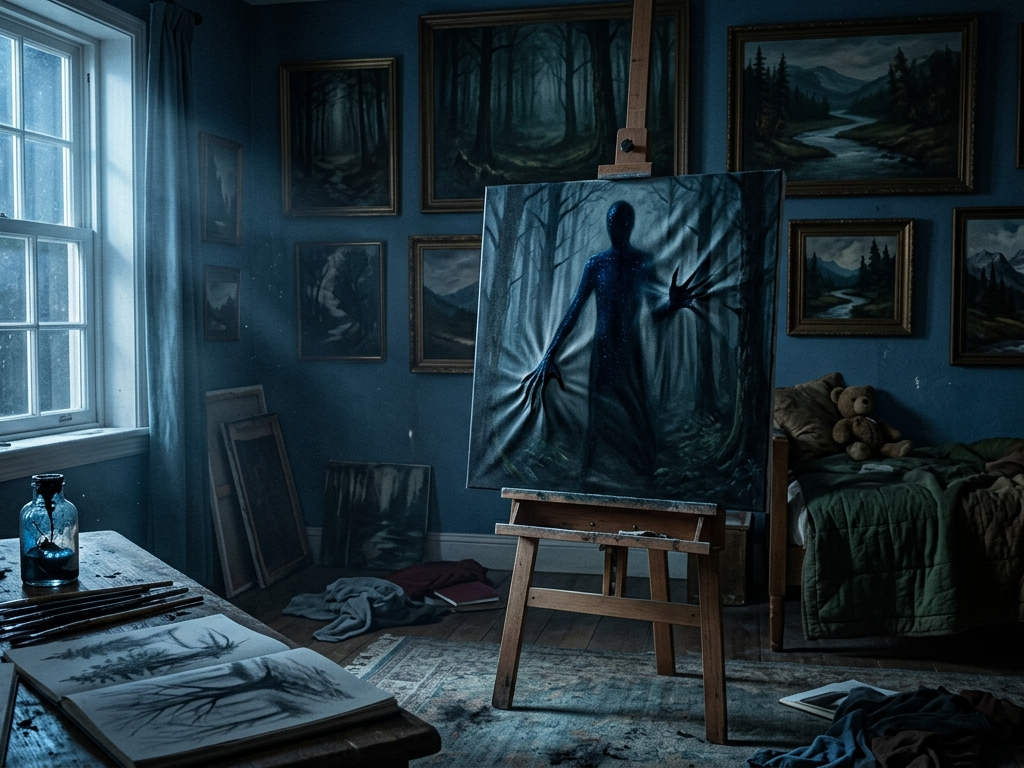
A dark shape shifted between the trees of the forest canvas.
The boy sat upright.
His breath slowed.
When he stared directly at the image, the shape remained perfectly still.
Yet moments later, when his gaze drifted toward the floor and returned again, the shape had moved closer to the front of the forest.
It resembled a tall figure.
Not clearly human.
But something close.
Over the following days the figure continued to shift.
Each morning it stood nearer to the edge of the painted forest.
The trees around it seemed to lean away slightly, as though the forest itself did not welcome its presence.
Arin began sleeping with the light on.
Sometimes during the night he thought he heard faint sounds from the easel.
Soft movements.
Like something brushing slowly against stretched canvas.
The night the figure finally reached the edge of the forest, the moon shone bright and cold through the window.
Arin woke once more.
The shape within the painting was no longer hidden among the trees.
It stood clearly visible now.
Tall.
Thin.
Its limbs stretched too long for any natural body.
The strange color that formed its shape appeared darker than anything else in the room.
The boy watched as the figure raised one elongated arm.
Slowly.
Very slowly.
The painted forest around it seemed to ripple.
Then the surface of the canvas bulged outward.
Not much.
Just enough to show pressure from within.
The stretched cloth pushed forward like skin pressed by a hidden hand.
Arin felt his breath vanish from his chest.
The figure leaned closer.
The canvas strained beneath its weight.
One leg pushed outward.
As though testing the thin boundary between image and air.
With sudden courage born from fear, the boy leaped from bed and seized the painting from the easel. The canvas twitched faintly in his hands.
He ran to the window and flung it into the rain-dark garden below.
The painting landed heavily in wet grass.
For several moments nothing happened.
Then the canvas slowly relaxed.
The forest became still.
The shadow vanished.
Morning arrived with quiet grey rain.
The ruined painting lay face-up in the garden mud. Most of the colors had blurred beneath the water, but the ground of the forest still showed faint marks.
Long dragging lines stretched across the painted soil.
They led from deep inside the trees toward the front edge of the canvas.
And then continued beyond it.
As though something had stepped through.
When Arin returned to his room, the other paintings hung peacefully on the walls.
A lake reflected a pale sky.
A river wound between smooth stones.
Yet in the lake painting he noticed a ripple spreading slowly across the water.
In the sky painting a small bird shifted its wings.
The tiny bottle still rested on his desk.
The strange color shimmered inside it.
But the paint level had dropped slightly.
Not much.
Just enough to suggest that something, somewhere, had begun using it.
Outside the rain continued washing the streets clean.
Inside the boy’s room, the paintings waited quietly.
And somewhere beyond the thin surface of canvas and color, something patient had discovered that pictures could become doors.