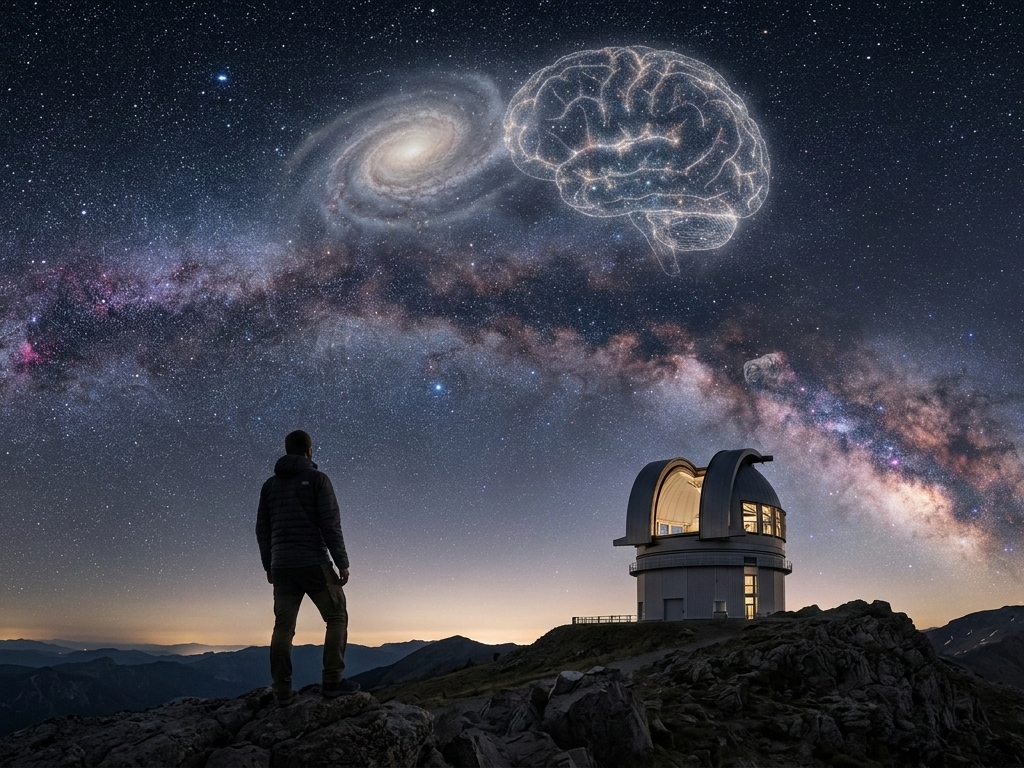
The first episode of this long unfolding began in silence, before hydrogen found the courage to gather, before gravity sculpted brightness from darkness. Now the arc bends toward a different quiet, one that trembles with thought. Between those silences stretches a river of transformation, and at its present bank stands a species that has learned not only to survive, but to ask.
After the rise of mammals and the curious ape, after hands learned to carry flame and minds learned to braid sound into meaning, the tempo of change altered. Evolution, once paced by mutation and climate, began to accelerate under culture. Information escaped the limits of DNA and took refuge in memory, story, and eventually symbol. The inheritance of ideas joined the inheritance of genes, and with that union the human trajectory curved sharply upward.
In caves where firelight flickered against stone, early humans pressed pigment into rock. The animals they painted were not merely prey but presences. Bison surged across limestone walls; horses ran in mineral ochre. Those images were acts of memory and invocation, the first visible attempts to wrest permanence from fleeting life. The cave became a threshold between the immediate and the imagined.
From such thresholds emerged settlements. Agriculture anchored wandering bands to rivers and fertile plains. Grains were cultivated, animals domesticated, seasons tracked. Villages thickened into cities, and cities into networks of exchange. Architecture rose from mud brick to carved stone, from timber to marble. Walls enclosed not only bodies but beliefs.
With cities came abstraction. Counting harvests demanded numbers. Measuring land required geometry. Tracking seasons refined astronomy. The sky, once a canopy of mythic fires, became a calendar. The same species that once scanned constellations for omens began to map their predictable motions. Mathematics crystallized as a language more durable than speech, capable of describing patterns invisible to the naked eye.
Philosophy followed, probing questions that tools could not cut and plows could not till. What is substance. What is change. What is justice. What is the good life. Minds turned inward and outward in equal measure, exploring both the structure of reality and the architecture of thought. Schools formed. Debates flourished. Ideas traveled along trade routes as surely as spices and silk.
Science emerged gradually from this ferment, distinguished not by subject matter but by method. Observation sharpened into experiment. Hypothesis submitted to evidence. Theories were refined or discarded. The cosmos, once narrated through myth, was interrogated through measurement. Instruments extended the senses. Lenses bent light to reveal moons orbiting distant planets. Pendulums traced the invisible pull of gravity.
The Earth itself, long assumed to be the axis of existence, was displaced from the center. The Sun assumed its rightful position as gravitational anchor. Planets became fellow travelers rather than wandering lights. The universe expanded conceptually, and with each expansion the human self-conception contracted and deepened simultaneously. To discover that one’s world is not central is humbling, yet to discover the laws governing its motion is empowering.
In laboratories and observatories, the patient accumulation of data revealed deeper structures. Matter resolved into atoms. Atoms into nuclei and electrons. Energy and mass intertwined. The star, once a symbol of constancy, became understood as a furnace powered by nuclear fusion. Hydrogen fused into helium, releasing light that would travel for millions of years before touching a human retina.
When physicists split the atom, they unlocked energies that dwarfed ancient fires. The knowledge carried both illumination and terror. Power plants and weapons emerged from the same equations. The capacity to manipulate fundamental forces forced humanity to confront ethical dimensions at scales previously unimaginable. Knowledge proved not neutral but potent.
Meanwhile, biology underwent its own revolution. The discovery of the structure of DNA revealed a code more elegant than any alphabet carved in stone. Four nucleotides arranged in sequences encode the proteins that build bodies and sustain life. The same chemical logic underlies bacteria and poets. The kinship among all organisms, hinted at by fossil and anatomy, was inscribed in molecular script.
To decode DNA was to read the autobiography of life. Mutations left signatures. Lineages branched. Evolution, once a theory inferred from morphology and geography, acquired genomic confirmation. The human species recognized itself as one twig on a vast tree, sharing ancestry with fungi, fish, and ferns. The boundaries between self and other softened under the weight of shared origin.
Telescopes grew in size and sensitivity. Radio dishes listened to cosmic whispers. Spacecraft slipped the bounds of Earth and carried instruments beyond the interference of atmosphere. Orbiting observatories captured images of galaxies whose light began its journey before mammals walked. The cosmic microwave background, faint and uniform, revealed the afterglow of the universe’s earliest moments.
In mapping the large-scale structure of the cosmos, scientists discovered that galaxies cluster along filaments of dark matter, weaving a web across billions of light-years. The universe is not random scatter but structured vastness. Its expansion accelerates under the influence of dark energy, a force as mysterious as it is pervasive. Questions multiply as answers accumulate.
And still, amid equations and instruments, the human element persists. Scientists argue, revise, and collaborate. Rivalries spark progress. Paradigms shift. The enterprise of knowledge remains a profoundly social endeavor, shaped by culture as much as by curiosity. The quest to understand is not divorced from the conditions of those who pursue it.
Technology transforms the context in which inquiry unfolds. Digital networks connect minds across continents. Data flows at speeds unimaginable to the cave painter. Artificial intelligence analyzes patterns beyond human capacity. Yet the fundamental impulse remains ancient: to discern order in complexity, to find coherence in the apparent chaos of existence.
Art has not retreated before science. It has evolved alongside it. Novelists grapple with quantum uncertainty. Composers translate cosmic background radiation into sound. Painters interpret nebulae in pigment. The boundary between aesthetic and analytic vision proves porous. Both seek resonance with reality, though through different modes.
As cities climb into the sky and probes descend into planetary atmospheres, humanity stands at a vantage point both precarious and profound. Climate change, biodiversity loss, and geopolitical tensions underscore the fragility of civilization. The same ingenuity that unlocked atomic energy must now navigate planetary stewardship. The story of Earthmen looking back at the stars unfolds against the urgent need to preserve the ground beneath their feet.
Yet there is wonder in the gaze upward. Children still lie on grass and trace constellations. Astronomers still feel the tremor of discovery when a new exoplanet is confirmed. The search for life beyond Earth intensifies. Spectrographs analyze atmospheric signatures for hints of oxygen or methane. The possibility that other worlds host biology reframes the human narrative once again.
If life is common, humanity is one chorus among many. If life is rare, the responsibility to cherish it intensifies. Either outcome expands the moral imagination. The cosmos, indifferent in its physical processes, becomes meaningful through conscious reflection. Meaning is not embedded in hydrogen but emerges in neural circuits shaped by evolutionary history.
The phrase stardust is no metaphor but chemical fact. Carbon in cells, calcium in bones, iron in blood were forged in stellar cores and scattered by supernovae. The human body is a temporary arrangement of ancient matter. To look at the stars is to look at kin. The distance is immense, yet the substance is shared.
Through science, the universe begins to examine itself. This assertion is neither mystical nor arrogant but descriptive. Consciousness arises from matter organized in specific ways. When that consciousness directs its attention toward cosmic origins, the loop closes. The atoms that once swirled in primordial plasma now participate in reflection.
This reflective capacity is fragile. It depends on education, stability, and freedom of thought. It can be suppressed by fear or distorted by dogma. The future of inquiry is not guaranteed. It must be cultivated as carefully as crops once were. Libraries and laboratories are as essential to the human story as fields and hearths.
The narrative from silence to self-awareness is not linear triumph but intricate weave. There were regressions and renaissances, burnings of books and bursts of discovery. Knowledge accumulated unevenly across cultures. Contributions arose from many regions and traditions. The global scientific enterprise is the heir to diverse intellectual lineages.
As telescopes peer deeper into space and particle accelerators probe smaller scales, limits appear. The Planck epoch remains beyond direct observation. Dark matter eludes identification. Consciousness resists full explanation. Mystery persists, not as a void to be feared but as frontier to be approached with humility.
Humility is perhaps the most necessary companion to knowledge. To recognize the scale of the cosmos is to acknowledge the modesty of human lifespan and territory. Yet humility does not negate significance. A fleeting consciousness can still apprehend vastness. A small planet can host questions that resonate across light-years.
The journey that began in the silence before the first question now rests in a moment saturated with inquiry. Earthmen look back at the stars not as supplicants alone but as investigators. They build instruments that ride rockets into orbit. They parse spectra and simulate cosmologies. They write equations that compress cosmic history into symbols.
And still, beyond calculation, there is awe. Not the awe of ignorance but the awe of comprehension. To know that galaxies spin according to gravitational law does not diminish their beauty. It deepens it. To understand nuclear fusion does not extinguish the glow of sunset. It intensifies it.
The universe does not require admiration. Stars will fuse and fade regardless of human sentiment. Yet admiration enriches the human experience. It transforms data into narrative, observation into meaning. In this transformation lies the distinctive contribution of consciousness.
The finality of this episode is only structural. The story itself continues. New telescopes will replace old. New theories will challenge established frameworks. The species may expand beyond Earth or confront constraints that force adaptation. The arc from silence to reflection may branch into unforeseen directions.
For now, the image is clear enough to contemplate. A planet formed from stellar debris hosts organisms evolved from microbial ancestors. Among them arises a lineage capable of mathematics and metaphor. That lineage reconstructs the history of galaxies and the chemistry of life. It recognizes itself as part of a continuum stretching back billions of years.
The silence before the first question has given way to a chorus of them. Each question is a spark against the dark, illuminating a fragment of the whole. The darkness is not vanquished but rendered articulate. In asking, the universe becomes self-aware in patches, luminous nodes of thought scattered across a vast expanse.
If there is a poetic invitation in this, it is gentle. Look up. Study deeply. Read widely. Build carefully. Protect the fragile conditions that allow inquiry to flourish. The cosmos is not exhausted by current understanding. It waits, not expectantly but indifferently, for further exploration.
Earthmen look back at the stars, and in that act they bridge epochs. The hydrogen that once drifted in primordial fog now resides in minds that calculate its spectral lines. The heavy elements forged in dying suns now compose neurons that fire with curiosity. The arc is neither complete nor closed, but it is coherent.
The silence remains beneath it all, vast and unbroken. Yet within that silence, thought flickers. The first question has multiplied into many. The universe, through these fragile thinkers on a small world, has begun to narrate itself. And perhaps, in that narration, the silence is not undone but transformed into understanding.
_______________________________________________________
This concludes the “Universe Creation Story” series of thirteen episodes, where we, Gamma, Mu and I, have tried to put our thoughts together. Here is the full list of articles you can browse at your leisure:
____________________________________________
Hope you liked our posts as much as we have enjoyed creating them for you. If you want us to write on some other topics, please let us know in the comments section.
Thank you for staying with us, and showing your valuable support. We will always try to make your stay here as entertaining as possible.