The sky had already practiced annihilation.
When stone fell from orbit and the age of colossal reptiles folded into ash, the planet did not mourn. It cooled, it rained, it sprouted again. Ferns returned to charred plains. Forests stitched themselves over craters. The long dominion of scaled monarchs receded into sediment, and in the shadows they left behind, smaller hearts began to drum louder.
Mammals had lived through the thunder. They had crouched in burrows, shivered in nocturnal margins, survived by secrecy and warmth. They were not new, but they were newly unrestrained. Freed from the tyranny of giants, they diversified with an almost impatient exuberance. Some took to trees and learned the grammar of branches. Some entered water and relearned the language of fins. Some grew hooves and outran the wind across open grasslands that were themselves recent inventions of a drying Earth.
Evolution, which had always been both patient and merciless, now explored fur and milk and complex teeth. It refined the middle ear. It reorganized jawbones. It experimented with placentas that could nourish young within the body for longer stretches of time, granting them a more elaborate beginning. Brains expanded, not in a single leap but in incremental rearrangements that increased memory, social nuance, and the capacity to navigate intricate environments.
Among the mammals, primates emerged as specialists of three-dimensional space. Forest canopies demanded judgment of distance and trust in grasping hands. Forward-facing eyes brought depth perception, and with it a more precise engagement with the world. Opposable thumbs made branches negotiable and fruit accessible. Social groups required recognition of faces and moods. Grooming became both hygiene and diplomacy. Within those arboreal societies, cognition found fertile ground.
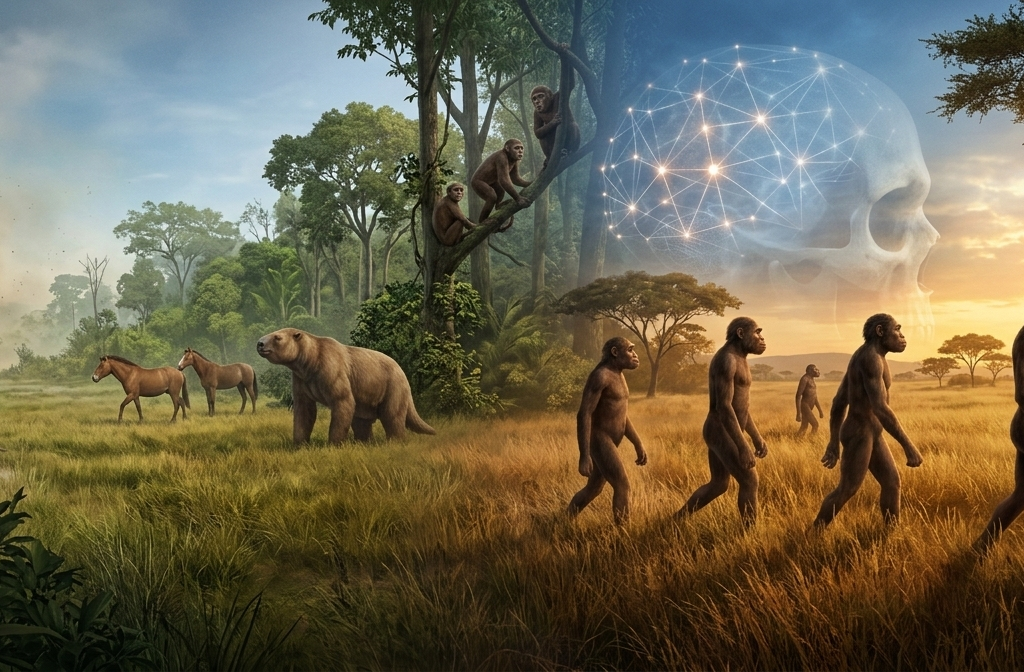
Climate shifted again, as it always does. Forests in parts of Africa thinned and fragmented. Woodlands gave way to mosaic landscapes of grass and scattered trees. In that changing terrain, some primates descended more frequently to the ground. Bipedalism did not arrive as a proclamation but as a gradual rebalancing of skeleton and muscle. The pelvis reshaped. The spine curved. The foramen magnum shifted to cradle a head poised above a vertical column.
Walking upright altered more than posture. It liberated the hands. Freed from the necessity of locomotion, hands could carry, manipulate, throw, signal. It also exposed the body to new vulnerabilities and opportunities. Standing tall allowed scanning of tall grasses for predators and prey. It reduced the surface area exposed to midday sun. It altered childbirth, making it more perilous and more consequential.
The lineage that would one day call itself Homo began as a collection of experiments in adaptation. Australopithecines navigated savannas and woodlands with mixed strategies. Their brains were larger than those of earlier primates, but still modest by later standards. They likely used simple tools, though stone does not always preserve intention clearly. Their existence was precarious and ordinary at once.
Then came a threshold in tool-making that left clearer signatures in rock. Oldowan flakes, chipped deliberately from cores, offered cutting edges that teeth alone could not provide. Meat became more accessible. Marrow yielded calories dense enough to feed a metabolically expensive organ. The brain, that hungry tissue, demanded fuel, and tool-assisted diets provided it.
With Homo habilis and later Homo erectus, the pattern deepened. Bodies elongated. Legs lengthened. The capacity for endurance walking and perhaps persistence hunting increased. Fire entered the story not as myth but as controlled combustion. At some point, hominins ceased merely fearing flame and began tending it. Hearths created islands of light in darkness. Cooked food softened fibers and released nutrients more efficiently, easing the digestive burden and reallocating energy.
Fire also extended the day. It invited gathering and communication. Around its perimeter, stories could be gestured before they were spoken. Predators hesitated at its edge. Cold retreated. Landscapes were reshaped deliberately by controlled burns. The species that harnessed fire began subtly to engineer its own environment.
Language remains more elusive in the fossil record than stone or ash. No bone preserves a sentence. Yet anatomical changes in the hyoid bone and the vocal tract suggest increasing capacity for complex vocalization. Neural circuitry expanded in regions associated with symbolic thought and syntax. It is likely that early forms of language emerged gradually, as calls and gestures layered into systems capable of transmitting not only immediate warnings but abstract ideas.
Language transformed cooperation. With it, knowledge could accumulate across generations more effectively. Myths could encode survival strategies. Plans could be shared before action. The social brain became a theater of shared imagination, and groups that communicated well outcompeted those that did not.
Migration followed curiosity and necessity. Homo erectus ventured beyond Africa into Eurasia, adapting to diverse climates. Clothing, perhaps first simple and improvised, extended habitable ranges. Stone tool technologies diversified into Acheulean hand axes, symmetrical and deliberate. Such symmetry hints at aesthetic sensibilities intertwined with function. Even in utility, there was form.
Over hundreds of thousands of years, lineages branched. Some led to Neanderthals, robust and adapted to Ice Age Europe. Others to Denisovans, known more from genetic traces than bones. Still others culminated in Homo sapiens, anatomically modern and cognitively explosive. The exact interplay among these groups remains under study, but interbreeding left signatures in genomes that persist in many humans today.
The emergence of Homo sapiens marked not the first intelligence on Earth but a new intensity of symbolic capacity. Cave walls became canvases. Pigments were mixed. Animals were rendered in motion. Handprints marked presence across time. Burial practices suggest an awareness of death that extended beyond immediate decay. Ornaments indicate identity and perhaps status.
Agriculture, much later, reshaped the human relationship with land. The domestication of plants and animals altered diets, social structures, and population densities. Settlements grew into villages, villages into cities. Writing systems arose to track trade, law, and memory. Brains that evolved for tracking prey and negotiating alliances now tracked taxes and myths codified into scripture.
Yet beneath all cultural elaboration, the biological substrate remained a product of evolutionary contingencies. The human brain, large and intricately folded, is still constrained by ancient architectures. It carries biases that once aided survival in small groups but now navigate vast societies. It is capable of mathematics and music, cruelty and compassion, introspection and delusion.
At some point in this unfolding, a peculiar feedback loop emerged. Brains began asking questions about brains. Consciousness turned upon itself, examining its own machinery. Philosophy and neuroscience became twin attempts to decipher subjective experience. How does electrochemical activity generate the sensation of being someone? Why does matter arranged in certain ways awaken into awareness?
This curiosity is not merely intellectual ornamentation. It is a continuation of the same evolutionary trajectory that once favored grasping hands and stereoscopic vision. Selection pressures rewarded organisms that modeled their environment effectively. In humans, that modeling capacity expanded until it encompassed not only external landscapes but internal states.
Science emerged as a disciplined extension of this modeling. Hypothesis and experiment refined intuitive guesses. Telescopes revealed galaxies beyond imagination. Microscopes exposed cellular universes within flesh. The same species that once chipped flint now splits atoms and sequences genomes. Tools have become abstract, extending cognition into algorithms and networks.
Yet the ascent of Homo sapiens has been anything but gentle. The capacity for cooperation scales with the capacity for conflict. Tribes coalesced into nations. Ideologies hardened. Wars scarred continents. The environmental consequences of industrialization now reverberate through climate systems and biodiversity. The curious ape reshapes planetary processes at rates unprecedented in geological history.
This is not a moral judgment but an observation of scale. The species that learned to control fire now influences atmospheric composition. Carbon once locked in ancient biomass is liberated in centuries. The biosphere responds. Feedback loops intensify. Evolution continues, though its pace is measured differently in cultural and technological domains.
Amid these transformations, the human individual remains fragile. Each brain arises from a fertilized egg, develops within a body subject to disease and decay, and flickers for a limited span. The lineage persists, but the bearer of consciousness does not. This tension between continuity and mortality has seeded religions, art, and existential inquiry.
The genus Homo did not emerge to contemplate the cosmos. It emerged to survive. Yet survival favored curiosity, and curiosity uncovered cosmic context. Humans now understand that their species occupies a small planet orbiting a middling star in a vast galaxy. The narrative has come full circle, from stellar death forging elements to brains forged from those elements asking about their origin.
The rise of mammals after the fall of dinosaurs was not destiny but possibility. The divergence of primates was not preordained. Bipedalism was an adaptation, not an aspiration. Each step in this lineage was contingent upon prior accidents and constraints. Remove one asteroid, alter one climate oscillation, and the story might have diverged beyond recognition.
Still, here stands a species capable of reconstructing its own deep past. Fossils, isotopes, and genetic sequences serve as fragments of a puzzle assembled through patient inference. The ape that once scanned grasslands for predators now scans time for origins. It measures skull capacity and allele frequency, mapping the subtle increments that led from forest-dwelling primates to symbolic architects of civilization.
In this rise there is no triumphalism, only complexity. The evolutionary process remains indifferent. Extinction is as available to humans as to any lineage before them. The same mechanisms that permitted expansion can facilitate collapse. Awareness does not guarantee immunity.
Yet awareness alters experience. To know that one is part of an unbroken chain stretching back billions of years is to inhabit a layered identity. The calcium in bones was forged in ancient stars. The oxygen breathed is a legacy of microbial revolutions. The upright gait carries echoes of savanna ancestors. The language forming these reflections is the latest iteration of a communication system honed over millennia.
The curious ape stands at a peculiar intersection of biology and reflection. It is both product and observer of evolution. It embodies ruthless competition and creative cooperation. It builds cathedrals and weapons, theories and lullabies. Its history is a palimpsest of adaptation, innovation, and error.
From the quiet burrows of early mammals to the restless cities of modern humans, the arc is neither linear nor smooth. It is jagged, punctuated by bottlenecks and bursts. It is guided by selection but sculpted by chance. The Age of Complex Life set the stage for vertebrates to experiment with cognition. The fall of dinosaurs opened ecological niches. Mammals diversified. Primates refined dexterity and perception. A lineage in Africa stood upright and began to alter not only its environment but its own trajectory.
Now the species contemplates futures as uncertain as its past was unpredictable. It engineers genomes and probes distant planets. It confronts crises of its own making. It composes symphonies and equations. It asks whether consciousness is fundamental or emergent. It wonders if other curious beings gaze back from distant worlds.
The rise of mammals and the emergence of Homo are chapters in a larger story of complexity unfolding under physical law. They are not conclusions but transitions. Evolution remains active, its tempo modulated by culture and technology. The brain continues to adapt, though the selection pressures are no longer solely ecological but informational.
In the end, the curious ape is a bridge between matter and meaning. It is star-stuff contemplating stars, mineral reorganized into memory. Its ascent from obscurity after the dinosaurs’ fall to planetary dominance is astonishing, but it is also fragile. The same evolutionary creativity that generated it can generate successors or silence.
The story continues, carried in genes and ideas, in fossils yet to be found and questions yet to be asked. The mammals rose in a world reshaped by catastrophe. The ape rose among mammals through incremental change. The brain rose within the ape, and with it the capacity to reflect on this entire cascade. The narrative is not finished. It is ongoing, written in neurons firing and in ecosystems shifting.
And somewhere in the circuitry of a questioning mind, evolution studies itself, as if the cosmos, having assembled a being capable of awareness, has turned a mirror upon its own long, relentless becoming.