Life did not rush toward grandeur.
It did not immediately sculpt forests or summon creatures that could look back at the sky and wonder. It remained small, almost secretive, folded into droplets and sediments, hidden within rock pores and drifting currents. For billions of years, the Earth belonged not to giants but to the nearly invisible.
After chemistry learned to remember itself, after membranes enclosed replication and replication invited variation, the oceans filled with single-celled organisms. They were fragile by appearance, yet relentless in persistence. They divided, copied, adjusted, and divided again. Each cell was a boundary holding order against the surrounding sea, a small insistence that structure could endure.
The planet was still young in cosmic terms. Its continents were scattered fragments. Volcanoes continued their slow exhalations. The Moon hovered closer than it does today, pulling at the oceans with a tidal hand. Beneath the surface, tectonic plates moved in patient procession. And in the waters that covered much of the globe, life multiplied quietly.
These earliest organisms were prokaryotes, lacking nuclei and complex internal compartments. They did not need them. Their simplicity was an advantage in a volatile world. Their metabolisms were diverse. Some extracted energy from chemical reactions involving sulfur, iron, or hydrogen. Others fermented organic molecules. They occupied every gradient the planet offered.
For a long time, the atmosphere remained hostile by modern standards. It was rich in carbon dioxide and nitrogen, with traces of methane and other gases. Oxygen, the gas that now fills lungs and fuels fire, was scarce. To most early organisms, oxygen would have been toxic. Their enzymes and metabolic pathways evolved in its absence.
Yet within this microbial dominion, an innovation emerged that would transform the planet irrevocably.
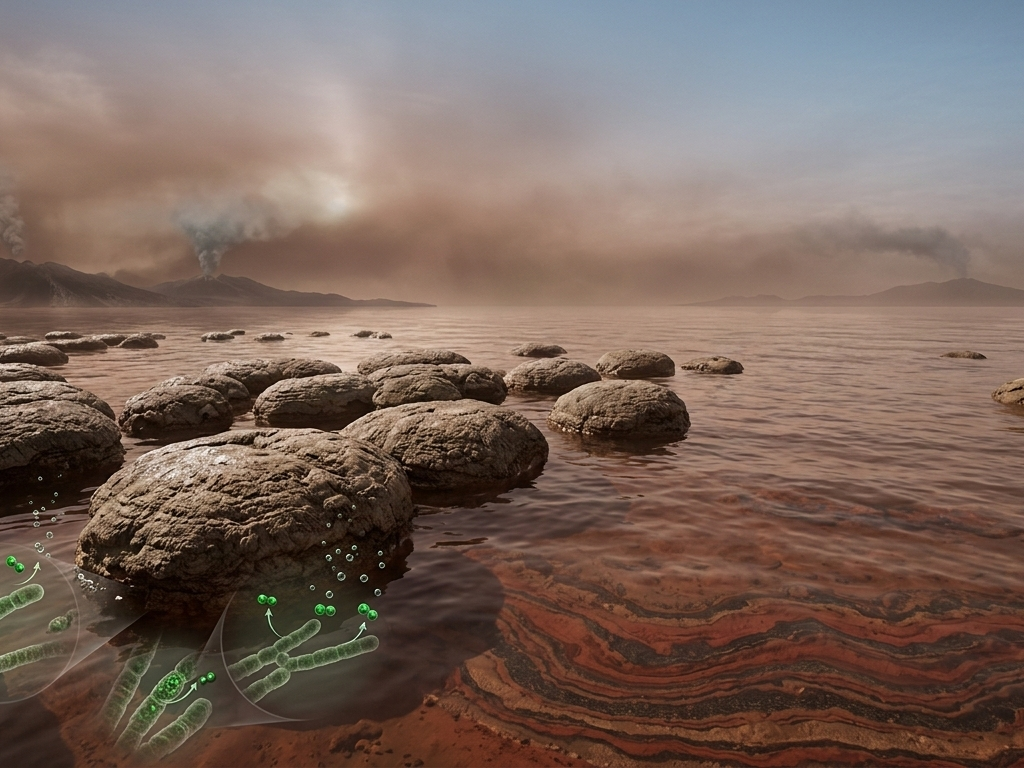
Photosynthesis did not begin as it is known today. The earliest forms were likely anoxygenic, using molecules such as hydrogen sulfide instead of water as electron donors. These primitive photosynthesizers captured light energy and converted it into chemical energy, weaving carbon into organic matter. They thrived in sunlit waters, building thin microbial mats along shallow coasts and within lagoons.
Over time, a lineage evolved the capacity to split water molecules using sunlight, releasing oxygen as a byproduct. These organisms, ancestors of modern cyanobacteria, harnessed a more abundant resource. Water was everywhere. The oceans were an inexhaustible reservoir.
The biochemical machinery required for oxygenic photosynthesis was intricate, involving pigment molecules such as chlorophyll and complex electron transport chains embedded in membranes. It did not appear fully formed. It was assembled through incremental modifications, each step selected for its advantage in harvesting energy more efficiently.
When these microbes began releasing oxygen into the surrounding water, the planet did not immediately change. The oceans were rich in dissolved iron. Oxygen reacted readily with this iron, forming insoluble iron oxides that settled to the seafloor. Over millions of years, these reactions produced banded iron formations, layered deposits that still mark ancient rock formations.
The oxygen was being absorbed, consumed by chemical sinks. It could not yet accumulate freely in the atmosphere.
For hundreds of millions of years, photosynthetic microbes continued their work, releasing oxygen molecule by molecule. Gradually, the available iron and other reducing agents in the oceans were depleted. The chemical buffers that had been soaking up oxygen became saturated.
Then, slowly, oxygen began to persist.
This transition, known as the Great Oxygenation Event, unfolded around 2.4 billion years ago. It was not a single moment but a prolonged shift. The atmosphere’s composition altered as oxygen levels rose from negligible traces to measurable fractions.
For many anaerobic organisms, this change was catastrophic. Oxygen is highly reactive. It forms reactive oxygen species that can damage proteins, lipids, and nucleic acids. Organisms adapted to an oxygen-free world faced an environment that now corroded their internal chemistry.
Mass extinctions do not require predators. They require conditions that shift beyond tolerance.
Yet for other lineages, oxygen represented opportunity. Some microbes evolved mechanisms to detoxify reactive oxygen species. Others went further, incorporating oxygen into their metabolic pathways. Aerobic respiration, using oxygen as a terminal electron acceptor, yields far more energy per molecule of glucose than anaerobic processes.
Energy is currency in evolution.
With greater energy efficiency, cells could afford larger genomes, more complex regulatory networks, and eventually more intricate structures. Oxygen, once a toxin, became a tool.
The rising oxygen levels also altered the planet’s geology and climate. Methane, a potent greenhouse gas present in the early atmosphere, reacted with oxygen to form carbon dioxide and water. The reduction in methane may have contributed to global cooling events, possibly even triggering widespread glaciations known as “Snowball Earth” episodes.
The interplay between life and environment became reciprocal. Life changed the atmosphere. The altered atmosphere changed climate. Climate shifts influenced evolutionary pressures.
The Earth was no longer shaped solely by tectonics and volcanism. Biology had become a planetary force.
In shallow marine environments, microbial mats flourished. Layer upon layer of cells trapped sediments and precipitated minerals, forming structures known as stromatolites. These formations, some of which are preserved in ancient rock, stand as silent monuments to the long reign of microbes.
They did not move across landscapes. They did not roar or hunt. Yet their cumulative impact surpassed that of any later organism in duration.
For nearly three billion years, life remained primarily microscopic. The reign of microbes was not a prelude but a dominant era. Multicellular complexity, when it eventually emerged, would do so atop a foundation built by countless generations of single-celled ancestors.
Within this vast span of time, evolutionary innovation continued at the cellular level. Genetic material, initially short and simple, expanded. Horizontal gene transfer allowed genes to move between lineages, accelerating adaptation. Metabolic pathways diversified, enabling microbes to exploit niches ranging from deep-sea vents to acidic hot springs.
Some cells formed symbiotic relationships. One of the most consequential events in evolutionary history occurred when an ancestral archaeal cell engulfed a bacterium capable of efficient aerobic respiration. Instead of digesting it, the host retained it. The engulfed bacterium became a mitochondrion, an organelle dedicated to energy production.
This endosymbiotic event marked the origin of eukaryotic cells, which possess nuclei and complex internal compartmentalization. It was a union of once-independent organisms, a merger that expanded the possibilities of cellular architecture.
Eukaryotes did not immediately dominate. They coexisted with prokaryotes, often at lower abundance. But their internal organization allowed for greater specialization within a single cell. Membrane-bound organelles created microenvironments for specific biochemical processes. The nucleus protected genetic material and allowed for more intricate regulation of gene expression.
With time, some eukaryotic cells incorporated photosynthetic bacteria as well, giving rise to chloroplasts and the lineage that would eventually produce plants and algae. These events further wove symbiosis into the fabric of life.
Throughout this immense stretch of time, the Earth’s surface continued to change. Continents collided and separated in cycles of supercontinent formation and breakup. Mountain ranges rose and eroded. Oceans opened and closed. Yet the microbial biosphere persisted through these transformations, adapting to shifting coastlines and climates.
Oxygen levels did not rise smoothly. They fluctuated, influenced by volcanic activity, organic carbon burial, and tectonic processes. But the overall trend moved toward an atmosphere increasingly enriched in oxygen. By around 600 million years ago, oxygen concentrations had approached levels that could support larger, more metabolically demanding organisms.
Complexity, though slow to emerge, was gathering momentum.
Multicellularity arose multiple times independently in different lineages. Cells that once lived solitary lives began to adhere to one another, coordinating division and differentiation. Some specialized in nutrient acquisition, others in reproduction. Communication between cells allowed for coordinated responses to environmental stimuli.
The step from single-celled to multicellular life did not erase the microbial world. It layered new forms upon it. Even today, microbes outnumber multicellular organisms by orders of magnitude and occupy environments that larger life cannot endure.
The long reign of microbes was not a stagnant era. It was a time of relentless experimentation at the smallest scales. The genetic code stabilized. Core metabolic pathways were refined. Biochemical cycles linking carbon, nitrogen, sulfur, and phosphorus were established. The biosphere became an intricate network of interactions.
Photosynthetic microbes continued to draw carbon dioxide from the atmosphere, converting it into organic matter and releasing oxygen. Some of this organic carbon was buried in sediments, preventing its immediate reoxidation. This burial allowed oxygen to accumulate further, gradually reshaping atmospheric chemistry.
The ozone layer, formed from oxygen molecules interacting with ultraviolet radiation, began to shield the surface from the most harmful wavelengths. This protective layer would later facilitate life’s expansion onto land.
The microbial era was long not because evolution was idle, but because foundational work takes time. Before complexity could flourish visibly, stability had to be achieved invisibly.
When considering the history of life, it is tempting to focus on dramatic transitions: the emergence of animals, the colonization of land, the rise of mammals. Yet these chapters occupy a fraction of the timeline. For the majority of Earth’s history, life was microbial, shaping the planet quietly.
The Great Oxygenation Event stands as a reminder that even the smallest organisms can alter planetary systems. The oxygen they released transformed oceans, rusted iron, reshaped climate, and paved the way for new metabolisms.
To some lineages, oxygen was annihilation. To others, it was liberation.
Evolution does not promise fairness. It rewards adaptability.
The long reign of microbes illustrates a deeper principle. Complexity does not emerge in haste. It accumulates through countless iterations of selection acting on small variations. The early cells that learned to harness light or detoxify oxygen did not foresee the forests and animals of the distant future. They responded to immediate pressures.
Yet through their responses, they prepared the world.
The oceans that once hosted only chemical reactions became cradles of cellular diversity. The atmosphere that once lacked oxygen became a reservoir of it. The crust that once endured relentless bombardment now bore sediments infused with biological signatures.
The planet was being rewritten, layer by layer.
In this rewriting, microbes were both authors and subjects. They shaped the environment and were shaped by it in return. Their reign was not tyrannical but foundational.
When, eventually, multicellular organisms began to appear in the late Precambrian seas, they did so in a world transformed by billions of years of microbial activity. Oxygen was available to fuel their metabolisms. Nutrient cycles were established. The ozone layer offered protection.
The stage was set not by sudden inspiration, but by prolonged persistence.
The long reign of microbes teaches patience. It reveals that the most profound changes may unfold beyond immediate perception. For vast stretches of time, the Earth’s surface showed little outward sign of the revolutions occurring at the microscopic scale.
Yet those revolutions altered everything.
From the first self-replicating molecules to oxygen-rich skies, the journey was neither linear nor smooth. It was punctuated by crises and recoveries, by innovations that flourished and others that faded.
But through it all, life endured in its simplest forms, adapting, diversifying, and gradually expanding the boundaries of possibility.
The reign was long because it needed to be.
Before animals could swim or plants could root, before consciousness could reflect on origins, there had to be cells mastering energy, genes stabilizing information, and ecosystems balancing chemistry.
The planet’s quietest inhabitants were its most transformative.
In their microscopic persistence, they prepared a world that would one day host forests, wings, and thought.
And yet, even in that future, their dominion would not truly end. They would remain in soil, in water, within every larger organism, unseen but indispensable.
The long reign of microbes was not an interlude.
It was the making of a living world.