There are regions within a galaxy where gravity lowers its voice.
Not because it weakens, but because it has already been obeyed.
For billions of years, the Milky Way had turned in its slow and measured rotation, carrying within its spiral arms the dust of innumerable endings. The galaxy had learned patience through repetition. It had learned that collapse need not be violent to be irreversible. It had learned that creation often begins as a quiet rearrangement of inheritance.
Within one of its spiral arms, far from the crowded ferocity of the galactic center, there existed a molecular cloud whose existence had no urgency. It drifted through the interstellar medium as countless others did, its interior cold and diffuse, its motion guided by the gravitational field of the galaxy as a whole. It contained hydrogen, still the most abundant element in existence, along with helium and traces of heavier atoms forged in the deaths of earlier stars.
Carbon was present.
Oxygen was present.
Iron was present.
They did not announce themselves. They remained suspended, invisible, waiting for gravity to speak more directly.
The cloud’s temperature hovered only a few degrees above absolute zero. At such low temperatures, atomic motion slows, and gas becomes susceptible to gravitational influence. Yet susceptibility alone does not guarantee collapse. Stability is often maintained through balance between internal pressure and external forces. This cloud had existed in such equilibrium for millions of years.
Equilibrium, however, is never permanent.
A disturbance moved through the region, not as an act of intention but as consequence. Perhaps a nearby supernova had released a shockwave that passed silently through interstellar space. Perhaps gravitational interactions with neighboring clouds altered its internal balance. The precise trigger no longer matters. What matters is that equilibrium ended.
Gravity began to gather what had once been content to remain dispersed.
The cloud contracted slowly, its vast size concealing the certainty of its inward motion. As matter moved closer together, gravitational potential energy converted into heat. Temperature rose. Density increased. The cloud did not collapse uniformly. Instead, it fragmented into smaller regions, each with its own center of gravitational attraction.
Within one such region, collapse became inevitable.
Matter accelerated inward, guided by gravity and constrained by angular momentum inherited from earlier cosmic motion. As material fell toward the center, it could not do so directly from all directions. Rotation ensured that infalling gas flattened into a disk surrounding the growing central mass.
This disk did not represent resistance. It represented adaptation.
At its center, matter continued to accumulate. Pressure increased as more gas fell inward. Temperature rose beyond what cold interstellar space had ever permitted. The central region became opaque, trapping heat within itself. The accumulation of matter formed a protostar, a structure defined not yet by nuclear fusion, but by gravitational confinement.
The protostar existed in tension.
Gravity continued to pull inward. Heat generated pressure that pushed outward. Yet fusion, the process that would define the star’s true existence, had not yet begun. The protostar remained an unfinished promise, its future dependent upon whether its core could reach the necessary temperature and pressure.
Time, measured now in millions of years, allowed the process to continue.
Matter continued to fall inward. The core grew denser. Temperature climbed toward thresholds defined by nuclear physics rather than gravity alone. Hydrogen nuclei, which had spent billions of years drifting through space without transformation, now approached conditions under which they could no longer remain separate.
At approximately ten million degrees Kelvin, hydrogen fusion became possible.
Protons, driven together by extreme temperature and pressure, overcame their natural electromagnetic repulsion. They fused to form helium nuclei, releasing energy in accordance with the fundamental relationship between mass and energy.
Fusion had begun.
The protostar became a star.
Energy released in the core created outward pressure sufficient to balance gravitational collapse. The inward pull of gravity and the outward push of fusion entered equilibrium. The star stabilized, no longer contracting, no longer dependent solely upon gravitational heating.
Light began to emerge from its surface.
This light did not represent decoration. It represented consequence.
Photons generated in the core moved outward, scattering countless times through the dense interior before escaping into space. Their journey outward took thousands of years, yet once free, they traveled across the galaxy at the speed of light.
The star had ignited.
This star would come to be known as the Sun.
Its formation occurred approximately 4.6 billion years ago, in a region of the Milky Way that had experienced many previous cycles of stellar birth and death. Its composition reflected that history. It contained hydrogen and helium, but also heavier elements inherited from earlier stars.
The Sun did not exist alone.
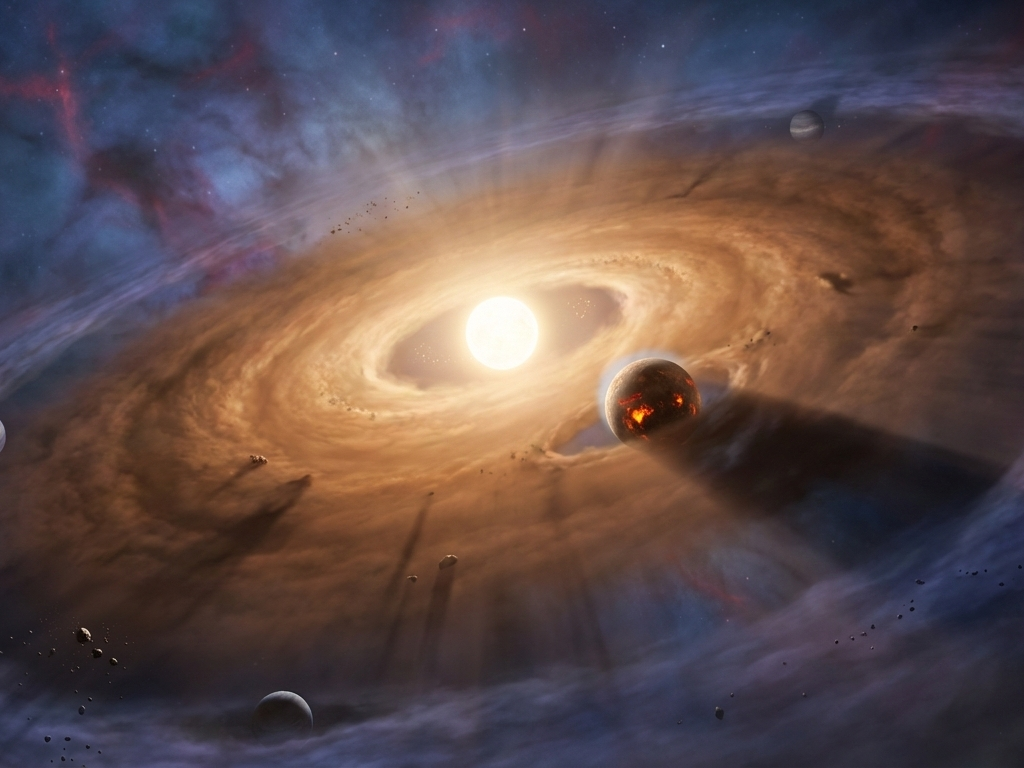
Surrounding it was the disk of gas and dust that had formed alongside it. This protoplanetary disk represented material that had not fallen into the Sun during its formation. It continued to orbit, shaped by gravitational forces and by collisions between particles within it.
Within this disk, particles began to adhere to one another.
Dust grains collided and stuck together, forming larger aggregates. These aggregates collided with others, growing through processes governed by gravity and electromagnetic interaction. Over time, these collisions produced larger bodies known as planetesimals.
Planetesimals possessed sufficient mass to exert measurable gravitational influence upon their surroundings. They attracted additional material, growing through accretion. Collisions between planetesimals produced larger structures known as protoplanets.
This process did not occur uniformly across the disk.
Distance from the Sun determined temperature, and temperature determined which materials could remain solid. In regions close to the Sun, heat prevented volatile compounds such as water and methane from condensing. Only metals and silicate minerals could exist as solids.
Farther from the Sun, temperatures were lower. Volatile compounds could freeze, allowing larger quantities of solid material to accumulate. This difference influenced the types of planets that formed at different distances.
Close to the Sun, rocky planets emerged.
Farther away, gas giants formed, their cores accumulating sufficient mass to attract large envelopes of hydrogen and helium.
This structure reflected physical necessity.
One of the rocky planets formed at a distance that would later prove significant.
This planet formed approximately 150 million kilometers from the Sun. At this distance, solar radiation provided sufficient energy to maintain moderate surface temperatures, but not so much as to prevent the existence of liquid water.
This distance did not represent intention.
It represented placement.
The planet formed through collisions between planetesimals, each impact releasing energy that melted portions of its surface. Over time, gravity shaped it into a sphere. Its interior differentiated, with heavier elements sinking toward its center and lighter materials rising toward its surface.
Iron moved inward.
Silicates remained above.
The planet developed structure.
Its early existence was violent, marked by frequent collisions with remaining debris from planetary formation. One such collision involved a body approximately the size of Mars. The impact released enormous energy, ejecting material into orbit around the planet. This material would later coalesce to form its moon.
The presence of a moon would influence the planet’s future stability.
Yet none of this was visible from the perspective of the Sun.
The Sun continued its fusion, converting hydrogen into helium at a rate that released vast amounts of energy. Each second, it converted millions of tons of mass into radiation. This energy radiated outward, illuminating the surrounding planetary system.
The Sun’s gravity held the planets in orbit.
Its radiation influenced their temperatures.
Its presence defined the structure of the system.
The solar system had formed from inheritance, from matter that had traveled through previous stars and previous explosions. Its existence represented continuity, not exception.
The Sun joined the countless stars that already existed within the Milky Way.
It did not distinguish itself through unusual mass or unusual brightness. It existed within the statistical majority, an ordinary star in an ordinary region of an ordinary galaxy.
Yet ordinary does not mean insignificant.
Its light would persist for billions of years.
Its planets would continue to orbit.
Its energy would drive processes upon at least one of those planets that had not yet begun.
The Sun did not know this.
It did not know anything.
It fused hydrogen because conditions required it.
It radiated energy because physics demanded it.
Its existence represented the continuation of processes that had begun long before it formed.
Gravity had gathered matter.
Matter had ignited fusion.
Fusion had produced light.
Light moved outward, crossing distances that had once contained nothing but darkness.
The galaxy continued its slow rotation.
The Sun continued its steady burning.
The planets continued their silent assembly.
The conditions necessary for future complexity had been established.
The star had ignited.
And around it, matter began to choose its form.