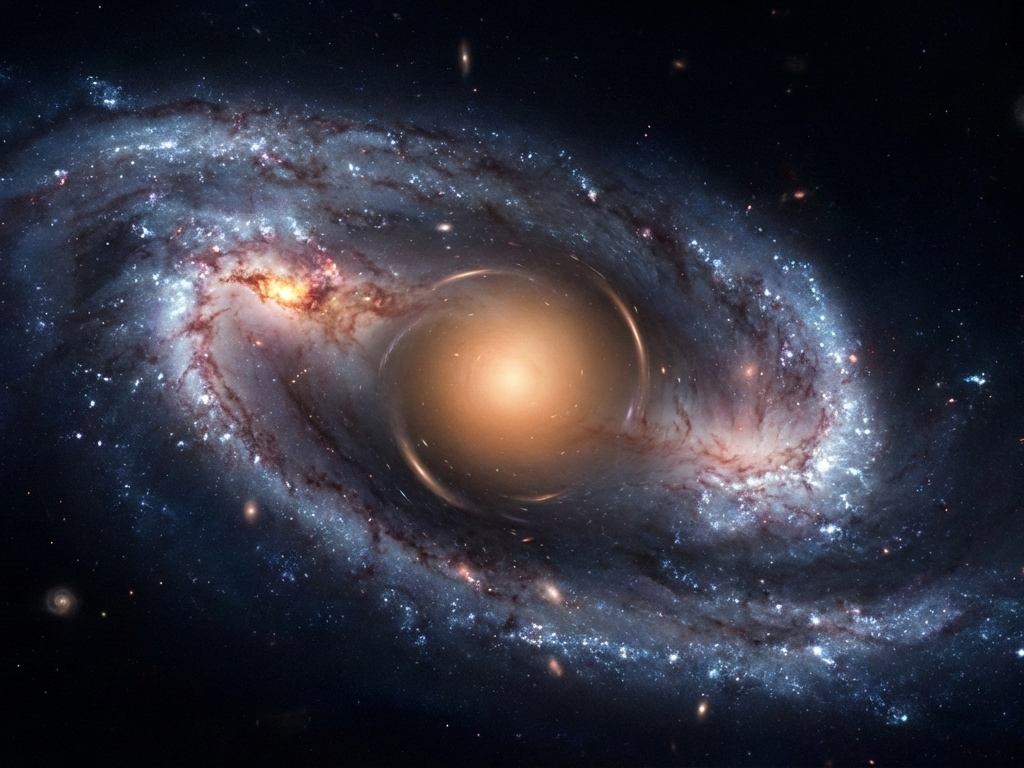
The universe had learned to bleed.
Not in the way fragile things bleed, not as loss, but as release. The great stars had opened themselves without hesitation, tearing apart the prisons of their own gravity and casting their interiors into the vast and waiting dark. Their deaths did not diminish the universe. Their deaths altered its vocabulary.
Before, there had been hydrogen and helium, simple syllables spoken in endless repetition. Now there were heavier elements, complex sounds forged in pressure and fire. Carbon drifted through space with quiet potential. Oxygen moved invisibly between regions that had never known breath. Iron, dense and stubborn, carried within itself the memory of stellar collapse.
The universe was no longer young enough to be simple.
It had begun to remember itself.
This remembering did not occur everywhere equally. Matter had never been perfectly uniform. From the beginning, there had been regions where gravity gathered more tightly, where dark matter shaped invisible wells into which ordinary matter descended without resistance. These regions had already given birth to the first stars, and those stars had already completed their violent offerings. Now those same regions held something new.
They held inheritance.
Clouds of gas moved slowly through these gravitational valleys, their motions governed by forces older than any structure they would eventually create. Hydrogen and helium remained dominant, but now they were no longer alone. They carried traces of carbon, oxygen, silicon, and iron, elements that had not existed when the universe first cooled into transparency.
The presence of these elements changed everything that followed.
Heavier elements interact with radiation differently than hydrogen and helium. They allow gas to lose heat more efficiently, and when gas loses heat, it becomes less able to resist gravitational collapse. Cooling makes matter vulnerable to gravity, and gravity never ignores vulnerability.
Gas clouds began to contract more readily.
This contraction did not produce a single object, nor did it occur in isolation. Instead, vast regions of space experienced gradual inward motion, guided by gravitational forces that shaped matter across scales too large to comprehend through ordinary intuition. The collapse was uneven, sculpted by initial density variations and by the hidden influence of dark matter halos that surrounded these regions like unseen architectures.
Dark matter remained silent, but its silence was decisive.
It provided the gravitational framework upon which visible structures assembled. Ordinary matter fell inward along paths determined by the deeper gravitational contours created by dark matter. Without dark matter, galaxies would not form in the way they do. Without dark matter, the visible universe would lack its most recognizable structures.
Within one such dark matter halo, matter gathered with increasing coherence.
Gas did not simply fall inward. It moved with inherited motion, carrying angular momentum from earlier cosmic conditions. As the cloud contracted, its rotation accelerated. The conservation of angular momentum ensured that inward motion could not proceed uniformly in all directions. Instead, the collapsing matter flattened into a rotating disk.
This disk did not appear instantly. It emerged gradually, its structure refined through continuous motion and interaction. Regions of higher density formed within the disk, and those regions gave birth to stars. The light of these stars illuminated the growing structure, revealing its shape to the universe for the first time.
A galaxy had begun to exist.
It was not yet the form it would eventually become. It was irregular, incomplete, shaped by ongoing mergers and interactions with neighboring structures. Smaller protogalaxies collided and combined, their stars and gas merging into larger systems. Gravity orchestrated these encounters without preference or hesitation.
Each merger altered the structure of the growing galaxy.
Each merger increased its mass.
Each merger changed its future.
Over time, repeated interactions smoothed the galaxy’s shape. Rotation became more organized. A disk formed with increasing clarity. Stars moved along predictable paths, orbiting a center defined not by any visible object alone, but by the collective gravitational influence of everything within the system.
This galaxy would come to be known as the Milky Way.
Its existence did not represent a singular event, but the cumulative outcome of countless smaller events. Every atom within it had traveled through earlier structures. Every star within it had emerged from clouds shaped by earlier stellar deaths. The galaxy itself was not an origin. It was a convergence.
Its spiral arms formed through the complex interplay of gravity and motion.
These arms were not fixed structures composed of the same stars indefinitely. They were density waves, regions where stars and gas accumulated temporarily as they orbited the galactic center. Individual stars passed through spiral arms, entering and leaving them over millions of years. The arms persisted not because their components remained constant, but because the underlying pattern endured.
The galaxy rotated, but it did not rotate like a solid object. Its inner regions completed orbits more quickly than its outer regions. This differential rotation influenced the structure of the disk, stretching and maintaining the spiral pattern.
At the center of the Milky Way, gravity gathered into extraordinary intensity.
A supermassive black hole formed there, containing millions of times the mass of the Sun. It did not create the galaxy, but it became part of its structure. Stars near the center moved in response to its presence, tracing orbits that revealed its invisible power.
The black hole did not dominate the entire galaxy. The galaxy’s structure arose from the combined gravitational influence of its dark matter halo, its stars, and its interstellar gas. The black hole existed as one component within a larger system, not its master.
The Milky Way continued to evolve.
Stars formed within its spiral arms, igniting and eventually dying. Supernova explosions enriched the interstellar medium further, increasing the abundance of heavy elements available for future star formation. The galaxy became more chemically complex with each generation of stars.
This complexity made new possibilities inevitable.
Regions within the galaxy contained clouds of gas and dust that held sufficient density to collapse under their own gravity. These clouds did not collapse immediately. They existed in delicate equilibrium, balanced between inward gravitational pull and outward pressure created by thermal motion and magnetic fields.
Equilibrium does not guarantee permanence.
Disturbances occurred.
Shock waves from nearby supernova explosions passed through the interstellar medium, compressing gas clouds. Gravitational interactions between nearby structures altered the stability of these clouds. Subtle imbalances grew until equilibrium failed.
Collapse began again.
Within one spiral arm of the Milky Way, approximately twenty-six thousand light-years from the galactic center, a molecular cloud began to contract. This cloud contained hydrogen and helium, along with heavier elements inherited from previous generations of stars. It rotated slowly, its motion shaped by forces that had acted upon it long before its collapse began.
The cloud fragmented as it contracted.
Multiple regions within it became gravitationally bound, each destined to form its own star. These regions collapsed independently, their internal densities increasing as gravitational potential energy converted into heat.
Within one of these collapsing regions, conditions approached inevitability.
Matter concentrated toward a central point. Temperature increased. Pressure increased. Motion organized itself around a forming center of gravity.
The cloud had not yet become a star.
It had become a promise.
Around this forming center, a disk of gas and dust emerged, shaped by rotation and gravitational influence. This disk contained the material that would eventually form additional structures. It existed not as a finished system, but as an intermediate stage within an ongoing transformation.
The galaxy had provided the environment.
The heavy elements dispersed through earlier supernova explosions had provided the material.
Gravity had provided the mechanism.
Time had provided the permission.
The Milky Way did not exist to witness this event.
It existed because events like this had already occurred countless times within it.
Its spiral arms were filled with similar clouds, similar collapses, similar beginnings. The formation of one system did not distinguish itself from the formation of others. Each followed the same physical principles. Each arose from the same inherited conditions.
Yet inheritance always narrows toward specificity.
The galaxy had gathered matter across billions of years.
It had organized that matter into a rotating structure.
It had enriched that matter with elements forged in stellar interiors.
Now, within one region of one spiral arm, that matter gathered again.
The scale had decreased.
The intimacy of structure had increased.
The galaxy remained vast, containing hundreds of billions of stars, but within it, individual systems prepared to emerge. The processes that governed the formation of galaxies now governed the formation of smaller structures within them.
The laws remained unchanged.
Gravity continued to pull.
Matter continued to respond.
Energy continued to transform.
Nothing within this process required intention.
Nothing required exception.
The Milky Way had become capable of producing systems that did not exist when the universe was young. Its chemical richness allowed solid particles to form. Its structure allowed localized gravitational collapse to proceed within stable environments.
It had become a cradle without awareness of what it carried.
Its spiral arms turned slowly, completing rotations over hundreds of millions of years. Stars orbited its center, unaware of the specific histories that had made their existence possible. Gas clouds moved through its disk, responding to forces that had shaped matter since the beginning.
Within one such cloud, collapse continued.
Density increased.
Temperature rose.
Matter moved inward with growing certainty.
The galaxy did not resist.
It allowed gravity to continue its work.
And in one modest corner of its vast and rotating body, the next chapter prepared to begin.