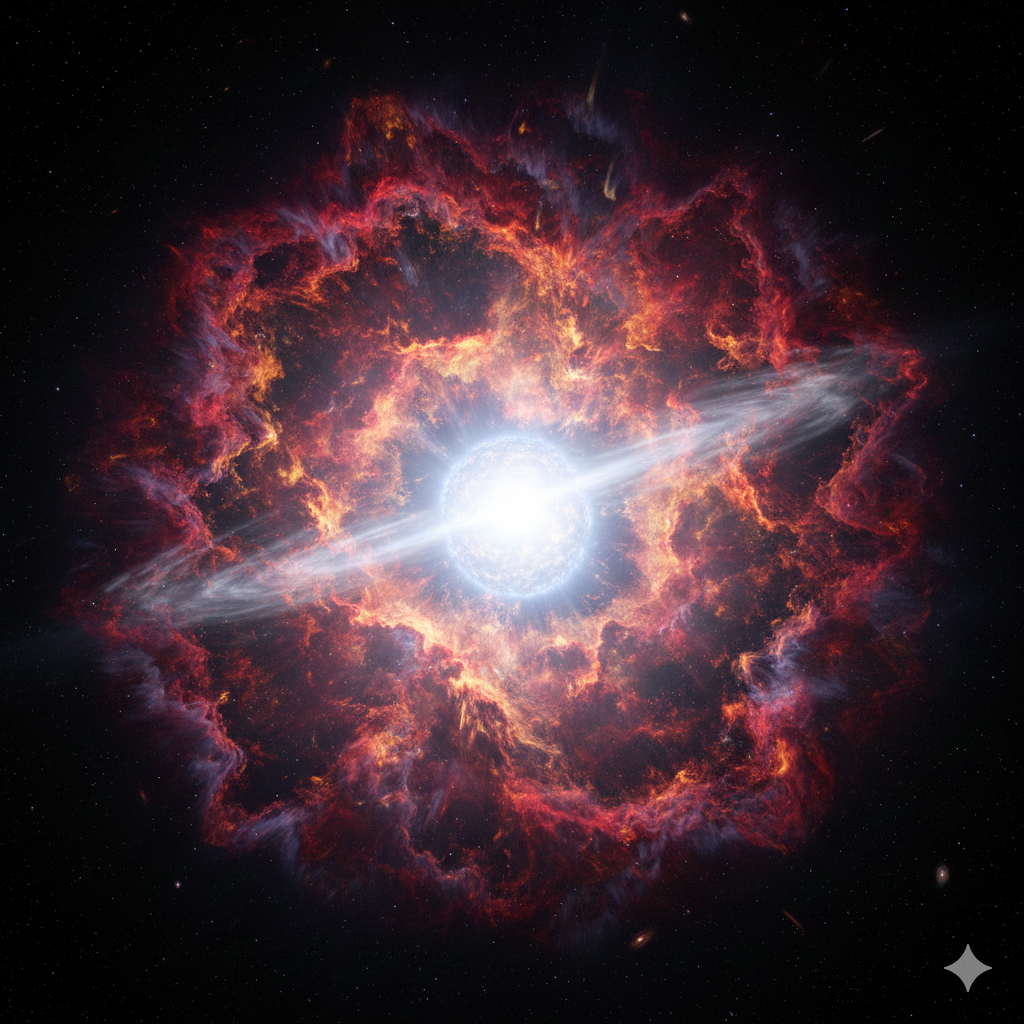
The first stars did not exist to endure.
They existed to transform.
When the earliest stars ignited, they brought light into regions that had never known illumination. They organized matter into stable, luminous structures sustained by nuclear fusion. They converted hydrogen into helium and helium into heavier elements, releasing energy that radiated outward across vast distances. Their existence represented order imposed upon the diffuse simplicity of primordial gas.
Yet their most important function was not their light.
It was their death.
To understand why, it is necessary to recognize a fundamental limitation within stellar physics. Stars sustain themselves through a balance between two opposing forces. Gravity pulls matter inward, attempting to compress the star into a smaller volume. Nuclear fusion generates outward pressure, resisting that compression.
As long as fusion continues in the stellar core, this balance remains stable.
However, fusion is not an endless process.
It depends on available fuel, and the nature of that fuel determines the star’s lifetime and its ultimate fate.
The first stars were different from most stars that exist today. They formed from gas that contained almost exclusively hydrogen and helium. Heavier elements, which astronomers collectively refer to as metals, did not yet exist in significant quantities. These first-generation stars are known as Population III stars.
Their lack of heavier elements influenced their structure in critical ways.
Without heavier elements to assist in cooling collapsing gas clouds, these stars tended to form with much greater masses than most modern stars. Many of them possessed masses tens or even hundreds of times greater than the Sun.
Mass determines everything about a star’s life.
More massive stars contain more fuel, but they also burn that fuel much more rapidly. Their cores reach higher temperatures and pressures, accelerating nuclear reactions. As a result, massive stars live shorter lives than smaller stars.
A star with ten times the mass of the Sun may live only tens of millions of years. A star with one hundred times the mass of the Sun may live only a few million years.
These durations are brief compared to the billions of years that smaller stars can endure.
Massive stars exhaust their fuel quickly.
The process begins with hydrogen fusion in the core, which produces helium. As hydrogen becomes depleted, the core contracts under gravity. This contraction increases temperature and pressure until helium fusion becomes possible.
Helium fusion produces carbon and oxygen.
Once helium becomes depleted, the core contracts again. If the star is sufficiently massive, temperatures rise high enough to fuse carbon into heavier elements. This sequence continues, producing neon, magnesium, silicon, sulfur, and eventually iron.
Each stage occurs more rapidly than the last.
Hydrogen fusion may last millions of years. Helium fusion may last hundreds of thousands of years. Silicon fusion, which produces iron, may last only days.
Iron represents a critical boundary.
Fusion reactions involving lighter elements release energy because the resulting nuclei are more tightly bound. Fusion involving iron does not release energy. Instead, it consumes energy.
Once a stellar core becomes composed primarily of iron, fusion can no longer provide outward pressure to balance gravity.
At that point, gravity begins to win.
The core collapses.
This collapse occurs rapidly. Without fusion to resist compression, the core contracts at speeds approaching a significant fraction of the speed of light. Temperatures and densities increase dramatically. Electrons and protons are forced together, forming neutrons and releasing neutrinos.
The core becomes a neutron-rich object with extraordinary density.
The outer layers of the star, no longer supported by the core, begin to fall inward. This inward motion accelerates under gravity until it encounters the incompressible neutron core.
The result is catastrophic.
The infalling matter strikes the core and rebounds outward. Neutrinos released during core collapse transfer additional energy to the surrounding matter. The combined effect produces a shock wave that propagates outward through the star.
This shock wave disrupts the star completely.
The star explodes.
This event is known as a supernova.
Supernova explosions release enormous amounts of energy. For a brief period, a single supernova may outshine an entire galaxy. The explosion ejects the star’s outer layers into space at velocities of thousands of kilometers per second.
This ejected matter contains elements that did not exist before the star’s life and death.
Carbon, oxygen, silicon, iron, and numerous other elements are expelled into the surrounding interstellar medium.
These elements were created inside the star through nuclear fusion and through additional processes that occur during the explosion itself.
Supernova explosions produce conditions of extreme temperature and pressure that allow for the formation of elements heavier than iron.
These elements include gold, uranium, and many others essential to planetary and biological systems.
The explosion disperses these elements across vast regions of space.
The interstellar medium, which once contained primarily hydrogen and helium, becomes enriched with heavier elements.
This enrichment changes the nature of future star formation.
Gas clouds containing heavier elements can cool more efficiently. Cooling allows gas to collapse more readily under gravity, producing smaller stars and more complex planetary systems.
Heavier elements also enable the formation of solid particles.
Atoms of carbon, silicon, oxygen, and iron combine to form dust grains. These grains accumulate into larger structures, eventually forming planets, moons, and other solid bodies.
Without supernova explosions, these elements would remain locked inside stellar cores.
The universe would contain stars, but not planets.
It would contain hydrogen and helium, but not carbon-based chemistry.
It would lack the material complexity necessary for biological systems.
Supernova explosions also influence their environments through their kinetic energy.
The expanding shock waves compress nearby gas clouds, triggering new star formation. In this way, stellar death initiates new stellar birth.
This process creates cycles of formation and destruction.
Stars form from interstellar gas. They produce heavier elements through fusion. They release those elements through supernova explosions. The enriched gas forms new stars and planetary systems.
This cycle has repeated throughout cosmic history.
Each generation of stars has increased the chemical complexity of the universe.
The earliest stars contained no heavy elements. Later stars contained small amounts. Still later stars contained larger amounts.
The Sun formed approximately 4.6 billion years ago from gas that had already been enriched by multiple generations of supernova explosions.
The presence of heavy elements within the Sun and its surrounding planetary system reflects this history.
Earth contains iron in its core, silicon in its crust, oxygen in its atmosphere, and carbon in its biological systems.
These elements originated in stellar interiors and were dispersed through supernova explosions long before the Sun formed.
Every atom of carbon within living organisms was produced through nuclear fusion in stars.
Every atom of oxygen was produced through stellar nucleosynthesis.
Every atom of iron was produced either in stellar cores or during supernova explosions.
The distribution of these elements across the galaxy reflects the cumulative history of stellar formation and death.
Regions with higher rates of star formation contain greater concentrations of heavy elements.
Galaxies that formed stars rapidly became enriched more quickly.
Galaxies that formed stars slowly remained chemically simpler for longer periods.
The Milky Way reflects this gradual enrichment.
Older stars contain fewer heavy elements than younger stars.
Astronomers can estimate stellar ages by measuring their chemical compositions.
Stars with very low metallicity formed early in galactic history.
Stars with higher metallicity formed later, after supernova explosions had enriched the interstellar medium.
Supernova explosions also produce compact remnants.
If the collapsing core has sufficient mass, it may become a neutron star.
Neutron stars are extremely dense objects composed primarily of neutrons. A typical neutron star contains more mass than the Sun compressed into a sphere approximately twenty kilometers in diameter.
If the core mass exceeds a critical threshold, gravitational collapse continues beyond the neutron star stage.
The result is a black hole.
Black holes represent regions where gravity is so strong that nothing, including light, can escape.
Both neutron stars and black holes influence their environments through gravitational interactions.
They may become sources of intense radiation if they accrete matter from nearby objects.
They may also merge with other compact objects, producing gravitational waves that propagate across the universe.
These remnants represent the endpoints of massive stellar evolution.
However, the material expelled during supernova explosions remains active.
It continues to interact with interstellar gas.
It becomes incorporated into new generations of stars and planetary systems.
The universe evolves chemically through these processes.
At the beginning of cosmic history, chemical diversity was minimal.
After billions of years of stellar evolution and supernova explosions, chemical diversity became extensive.
This diversity enabled the formation of solid planets.
It enabled the formation of liquid water.
It enabled the formation of complex molecules.
It enabled the formation of biological systems.
The connection between stellar death and biological existence is direct.
Without supernova explosions, the chemical elements required for life would not exist in sufficient quantities.
The atoms that compose biological organisms were created through nuclear reactions in stars.
They were dispersed through supernova explosions.
They were incorporated into planetary systems.
They became part of planetary surfaces, atmospheres, and oceans.
They became part of living systems.
This process does not represent intention.
It represents consequence.
Physical laws govern nuclear reactions, gravitational collapse, and energy transfer.
These laws operate consistently throughout the universe.
Their operation produces predictable outcomes.
Massive stars exhaust their fuel.
Their cores collapse.
They explode.
They release heavy elements.
These elements become part of new structures.
The universe increases in complexity over time.
This increase reflects cumulative processes operating across billions of years.
Supernova explosions represent one of the most important mechanisms in this progression.
They transform stellar interiors into interstellar resources.
They convert localized structure into distributed material.
They enable subsequent stages of cosmic evolution.
The existence of planets, atmospheres, and biological systems depends on this transformation.
The universe did not begin with the chemical diversity it now possesses.
It acquired that diversity through stellar evolution.
The death of massive stars made future complexity possible.
The processes that formed the first stars did not conclude with their formation.
They continued through their destruction.
The universe did not simply create stars.
It created the conditions necessary for stars to create everything else.
The elements dispersed by supernova explosions did not remain static.
They moved through interstellar space.
They accumulated in new regions.
They participated in new gravitational collapses.
They became components of new systems.
This progression continues.
Stars continue to form.
Stars continue to die.
Supernova explosions continue to enrich interstellar gas.
The cycle persists because the physical laws that govern it remain unchanged.
Each explosion contributes to the ongoing transformation of the universe.
Each explosion redistributes matter and energy.
Each explosion enables future structure.
The material released through stellar death does not disappear.
It becomes part of what follows.
The universe retains the results of every transformation.
Nothing is wasted.
Everything is reused.
The processes that began with gravitational collapse now extend into chemical evolution.
The universe has learned to build not only stars, but the material from which more intricate systems can emerge.
The next stage does not require new laws.
It requires only time, gravity, and enriched matter.
The elements now exist.
They have been released.
They are free to assemble into new forms.
And within one galaxy among billions, those elements will soon gather again.