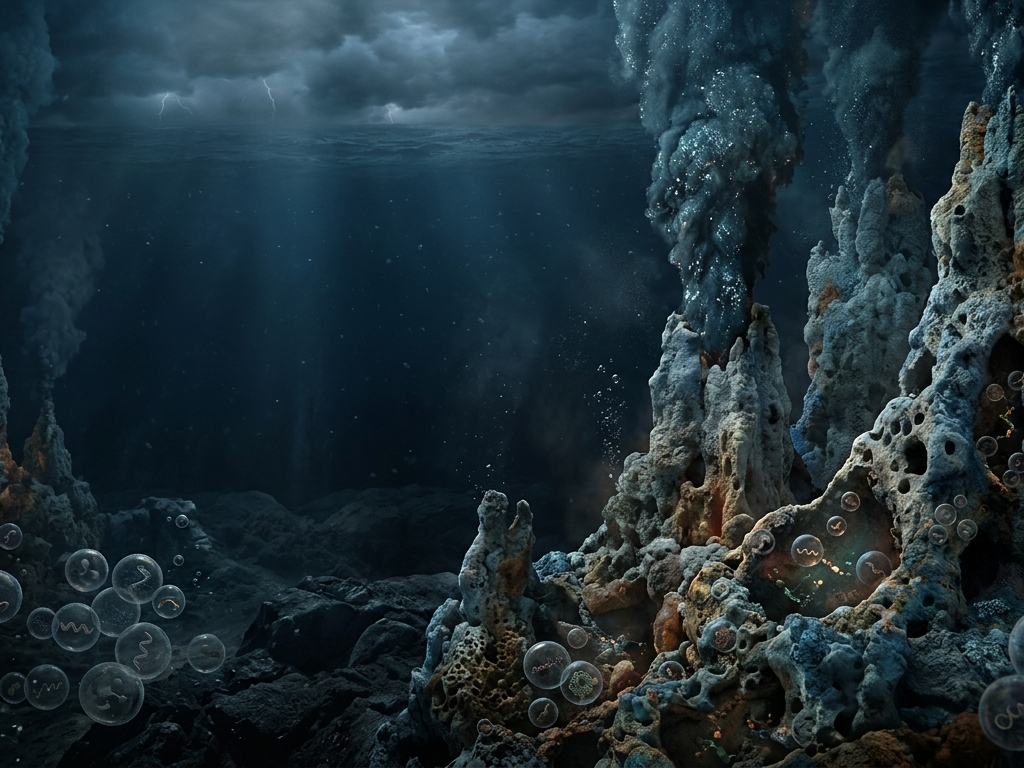
The oceans had finally settled into themselves.
Not into silence, never into silence, but into rhythm. Tides rose and fell beneath the pull of the Moon. Continents, still small and fractured, shifted slowly under the weight of tectonic insistence. Volcanoes continued to exhale into the sky, and lightning stitched momentary fire across thick clouds. The planet no longer burned everywhere at once. It burned selectively, internally, with discipline.
The surface had cooled enough to hold water. The water had accumulated enough to hold chemistry. And chemistry, given space and time, does not remain idle.
In those early oceans, the world was not empty. It was saturated with possibility.
The atmosphere above, rich in carbon dioxide, nitrogen, methane, ammonia, and water vapor, fed the sea with reactive ingredients. Ultraviolet radiation from the young Sun penetrated the upper layers, striking molecules and breaking bonds. Lightning supplied sudden bursts of energy. Hydrothermal vents at the ocean floor released mineral-rich fluids heated by Earth’s interior. Gradients of temperature, pH, and chemical concentration formed everywhere that water touched rock.
Gradients are invitations.
Where there is a difference, there is movement. Where there is movement, there is interaction. Where there is interaction, there is the potential for complexity.
The earliest Earth did not need a miracle. It needed persistence and disequilibrium.
In shallow pools near volcanic coasts, evaporation concentrated dissolved molecules. In tidal flats, cycles of wetting and drying allowed chemical bonds to form and break repeatedly. On the ocean floor, alkaline hydrothermal vents built towering mineral structures with microscopic pores, each pore a natural reaction chamber. These environments were not serene. They were restless laboratories, driven by heat from below and radiation from above.
Simple molecules such as water, methane, ammonia, and carbon dioxide collided and recombined under the influence of energy. Experiments conducted billions of years later in glass flasks would show that such conditions can produce amino acids, the building blocks of proteins. Other reactions could yield nucleotides, the components of RNA and DNA, as well as simple lipids capable of forming membranes.
But the presence of building blocks is not yet life.
The ocean was a vast solution, molecules drifting, reacting, dissolving, reassembling. The question was not whether complexity could form. It was whether complexity could endure.
For life to begin, chemistry had to cross a threshold. It had to move from mere reaction to replication.
Replication is a dangerous idea for matter. It introduces continuity beyond the original event. A molecule that can make copies of itself is no longer a fleeting arrangement. It becomes a lineage.
One of the most compelling hypotheses for this transition is the RNA world scenario. RNA, a molecule capable of both storing information and catalyzing chemical reactions, occupies a peculiar position in modern biology. It acts as a messenger between DNA and proteins, and in some viruses, it carries genetic information directly. Laboratory experiments have shown that certain RNA molecules can act as ribozymes, catalyzing their own replication under suitable conditions.
It is conceivable that, before DNA and proteins dominated biological systems, RNA-like molecules performed both roles. In a world rich in nucleotides and energy sources, short RNA strands could have formed spontaneously. Some would have been unstable, degrading quickly. Others, by chance, would have adopted shapes that allowed them to catalyze reactions, including the assembly of complementary strands.
Natural selection begins not with intention but with differential survival. Molecules that replicate more efficiently become more numerous. Variations that enhance stability or catalytic power persist. Those that fail disappear back into the ocean’s anonymity.
This process requires no foresight. It requires only variation, replication, and competition for limited resources.
Hydrothermal vents offer another plausible cradle. These vents, particularly alkaline ones, create steep chemical gradients between the hot, mineral-rich fluids rising from the mantle and the colder, more acidic ocean water. The resulting structures are riddled with microscopic compartments lined with catalytic minerals such as iron and nickel sulfides.
Within such compartments, simple organic molecules could have been concentrated and organized. The natural proton gradients across vent membranes resemble, in primitive form, the electrochemical gradients used by modern cells to generate energy. Some researchers propose that early metabolic pathways originated in these mineral labyrinths, driven by geochemical energy before the evolution of genetic systems.
Whether life began in shallow pools kissed by ultraviolet light or in the darkness of submarine vents heated by the planet’s interior remains unresolved. It is possible that both environments contributed. The early Earth was not a single laboratory but a network of them, each experimenting with chemistry under different constraints.
Lipids, simple amphiphilic molecules with water-loving heads and water-repelling tails, have a tendency to self-assemble into bilayers when placed in water. These bilayers can form spherical vesicles, enclosing a small volume of solution within a membrane. Such protocells do not require genes to exist. They arise spontaneously from the physics of hydrophobic interactions.
If replicating RNA molecules or proto-metabolic systems became enclosed within such vesicles, a new level of organization would emerge. The membrane would create a boundary, separating internal chemistry from the external environment. Molecules inside could be retained and concentrated. Reactions could proceed with greater efficiency.
Boundaries are transformative.
Once a chemical system is enclosed, selection can act not only on individual molecules but on entire protocells. Vesicles that grow and divide, carrying replicating molecules within them, establish lineages at the cellular level. Errors in replication introduce variation. Some protocells outcompete others, perhaps by harnessing energy more effectively or maintaining membrane integrity under harsh conditions.
At this stage, the distinction between chemistry and biology begins to blur.
There is no single moment when non-living matter becomes alive. There is instead a gradual accumulation of properties associated with life: metabolism, replication, compartmentalization, and evolution. Each property can arise independently. Their convergence marks the emergence of the first true cells.
The earliest cells were likely simple, lacking nuclei or complex internal structures. They were prokaryotic in organization, similar in some respects to modern bacteria and archaea. Their membranes enclosed a cytoplasm containing genetic material and rudimentary metabolic machinery. They extracted energy from chemical gradients, perhaps from hydrogen and carbon dioxide reactions at hydrothermal vents or from simple redox reactions in sunlit waters.
These first cells did not breathe oxygen. Oxygen was scarce and, at the time, toxic. Their metabolisms were anaerobic, relying on fermentation or chemolithotrophy. They existed in a world where the sky was tinted differently, where ultraviolet radiation penetrated more deeply, and where the chemistry of the ocean bore little resemblance to today’s.
Yet they persisted.
The fossil record offers only faint whispers of these earliest organisms. Microfossils preserved in ancient rocks and isotopic signatures suggesting biological carbon fractionation provide indirect evidence that life had emerged by at least 3.5 billion years ago, perhaps earlier. The geological record from the Hadean is sparse, recycled by tectonics and erosion, but zircon crystals and ancient sedimentary structures hint at environments that could have hosted life.
The transition from non-living chemistry to living systems did not require perfection. It required robustness. Early replicators were likely error-prone, producing imperfect copies. But in a dynamic environment, occasional beneficial variations would confer advantages. Over time, molecular networks became more sophisticated, metabolic pathways more integrated, genetic systems more stable.
The genetic code itself, mapping nucleotide triplets to amino acids, may have emerged gradually from chemical affinities and selection pressures. Proteins, with their diverse catalytic capabilities, likely supplanted ribozymes in many functions, while DNA, more stable than RNA, became the primary repository of genetic information. This division of labor between DNA, RNA, and proteins represents a later refinement, built upon simpler foundations.
Energy flow remained central throughout. Life is not a violation of thermodynamics. It is an expression of it. Organisms maintain order internally by exporting entropy to their surroundings. They exploit gradients, whether chemical, thermal, or photonic, to drive reactions that would not occur spontaneously in equilibrium.
The early Earth was far from equilibrium. It offered abundant gradients.
Lightning, ultraviolet radiation, geothermal heat, and chemical disequilibria between the atmosphere and ocean provided continuous energy input. The young Sun, though slightly dimmer than today, still bathed the planet in photons. The interior of the Earth continued to churn, releasing heat through vents and volcanic activity.
Life did not arise in defiance of this environment. It arose because of it.
The spark of life was not a single flash but a series of small, cumulative ignitions. A self-replicating molecule here. A stable membrane there. A metabolic loop that closed upon itself and refused to dissipate. Each innovation built upon prior ones, constrained by chemistry but amplified by selection.
Once true cells existed, evolution accelerated. Natural selection operates more efficiently on entities that reproduce with variation. Lineages diverged. Some cells adapted to specific niches, exploiting particular chemical sources. Others developed mechanisms to cope with environmental stress.
Eventually, one lineage would evolve the capacity to harness sunlight directly through photosynthesis, fundamentally altering the planet’s atmosphere by releasing oxygen as a byproduct. That transformation lies ahead in the narrative.
For now, it is enough to recognize that by the time the Earth’s violent youth had subsided into relative stability, the oceans had become more than reservoirs of water. They had become incubators of self-organizing chemistry.
The boundary between the living and the non-living is often imagined as a sharp line. In reality, it is a gradient, much like the chemical gradients that powered early metabolism. On one side lie simple molecules, governed solely by physical laws. On the other side lie cells, still governed by those same laws but organized into networks capable of replication and evolution.
The transition did not require the suspension of physics. It required the emergence of systems that exploited physics in new ways.
The first cells were fragile compared to modern organisms. Their membranes were simple. Their genomes were short. Their metabolic pathways were limited. Yet they possessed the essential property that defines life: the capacity to make more of themselves while incorporating variation.
With that property, the Earth’s surface entered a new phase.
The oceans were no longer merely chemical. They were ecological.
Competition began. Cooperation emerged. Horizontal gene transfer may have allowed early cells to exchange genetic information, blurring lineage boundaries and accelerating innovation. Communities formed around vents, in sediments, and in shallow waters.
The planet, once defined by molten rock and relentless bombardment, now hosted entities that could sense, respond, and adapt.
The spark of life did not extinguish the violence of the world. It adapted to it. It learned to endure fluctuations in temperature, shifts in chemistry, and exposure to radiation. It exploited niches created by tectonic activity and volcanic outgassing.
From the perspective of the planet’s long history, the emergence of life was subtle. No visible fireworks marked the first replicator. No sudden transformation announced the birth of the biosphere. The change was incremental, detectable only in hindsight through isotopic ratios and microscopic structures.
Yet in another sense, the change was profound. Matter had begun to remember.
Through genetic information, arrangements of atoms persisted beyond their initial formation. They encoded instructions for their own reconstruction. They carried forward variations shaped by selection. The ocean’s chemistry had become historical.
The Earth’s stability, achieved through billions of years of physical processes, provided the continuity necessary for this history to unfold. Without stable oceans, without a retained atmosphere, without a magnetic shield, replicators might have arisen only to be erased repeatedly.
Instead, they were allowed to accumulate.
The spark of life was not an interruption in the story of the cosmos. It was a continuation of increasing complexity under persistent energy flow. Stars had forged the elements. Planets had assembled from debris. The young Earth had endured collision and cooling. Now chemistry had crossed into biology.
The world was no longer solely shaped by tectonics and impacts. It would increasingly be shaped by organisms that altered atmospheric composition, influenced mineral deposition, and eventually transformed landscapes.
But in this early chapter, life was microscopic, hidden within water and rock. It left faint signatures rather than monuments.
Its power lay not in scale but in persistence.
From self-replicating molecules to the first cells, the transition required no external intervention beyond the conditions already present. It required time measured in millions of years and environments rich in gradients. It required errors that did not annihilate but diversified.
The violent youth of Earth had forged a planet capable of holding oceans and atmosphere. Within those oceans, chemistry became ambitious. It experimented, failed, retried, and gradually organized itself into systems that could endure.
The spark was small. Its consequences would be immeasurable.
In the quiet depths of ancient seas and the shifting boundaries of tidal pools, matter learned to copy itself. With that capacity, the Earth entered a new era, one in which the surface would no longer be shaped solely by physics and chemistry, but also by life seeking, without intention, to persist.