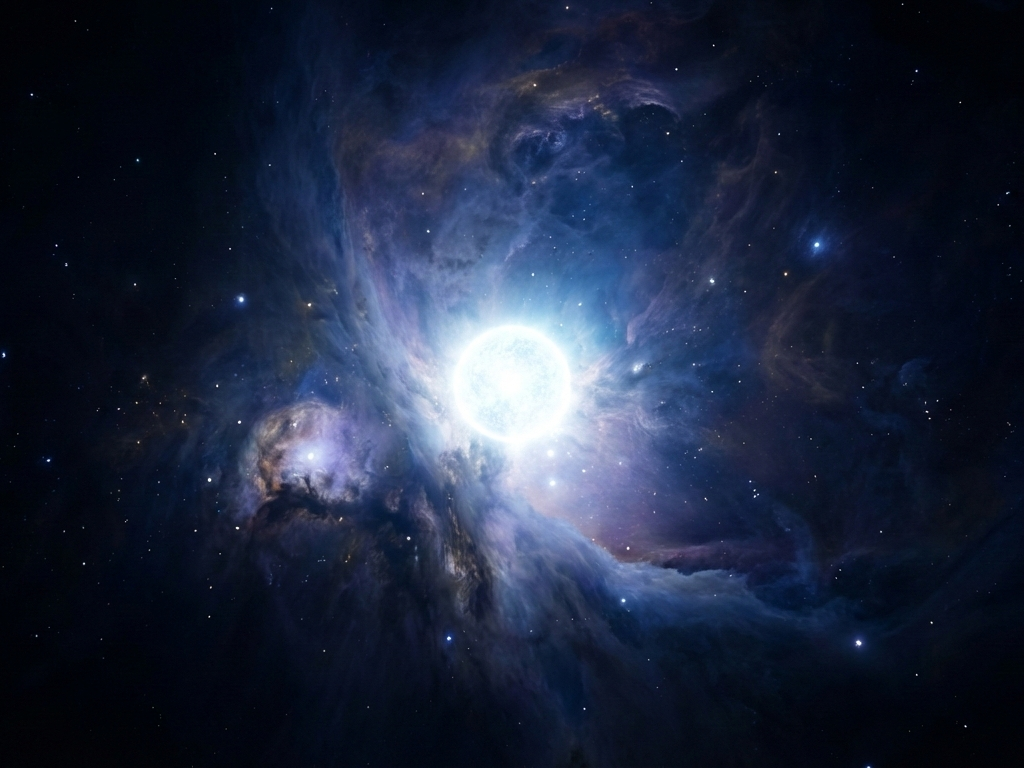
There was a long time when the universe knew light, but did not yet know fire.
It had already survived its first violence and its first cooling. The expansion that began everything had stretched space wide enough for matter to settle into quieter arrangements. Protons and electrons had found one another and learned how to remain together. Hydrogen filled the young cosmos like an unfinished sentence, waiting for something to give it meaning.
Light moved freely now, no longer trapped in the dense fog of its earlier confinement. It traveled in every direction, indifferent and tireless, carrying with it the memory of an origin it could never revisit. This ancient radiation filled the universe evenly, a soft afterglow that did not illuminate objects because there were no objects yet worthy of illumination. The universe had brightness, but it did not yet have lamps.
Darkness, therefore, was not the absence of light, but the absence of structure.
Space had become transparent, but it remained largely uniform. Hydrogen atoms drifted in immense oceans, their motions governed by the simple arithmetic of expansion and the subtle influence of gravity. Nothing yet interrupted the symmetry in a dramatic way. There were no stars to puncture the dark, no galaxies to spiral, no heavy elements to complicate the chemistry of existence.
And yet, hidden within this simplicity, there were imperfections.
These imperfections were small, almost trivial variations in density, fluctuations so slight that they would have escaped any ordinary notice. In some regions, matter was fractionally more concentrated than in others. These differences were not imposed from outside; they were the natural consequence of the quantum fluctuations that had been stretched across cosmic scales during the earliest expansion. They were the fingerprints of uncertainty, preserved and enlarged by time itself.
Gravity recognized these imperfections immediately.
Gravity does not require permission to act. It does not wait for complexity. It responds to mass wherever mass exists, and it responds with infinite patience.
In regions where hydrogen was slightly denser, gravity began to draw more matter inward. The process was slow beyond ordinary comprehension. Individual atoms did not rush toward their destination. They drifted, guided by forces too weak to create sudden motion, but too persistent to be ignored.
Over millions of years, the denser regions grew denser still.
This growth was self-reinforcing. As matter accumulated, gravity strengthened locally, which attracted even more matter. The universe began to develop structure not because of any external intervention, but because of its own internal laws operating without interruption.
Clouds formed.
These were not clouds in the familiar sense. They were vast regions of hydrogen gas, spanning distances that would later contain entire galaxies. Their edges were diffuse, their boundaries indistinct. They did not float in anything; they were suspended within space itself, which was expanding even as gravity tried to draw matter inward.
The competition between expansion and gravity defined this era.
Expansion attempted to pull everything apart, increasing the distance between all points in space. Gravity attempted to pull matter together, creating localized islands of density. Neither force canceled the other entirely. Instead, they established a dynamic balance in which some regions continued to disperse while others began to collapse.
Where gravity gained the upper hand, the first decisive transformations began.
As a cloud of hydrogen contracted under its own gravity, its internal conditions changed. The atoms moved closer together, increasing the frequency of their interactions. Their motions, once governed primarily by expansion, became governed increasingly by mutual attraction.
This contraction converted gravitational potential energy into thermal energy.
The cloud began to warm.
Temperature is not an external property imposed on matter; it emerges naturally from motion. As particles move faster and collide more frequently, their collective behavior manifests as heat. In the contracting hydrogen clouds, gravity provided the mechanism for this acceleration.
The process continued, uninterrupted and inexorable.
The cloud shrank further. Its density increased. Its temperature rose.
Eventually, the conditions at the center of the cloud reached a critical threshold. Hydrogen atoms, which normally remained separate due to their electrical repulsion, were forced into closer proximity than ever before. The pressure and temperature became sufficient to overcome the barriers that had previously prevented deeper interaction.
At this point, something entirely new occurred.
Fusion began.
Fusion is not merely a reaction. It is a transformation at the most fundamental level of matter. It alters the identity of atoms, reshaping the building blocks of existence.
In the core of the contracting cloud, hydrogen nuclei began to combine.
Two protons merged through a sequence of interactions, forming heavier nuclei. These processes were governed by the strong nuclear force, a force that operates only at extremely short distances but possesses immense strength. Where electromagnetic repulsion had once kept protons apart, the strong force now bound them together.
Hydrogen became helium.
This transformation released energy.
The energy did not appear arbitrarily. It emerged from the difference in binding energy between the original hydrogen nuclei and the newly formed helium nucleus. The combined system possessed less total mass than its components had individually. The missing mass had been converted into energy, in accordance with the relation between mass and energy that governs all physical interactions.
This energy radiated outward from the core.
For the first time since the universe became transparent, there existed localized sources of light that were not remnants of the beginning, but products of ongoing processes.
The first stars had been born.
They did not appear suddenly as finished objects. Their formation was the culmination of a gradual evolution that had begun with subtle density fluctuations and proceeded through gravitational collapse and nuclear ignition. Their existence represented the convergence of gravity, thermodynamics, nuclear physics, and time.
A star is not a static entity. It is a balance.
Gravity continuously attempts to compress the star inward, drawing its mass toward its center. Fusion continuously generates energy that produces outward pressure, resisting gravitational collapse. The star exists in a state of equilibrium between these opposing influences.
This equilibrium defines its stability.
If gravity were stronger than the outward pressure, the star would collapse further. If the outward pressure were stronger than gravity, the star would expand and disperse. The star remains stable because these forces are precisely balanced.
This balance is not permanent.
The fuel that sustains fusion is finite. Hydrogen in the core is gradually converted into helium. As the composition of the core changes, so do its physical properties. The evolution of the star proceeds according to the availability of fuel and the interplay of forces within it.
But in their earliest moments, the first stars were dominated by hydrogen.
They were different from most stars that would form later.
The early universe contained almost no heavy elements. Hydrogen and helium comprised nearly all of its matter. This simplicity influenced the formation and behavior of the first stellar objects. Without heavier elements to facilitate cooling, the gas clouds required greater mass to collapse effectively.
As a result, the first stars were likely very massive.
Massive stars live differently from smaller ones.
Their cores reach higher temperatures and pressures. Fusion proceeds more rapidly. Their luminosity is greater. Their lifespans are shorter.
They burn intensely.
These early stars transformed their internal composition through successive stages of fusion. Helium nuclei combined to form heavier elements such as carbon and oxygen. In the most massive stars, fusion continued further, producing increasingly complex nuclei.
The periodic table began to take shape within stellar cores.
Elements are not abstract concepts. They are physical entities with specific origins. Hydrogen and helium originated in the early universe. Heavier elements originated inside stars.
Carbon, oxygen, nitrogen, silicon, and iron were all forged through nuclear processes that occurred within stellar interiors. These elements did not exist in significant quantities before the formation of stars.
Stars are therefore not only sources of light. They are sites of creation.
They alter the chemical composition of the universe.
When massive stars reached the end of their lifespans, their internal balance could no longer be maintained. Fusion ceased in their cores. Gravity regained dominance. The core collapsed rapidly, and the outer layers were expelled in catastrophic explosions known as supernovae.
These explosions dispersed the newly formed elements into space.
The matter that had once been confined within a single star was now distributed across vast distances. This enriched material mixed with the surrounding hydrogen and helium, altering the composition of the interstellar medium.
Future generations of stars would form from this enriched material.
Each generation inherited the products of its predecessors. The universe became progressively more chemically complex.
The existence of planets required elements heavier than hydrogen and helium. The existence of solid surfaces required elements such as silicon and iron. The existence of organic chemistry required carbon.
All of these elements originated in stars.
The formation of stars was therefore a turning point.
Before stars existed, the universe contained matter but lacked diversity in its composition. After stars formed and evolved, the universe contained a wide range of elements, each with unique properties and possibilities.
Structure emerged.
Galaxies began to form as stars gathered into larger gravitational systems. These systems developed distinct shapes and dynamics. Spiral galaxies rotated gracefully. Elliptical galaxies formed dense, rounded assemblies. Irregular galaxies exhibited more chaotic arrangements.
The universe, once nearly uniform, became richly structured.
Light acquired new meanings.
It was no longer only a remnant of the beginning. It became a continuous expression of ongoing processes. Each star emitted light produced by fusion in its core. This light traveled across space, carrying information about its origin.
By observing starlight, it became possible to infer the composition, temperature, motion, and distance of stars.
Light became a messenger.
Time, which had begun with expansion, now revealed itself through change. Stars formed, evolved, and died. Their lifecycles introduced temporal structure to the universe. The universe was no longer defined solely by its expansion, but by the transformations occurring within it.
The birth of stars marked the beginning of a new era.
This era did not erase what came before. It built upon it.
The expansion of space had created the conditions necessary for matter to exist independently. The cooling of the universe had allowed atoms to form. The freedom of light had established transparency. Gravity had gathered matter into dense regions.
Fusion had ignited within those regions.
The universe had begun to generate its own sources of illumination.
These sources were not permanent. Each star represented a temporary balance, sustained by finite fuel and governed by physical laws. Yet their collective presence transformed the universe permanently.
The darkness that had once dominated space was now punctuated by countless points of light.
These points of light were not random. They were the inevitable consequence of the universe’s structure and laws.
The universe had developed the capacity to create complexity.
This capacity emerged naturally, without external intervention. It arose from the interaction of fundamental forces and the passage of time.
The first stars did not exist to illuminate observers. They existed because the conditions of the universe made their formation unavoidable.
Their existence was an expression of physical law.
Gravity gathered matter. Pressure and temperature increased. Fusion began. Energy was released.
The sequence required no intention.
It required only consistency.
And consistency was something the universe possessed from its beginning.
The birth of stars was therefore not an anomaly. It was a continuation.
It represented the universe moving forward through its own possibilities, transforming simplicity into complexity, uniformity into structure, and darkness into light.
The process did not end with the first stars.
It continues.
Even now, in distant regions of space, hydrogen clouds collapse. New stars ignite. Fusion begins again. The universe repeats its patterns across scales too vast for direct perception.
The light from those stars travels across space, carrying evidence of ongoing creation.
Every star that exists is part of this continuous unfolding.
Every atom heavier than hydrogen carries within it the history of stellar interiors.
The universe remembers its transformations through the matter it produces.
The first stars marked the moment when the universe began to manufacture the elements required for everything that would follow.
They were the first furnaces.
They were the first sustained sources of generated light.
They were the first agents of chemical transformation.
They were the beginning of a new order, in which matter did not merely exist, but evolved.
The universe had entered its next chapter.
And it would not turn back.