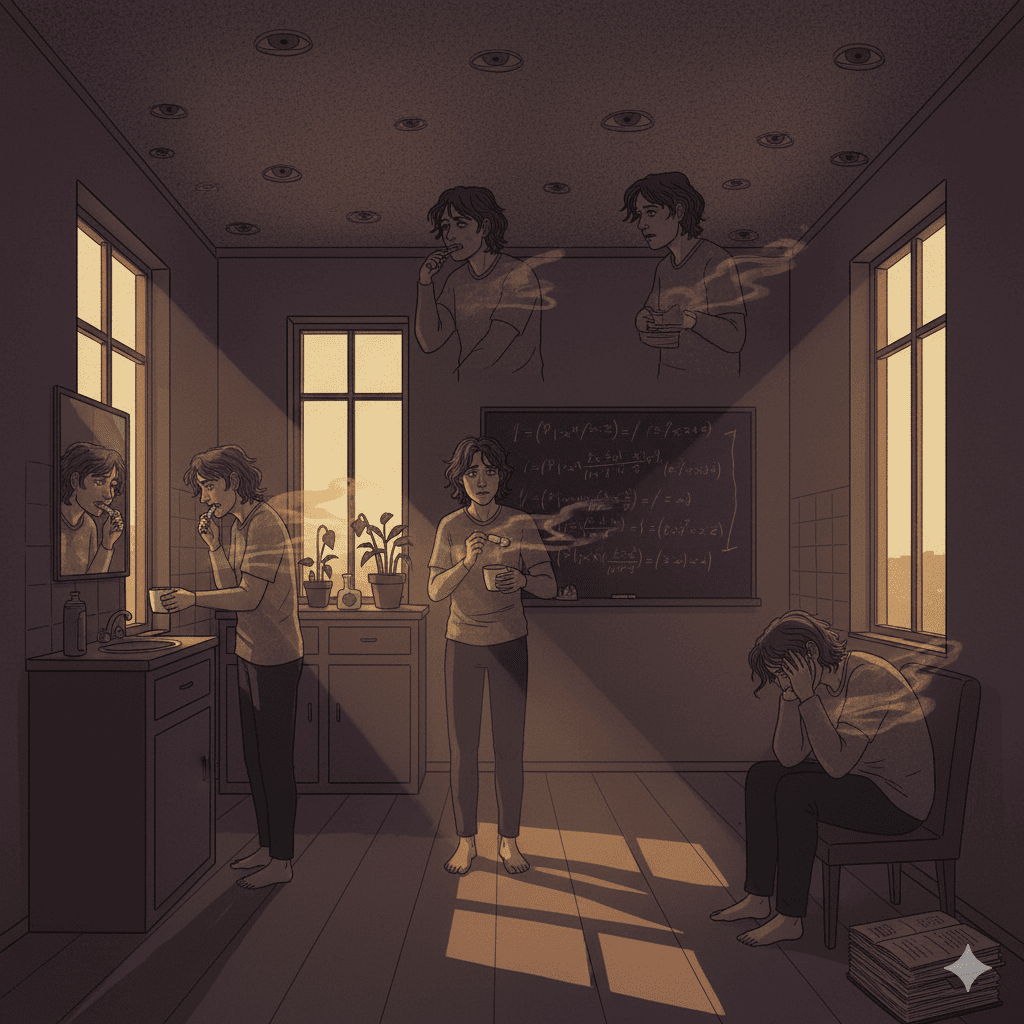
He tells himself the day is harmless.
He tries to say it lightly—like one names a stray dog loitering at the gate—but the sentence doesn’t float the way light things do. It sinks somewhere between his ribs. The day hears him, of course. Days like this always do. They’re nosy creatures, oddly theatrical, lingering in the corners of a mind the way incense smoke clings to fabric long after the ritual ends.
He talks to himself about it.
He always does.
Not out of madness but out of habit—an old, comforting form of self-company. Addressing himself in the third person helps him feel as though someone else is listening, someone kinder, someone mildly amused by the chaos he pretends is order.
“He thinks the day is harmless,” he tells the blank wall near his desk.
“He tries so hard to believe that.”
The wall does not answer, but the day snickers.
Days like this never stay quiet.
Morning arrives with the smugness of a creature convinced of its own importance. It seeps into the room before he opens his eyes, crawling in through the cracks of the curtains as though the sun has a backstage pass to his private anxieties. He lies still for a moment, hoping the morning will mistake him for someone else. Someone sturdier. Someone who has not been whispering bargains to the ceiling at 3 AM.
No such luck.
The morning knows him too well—knows the shape of his thoughts, the texture of his worries, the soft underbelly he tries to hide. And so the day begins not with routines but with an ambush.
“You again,” he mutters to the light.
“Yes, him again,” the morning murmurs inside his head, pleased with itself.
There are well-behaved days, of course—days that knock before entering, days that arrive with the decency of folded weather. Those days linger politely, making soft impressions and leaving footprints that wash away with the next tide of hours.
But this one?
This one is one of the Days That Refuse to Leave Us Alone.
It follows him like an echo with excellent memory. Every footstep he takes is met with another, half a beat behind, whisper-soft yet unmistakably present.
He brushes his teeth, and the day slinks into the bathroom like a cat.
He switches on the kettle, and the day leans against the kitchen counter, studying him with quiet amusement.
He pours his first cup of tea, and the day dips a finger into the steam as though testing the warmth of his thoughts.
He talks to himself in his familiar way.
“He knows he should ignore it,” he says aloud, stirring the tea he has no intention of finishing.
“But he also knows he won’t.”
The day hums in agreement.
While teaching, he finds himself speaking to the class with one version of himself while another version—his quieter, more watchful self—argues with the persistent day curled around his spine. He writes on the board, but the day tugs at the hem of his shirt. He explains a concept, but the day whispers a memory sharp enough to draw a thin line of ache across his chest. Students don’t notice; children have their own weather, their own storms, their own suns. Adults fool them with practiced smiles.
He returns home later, tired in the way that happens when the mind has been hosting an unwelcome guest all day. He sets down his bag. The day sets down its grievance. He sighs. The day sighs louder, just to be difficult.
He wonders, briefly, if the day is actually a day at all or if it is the ghost of something he tried to forget. Something he pretended had dissolved with time, like salt disappearing in water. But salt doesn’t disappear. It waits. It lingers invisibly until the water evaporates, and then it returns as crystals—sharp-edged and unignorable.
This day feels like that.
He tries to reason with himself, a habit he has never grown out of.
“He thinks he’s being logical,” he mutters while heating leftovers.
“He thinks logic is a broom that can sweep away emotional debris.”
But the day knows better.
And so does he.
He eats slowly, as though chewing will somehow break the day into smaller pieces. It doesn’t help. The day is patient, stronger than hunger, sturdier than routine. It follows him into the shower, where the steam curls around his shoulders but refuses to soften the tension lodged there. It watches him towel his hair, shameless as a guest who has overstayed and knows he won’t dare ask it to leave.
By evening, the weight of the day becomes heavier, not burdensome but insistently present—like someone tapping a finger on the same spot of his skin over and over until the sensation becomes unbearable. He sits at his desk, a notebook open, pen poised, attempting to write something—anything—that might dilute the day’s grip.
But the day leans in close and whispers:
“You remember what you tried to forget.”
He closes the notebook.
He cannot argue with truth spoken in a voice he recognizes as his own.
He sometimes jokes with himself, half-heartedly.
“Look at him,” he says, staring at his reflection in the dark screen of the laptop.
“Carrying old ghosts like they’re groceries.”
The reflection smirks.
The ghost smirks back.
Around this time, when the sky turns a tired shade of blue, he tries to distract himself with little tasks—rearranging the bookshelf, adjusting the alignment of pillows, pretending to find satisfaction in small acts of order. But the day follows, offering commentary he never asked for.
When he checks his phone, the day asks him why he’s avoiding that one message.
When he waters the plants, the day reminds him how many things he has forgotten to nurture.
When he sits down, exhausted, the day sits beside him, humming a tune he almost recognises—a tune that pulls dusty memories out of closed drawers.
He sighs.
The day matches his breath, a perfect shadow.
Eventually, he stops fighting.
He lets the day occupy its chosen space inside him. By now, it has turned from an echo into a presence—something with form, something with intention.
He speaks to himself gently.
“Let him breathe,” he tells the empty room.
“Let him move. Let him forget.”
But the day only grins wider.
It knows the architecture of his mind.
It knows which doors he never locks.
Night arrives like a weary guardian trying to intervene, but even darkness has limits. Shadows can muffle the edges of pain but cannot erase the shape of it. The day remains, curled like a creature that has burrowed into warm soil, refusing eviction.
He lies in bed, staring at the ceiling as though it might offer an explanation.
He considers the possibility that these relentless days are not really days at all but slow-moving messages from the mind—a kind of internal weather warning. A quiet alarm.
He has always been someone who treats his inner world like a landscape he can walk through, observing, narrating, conversing.
But tonight the landscape feels unfamiliar, as though a new room has appeared in the house of his mind, unlit and waiting.
He is afraid to enter.
The day sees his hesitation.
It stretches itself, comfortably, maliciously, and whispers—not in words, but in a sensation that runs down his spine like a cold finger:
“You can pretend I’m temporary. But you and I both know what I really am.”
He doesn’t answer.
Some truths are too sharp to be touched directly.
He turns to his side.
Closes his eyes.
Breathes slowly.
But the day does not fade.
It settles deeper, as though marking territory.
In the silence that follows, he recognises something unsettling:
these days that refuse to leave us alone often return with increasing confidence.
They learn our patterns.
They memorise our weaknesses.
They become louder when ignored and gentler only when acknowledged—which might be the cruelest twist of all.
He realises, with a sinking clarity, that some days arrive not to be endured but to be decoded. They are warnings disguised as hours. They are truths dressed in the costume of time.
And when too many such days gather—when they stack up inside a person, jostling for space—they do not merely crowd the mind.
They begin to reshape it.
He lies awake far longer than he admits, listening to the soft pulse of the day sitting inside him like an omen. It waits patiently, knowing it has time. Shadows shift across the ceiling, quiet but restless.
He whispers to himself at last, a confession meant for no one and nothing:
“He knows this day will return.”
“He knows others like it will follow.”
The room does not react.
The night pretends not to hear.
But the day—oh, the day that refused to leave—smiles in the dark, satisfied.
Because it is no longer simply a day.
It is a door.
And it has just been opened.
Whatever waits on the other side does not need to rush.
It knows the way in.