I meet them sometimes—
not in dreams,
not in memories exactly,
but in those thin, breath-held moments
when the day hesitates
before becoming itself.
They arrive without footsteps.
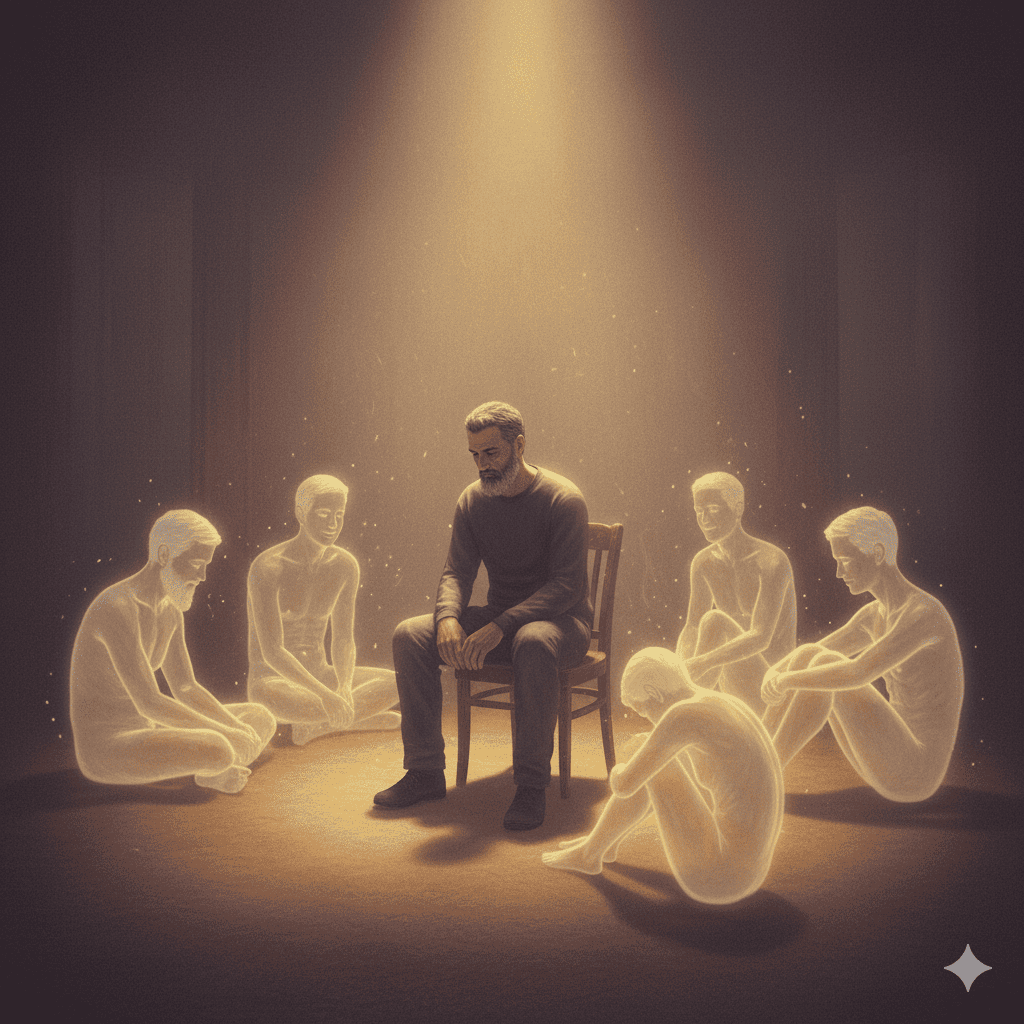
Versions of me I once carried like fragile lanterns:
the boy who believed love could save everyone,
the young man who mistook silence for strength,
the weary one who learned to hold himself
with two shaking hands
because no one else knew how.
They sit beside me
as though we were gathered around a fire
only I can see.
Their faces are familiar,
not as photographs are familiar
but the way forgotten songs are—
you don’t remember each note,
only that something in you
once moved to it.
We talk, these ghost-selves and I,
not with words but with
the quiet press of understanding.
They ask simple, impossible questions.
Was it worth it?
Where did we stray?
Why do we keep choosing days
that feel heavier than we can lift?
I answer in truths I never speak aloud:
that courage is a shape-shifter,
that grief teaches in dialects
we don’t understand until long after,
that every path I abandoned
still walks with me in the dark.
Some of them forgive me.
Some of them don’t know how.
One of them—the tender one,
the one who still waits at the edge of every decision—
touches my wrist as if checking
whether I’m still alive inside.
He doesn’t ask a question.
He just listens.
He always listened.
And I tell him—
quietly, as though the truth were a sleeping animal—
that I’ve tried,
in all the ways it’s possible to try,
to honor what he hoped we’d become.
Not perfectly.
Not even gracefully.
But honestly,
and with as little fear as I could manage.
He nods,
slow as a sunrise that doesn’t want to rush the world awake.
Time folds around us.
The others begin to fade,
their outlines thinning
like old ink exposed to light.
They leave no accusations,
only a solemn, strange gratitude—
as though they were never meant
to be anything more
than the scaffolding
that held up the person I am still learning to be.
Before he disappears,
the listening one says:
Remember us,
but do not worship us.
A gentle warning, a blessing.
Then nothing—
only the day finally deciding
to step fully into itself.
I am left with the echo of them,
those ancient strangers who birthed me,
those temporary constellations
that once lit my way.
And in the quiet that follows,
I realize something I should have known:
we’re never alone
in the house of our becoming.
Every version of us
keeps a small room there,
door half-open,
waiting—
not to return,
but to witness
who we are becoming next.