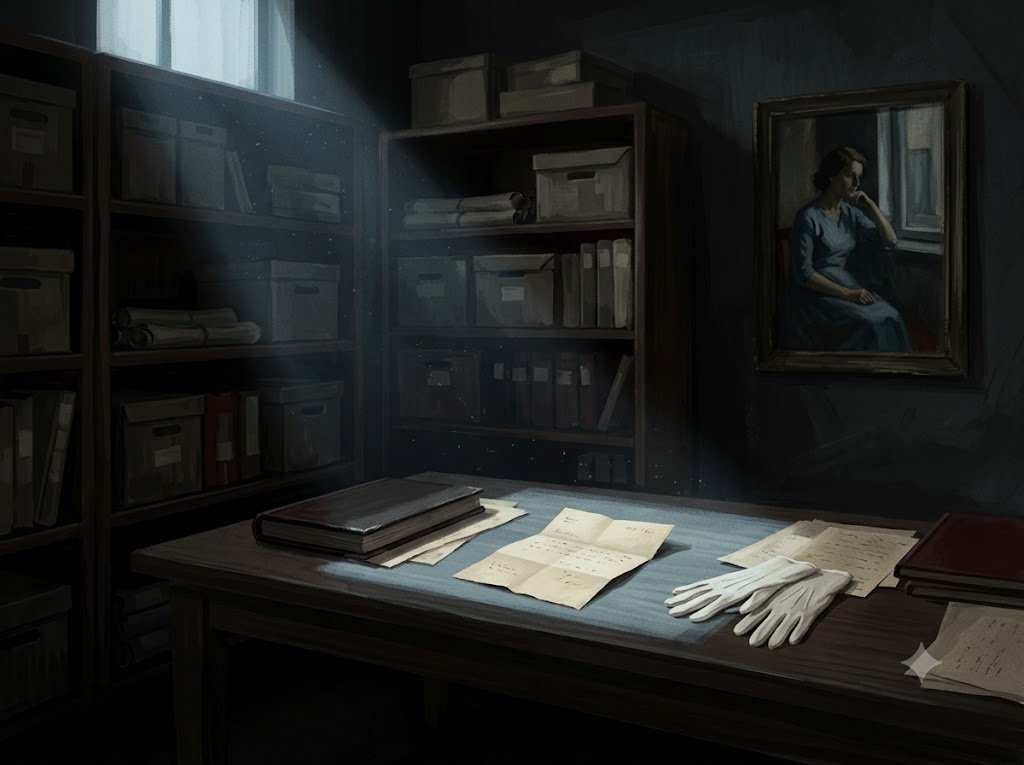
1. Commission
Catalogue entry: Adrian Vale, Woman at a Window, circa 1958. Oil on linen. Provenance dossier commissioned by S., private collector. Examination commenced 7 October 2026.
S offered me tea before he offered me the painting.
He did it without ostentation. A cup, a saucer, a small silver pot. The sort of hospitality that assumes you have already accepted the terms of the room.
“Milk?”
“None, thank you.”
“Sugar?”
“No.”
He remembered this, which I appreciated. Courtesy is useful when it is exact. It becomes a performance when it requires an audience.
The painting hung behind him, at the end of a long room whose windows had been fitted with heavy curtains. A woman sat beside an open window. Her face was turned slightly away from the viewer. One hand rested on the sill. Beyond her, the garden had been reduced to a series of green and brown planes that might have been trees or might have been the painter’s refusal to finish them. The light fell across her left shoulder and stopped.
S stood beside me while I examined it.
“You see why I have kept it for so long.”
I saw that he had kept it for a long time. This was not the same thing.
“The auction house has been very encouraging,” he continued. “They believe the work may be worth considerably more than the previous valuation. Naturally, they require a complete provenance dossier.”
“Of course.”
“Your reputation is for thoroughness.”
“My reputation is not a document.”
He laughed, uncertain whether this was a joke. I allowed him the uncertainty.
An art heist is generally understood to require the removal of an object. A painting disappears from a wall. An alarm sounds. Someone runs. The news acquires a photograph of an empty frame.
That model is convenient because it assumes the object is the principal thing.
I have never shared the assumption.
A painting is pigment, fabric, wood, varnish. Its price, however, is a collective decision supported by a history. Who made it. Who possessed it. Who sold it. Who exhibited it. Which earlier record confirms the details of the next. A hundred years of ownership can be condensed into a few lines beneath a catalogue photograph, but those lines must survive examination.
I had been hired to establish that the lines were true.
For three weeks, I was to work in S’s private archive, a converted room on the ground floor. The housekeeper would bring lunch. S would remain available for questions. Every document would be returned to its place at the end of each session.
“Nothing leaves the room,” he said.
I looked at the painting once more.
“Nothing that belongs here will be lost,” I replied.
He took this for reassurance.
My working rule is simple. I touch only what bears weight.
I wrote it at the top of my notebook, beneath the commission number. There are rules that protect a person from error, and rules that protect a person from having to explain herself. This one had always served both purposes.
2. Survey
Catalogue entry: Supporting documentation inspected. Hales Gallery stock book, London, 1963; exhibition label, 1964; catalogue entry, 1978; insurance valuation, 1981. Cross-references provisionally accepted.
The archive occupied two steel cabinets, three flat files and a locked cupboard for oversized material. The room smelled faintly of paper, furniture polish and the warm dust expelled by the dehumidifier.
S had spent money on the room. I recognised the equipment, the archival boxes, the careful separation of materials that should not share a container. He had done everything one does when one wishes an object to survive time.
He had not understood that preservation and proof were different disciplines.
I began with the catalogue entry. Adrian Vale’s Woman at a Window had appeared in a modest exhibition at Hales Gallery in November 1964. The exhibition label identified the work, named the artist and stated that it had been lent by Evelyn Morrow, who had acquired it through the gallery the previous year.
The 1978 catalogue repeated the attribution and recorded the same chain of ownership. A valuation prepared three years later relied upon the catalogue and added a description of the painting’s condition. The most recent insurance schedule referred to the earlier valuation.
Four documents. Four apparent confirmations.
The difficulty was that they were not independent confirmations. Three depended, directly or indirectly, upon one.
I drew the relationships in my notebook. A line from the exhibition label to the 1978 catalogue. Another from the catalogue to the valuation. A third from the valuation to the insurance schedule. All of them returned, sooner or later, to one entry in the Hales Gallery stock book.
Entry 63/118.
The painting had been registered there in 1963, when Vale transferred it to the gallery. The dimensions, medium, title and price were noted in a narrow hand. A second annotation recorded its subsequent sale to Evelyn Morrow.
That was the keystone.
The exhibition label corroborated the catalogue. The catalogue supported the valuation. The valuation justified the sum S had insured. The stock book established the earliest documented transfer and supplied the original details against which every later description could be compared.
Without it, the remaining documents would still exist. They would still look convincing. They might even be entirely accurate.
They would no longer establish what their owners believed they established.
I checked the entry twice, then a third time against a reference photograph provided by the gallery’s archive. The number was legible. The handwriting was consistent. The annotation appeared contemporary with the original entry.
A neat little bridge across sixty-three years.
I wrote load-bearing in the margin.
S came into the room at eleven, carrying a plate of biscuits.
“Any difficulties?”
“Several dependencies.”
“Administrative?”
“Evidentiary.”
He set the plate down and peered at my diagram. I turned the notebook towards him. It was a small concession, carefully chosen. People enjoy being shown the machinery of their own importance, provided the machinery appears to be working.
“So the documents confirm one another.”
“They refer to one another.”
“Is there a practical distinction?”
“There is when the first document is challenged.”
He considered this, then looked at the painting through the open door.
“But the work itself is genuine.”
“That is a separate question.”
He did not like the answer. He was polite enough not to say so.
After he left, I examined the archive’s arrangement, the condition of the files and the consistency of the descriptions. I identified two minor inconsistencies in the dates and one discrepancy in the recorded dimensions. None was fatal. Each could be explained by ordinary clerical variation, provided the underlying record survived.
That qualification mattered.
A provenance dossier is a structure of permissions. Each document grants the next permission to make a claim. The claims accumulate until confidence begins to resemble certainty.
My task was to find the point at which the permissions ended.
By noon, I had found it.
3. First Removal
Catalogue entry: Hales Gallery exhibition label, 1964. Paper label bearing title, artist attribution and lender information. Original removed from archival folder; facsimile substituted.
The first document was not essential.
It was a small exhibition label, its edges browned to the colour of weak tea. The gallery’s name appeared at the top in a typeface no one would choose now, though people might pay money for the right to reproduce it. Below it were the painting’s title, the artist’s name and Evelyn Morrow’s name as lender.
The label had been used in the 1964 exhibition and returned to the owner with the work. It offered a neat connection between the painting and the gallery’s stock-book entry.
It did not establish the connection independently.
I had selected it because it was the easiest place to begin, not because it was the most important. The distinction is worth recording. Practice does not always require necessity. Sometimes it requires a small act from which the hand learns nothing new.
The exchange was unremarkable. There was no locked drawer to open, no guard to distract, no dramatic negotiation with a machine that considered my presence suspicious. S had commissioned the examination. I had permission to handle the contents of the archive. He had granted the very access that would later make the loss difficult to explain.
I made the substitution during a routine examination, then entered the label’s reference number in my notebook.
The facsimile was exact enough for ordinary inspection. Its presence did not create a new ownership claim, invent a seller or alter a date. It merely occupied the place where the original had been.
I recorded the change in a private list, separate from the official inventory.
The distinction between the two lists was becoming important.
In the official inventory, the label remained present. In my private list, it had been removed. Both statements could be made without an error of handwriting.
I sat back and waited for the familiar sensation of a decision becoming irreversible.
Nothing happened.
The dehumidifier continued its low mechanical hum. The tea S had left beside my notebook developed a thin skin. Outside, someone moved a ladder along the wall of the house, the metal feet making brief, irregular sounds against the paving.
I had expected to feel something resembling satisfaction. Instead, I began to consider why I had chosen the work.
My first explanation was that Evelyn Morrow’s family had been cheated.
The family name appeared in the papers only as a point of passage. Morrow had acquired the painting, lent it for exhibition and eventually passed it to another owner. After her death, the work entered the private market. A later catalogue gave three lines to its movements and a paragraph to Vale’s technique. The woman in the painting received a title, a date and a description of her posture.
Nothing more.
I had read a short correspondence in which a member of the Morrow family asked for greater acknowledgement of the sitter. The request had been declined. The gallery had regarded the matter as outside the scope of its catalogue.
It was possible to call this an injustice. It was possible to imagine a family watching a woman they knew become an asset, her presence reduced to something that increased the value of an object belonging to someone else.
It was even possible to tell myself that removing the records would restore a balance.
I examined the explanation for defects.
The family had not been dispossessed of the painting. No document suggested that the work had been taken from them. They had asked for acknowledgement, not ownership. A failure of recognition could not be repaired by creating another absence, particularly one that might erase the little recognition the woman had received.
That argument failed.
I crossed it out.
The label remained under its clear sleeve, indistinguishable from where it had always been. Nothing about the room suggested that a transaction had occurred.
I put the private list away.
4. Keystone
Catalogue entry: Hales Gallery stock book, volume III, folio 118. Entry dated 14 March 1963. Primary documentary reference for the earliest recorded transfer of Woman at a Window.
S liked to talk about the painting when he was in a good mood.
He had bought it in 1998 from a private estate, he explained, after having followed its market history for several years. He had paid what he considered a reasonable price at the time. Since then, he had spent money on conservation, insurance and proper storage.
“I have been a good custodian,” he said one afternoon.
We were standing before the painting. He had asked whether the surface required further examination, and I had told him that the condition report offered no immediate cause for concern.
“A good custodian,” I repeated.
“Isn’t that what ownership amounts to, in the end? You take responsibility for something and preserve it for whoever comes after you.”
It was a respectable answer. I had no objection to responsibility. I objected to the assumption that responsibility conferred a permanent authority over the meaning of an object.
He pointed to the painted woman.
“Vale understood how to keep something private. Look at the way she turns her face. You never quite get her.”
I looked.
The woman’s turned face was not an invitation to solve her. It was a fact of the composition. S treated it as a service performed for him.
“She gives the painting its mystery,” he said.
I wondered whether he had ever considered that she might simply have been looking at something beyond the frame.
The thought produced my second explanation.
Perhaps I resented him because he had never actually looked at the painting. He had studied its market value, the condition reports, the exhibition history, the favourable language of the catalogues. He knew the dimensions and the insurance sum. He could name the gallery through which it had passed. He had mistaken the accumulation of facts for intimacy with the object.
Perhaps the crime was a correction. I would remove the documentary structure he mistook for possession and leave him with the thing itself. He could look at it without the reassurance of its history. He might even discover that he had never seen it clearly.
This was an appealing explanation.
It was also insufficient.
S was not incapable of looking. He noticed the narrow alteration along the woman’s sleeve, where the paint sat more heavily than the surrounding passage. He knew that the dark shape beyond the window had been repainted. He had once asked a conservator whether the artist had changed the angle of the sitter’s hand during the work.
These were not the observations of a man entirely indifferent to the painting.
His relationship to it was compromised by ownership, as most relationships to valuable things are. But compromise is not absence. I could not make him into a caricature merely because it would simplify my account.
I crossed out the second explanation.
The stock book lay in the archive room, in a box labelled Hales Gallery: Correspondence and Registers. Its pages were ruled, its entries arranged by date. It was not beautiful. It had no special quality that would have attracted the attention of anyone looking for something to admire. Its authority came from being ordinary and old, from having occupied its place in a sequence of transactions without interruption.
I had no need to destroy it. Destruction would have been untidy, and it would have introduced an event into the record. Fire leaves residue. Water leaves stains. A missing volume invites questions that a present volume does not.
I had already arranged for the archive’s originals to be replaced by facsimiles. The replacement volumes and sheets had been prepared to reproduce their visible contents, including the irregularities that made the records look lived in. They were copies, not new accounts of events. They did not invent a transaction. They could simply no longer serve as the original evidence of one.
The distinction was the entire point.
That afternoon, S took a telephone call in the adjoining room. His voice became quieter, then cheerful. He was discussing the auction estimate. I could hear him thank someone for their confidence in the painting.
I remained at the table.
There is a particular silence in a room where the person with authority has stepped away but is expected to return. It is not freedom. It is a loan of time.
I removed the stock book from its archival box. The original passed into my custody. The replacement occupied its place.
I checked the inventory. It still described the correct volume, folio and entry. Every date remained the same. Every figure remained the same. The painting’s documented history had not been edited. Its evidence had been deprived of its source.
When S returned, he found me writing.
“Making progress?”
“Yes.”
“Excellent. I knew you would find everything in order.”
He thanked me for my thoroughness. It was the nearest he would come to asking what I was looking for.
5. The Letter
Catalogue entry: Correspondence, undated. One handwritten letter, addressed to Adrian Vale. No exhibition, transaction or ownership reference identified. Excluded from the formal provenance chain.
The letter was folded twice.
It lay between two sheets of correspondence concerning the 1964 exhibition, neither of which mentioned it. The paper was thinner than the stock used for the gallery’s administrative records. The handwriting leaned forward across the page, as though its author had been in a hurry but had refused to let hurry dictate the shape of the letters.
There was no date.
The salutation was simple.
Adrian,
Come before four. After that the window gives you nothing. I have moved the chair myself; do not move it back. I will not sit again on Sunday.
No signature was necessary. The address was in the artist’s name, and the letter had survived among his papers before entering the archive. It might have been delivered. It might have been kept without being answered. The record did not say.
Nothing in the letter bore weight.
It established no sale, no exhibition, no transfer, no chain of custody. It did not identify the painting by title. The woman did not claim the work, negotiate payment or ask to be named in any future account of it. There was no indication that she had written in connection with the painting’s commercial history at all.
A registrar would have described it as incidental correspondence.
I read it again.
The woman had moved the chair herself. She had set the hour. She had refused another sitting on Sunday. The letter contained no explanation, no softening phrase, no plea that the painter understand. She had told him when to arrive and what not to change. The window, like the hour, belonged to the terms she had set.
I knew the gesture.
Not the chair. Not the window. The small, absolute act of deciding the conditions under which one may be seen.
I held the paper by its edges and felt the fine unevenness of its grain. It was the only document in the archive in which the sitter spoke in her own voice. Everywhere else she was a reference, an image, a name passed through the hands of people who had reason to describe her and no obligation to hear her.
I had not come to give her a voice. That would be an elegant claim, and an inaccurate one. The letter already had a voice. It had survived without my assistance. No one had asked me to rescue it.
My rule said to leave it.
The rule was clear. The letter did not bear weight. Removing it would not weaken the chain of provenance. Replacing it with a facsimile would not accomplish anything useful. It could remain precisely where it was, safe in its sleeve, unremarked upon by the people who had placed it there.
I put it down.
Then I picked it up again.
The dehumidifier stopped. The sudden absence of its hum made the room seem larger, although nothing had changed. I heard S in the hall, speaking to the housekeeper about a delivery. A cup touched a saucer. Somewhere, a door closed.
I folded the letter along its existing creases.
This was not part of the commission. It was not necessary to the work. It did not follow from either of the explanations I had written and rejected. There was no defensible connection between taking this letter and making the painting’s history uncertain.
I took it anyway.
I recorded no substitution. I did not prepare a replacement, nor did I create an entry describing its removal. For once, the official inventory and my private list did not disagree because I had made one version accurate and the other incomplete. They disagreed because I had refused to keep an account.
The paper went into my bag.
I returned the remaining correspondence to its box and closed the lid. My hands were steady. I would prefer to record that as evidence of discipline, but it proves nothing of the sort. A hand can perform a familiar action while the person attached to it has abandoned every principle that made the action familiar.
S came into the room.
“Everything all right?”
“Yes.”
“Anything of interest?”
“Nothing relevant to the provenance.”
He accepted the answer.
I let him.
6. Handover
Catalogue entry: Provenance dossier submitted to auction house, 28 October 2026. Reproductions and documentary references arranged in chronological order. Request received for inspection of original supporting records.
The dossier was complete.
It contained the catalogue entries, the exhibition history, the insurance valuation, the condition report and the cross-references to the gallery’s stock book. The language was cautious. Unsupported claims had been removed. Minor inconsistencies were noted without being inflated into discoveries. The documents agreed with one another as they had agreed before I arrived.
I delivered the file to S on a Thursday afternoon.
He turned through the pages slowly, stopping at the photograph of the painting.
“You have made this very easy to follow.”
“That is the purpose of a dossier.”
“I suppose I should thank you.”
“You already have.”
He smiled at that. He had begun to enjoy our conversations because I gave him answers that sounded conclusive without being warm enough to require anything in return.
The auction house’s specialist contacted me three days later. She was courteous, precise and entirely without suspicion. Her email thanked me for the supporting material and requested access to the original Hales Gallery stock book, together with the original exhibition documentation, before the catalogue could be finalised.
There was nothing unusual in the request.
The originals were the basis of the claim. The dossier was an arrangement of references to them, not a replacement for them. Copies were adequate for preliminary assessment. They were not adequate where a specialist needed to establish the chain of custody independently.
I read the email twice.
The language was professional enough to leave no room for offence. The specialist had not accused anyone of error. She was asking for the ordinary next step, the step every careful person would take.
I replied that the records were held in the owner’s archive and that access could be arranged.
I did not say the originals were missing.
I did not say they were in my possession.
I did not say that the dossier itself remained accurate in every detail while the evidence supporting it had become inadequate.
The specialist thanked me for the prompt response. She suggested a date for inspection.
I forwarded the message to S.
He called within the hour.
“They want the originals,” he said.
“Yes.”
“But we have provided everything.”
“We have provided the dossier.”
“Which contains the relevant documentation.”
“Descriptions and reproductions of it.”
There was a silence. I let it remain his responsibility to fill.
“Are you suggesting there is a problem?”
“I am suggesting that the request is reasonable.”
He took a breath, controlled himself, then thanked me for explaining the distinction. He would arrange access to the archive. He was confident there was nothing to worry about.
I was confident too.
A facsimile can establish what a document appears to say. It cannot establish that this particular piece of paper occupied a particular place in a historical transaction. Its accuracy is not the same as its authority. It resembles the original in every visible respect and still fails at the one task for which the original is required.
The specialist would examine the records, ask for corroboration, and follow each reference back to its source. The stock-book entry would lead to the exhibition label, and the label would lead to the catalogue, and the catalogue would return her to the entry that could no longer be authenticated as the original register. The chain had not been contradicted. It had been deprived of the independent evidence required to hold it together.
The painting remained on the wall.
The dossier remained in the auction house’s possession.
The history remained legible.
Only the proof had become uncertain.
I closed my notebook and placed it in the drawer. I had done the work for which I had been commissioned. Whether I had done it well would depend on the standard by which it was judged.
There was no further entry I could make.
7. Lacuna
Catalogue entry: Woman at a Window. Auction lot withdrawn pending further authentication. No conclusion recorded as to attribution. Physical object retained by owner.
The lot was withdrawn the following week.
The auction house did not announce a scandal. There was no suggestion of theft or forgery. The notice stated that additional documentation was required before the work could be offered for sale. The wording was bland enough to preserve everyone’s dignity and precise enough to protect the auction house from a claim that it had certified what it could not establish.
S rang me that evening.
“I cannot understand it,” he said. “The painting has not changed.”
“No.”
“The records have not changed.”
“Not in their contents.”
“Then what has happened?”
I was standing beside my desk. The folded letter lay in the drawer beneath my hand. I had not read it again. I knew where the paper had been folded, and I knew the weight of it in my palm. This knowledge was sufficient to prevent the kind of forgetting that would have made the act easier to live with.
“I think,” I said, “that the auction house has reached the limits of the available evidence.”
“But the provenance is clear.”
“The sequence is clear. The sequence can be reconstructed from the material they have.”
“Then why will they not accept it?”
“Because reconstruction is not verification. The copies agree with the descriptions, and the descriptions agree with one another. The question is whether the earliest record can still be examined as an original source.”
He said nothing.
I could have told him that the distinction had been present from the beginning. I could have explained that the archive had always contained a fragile dependency concealed by the appearance of abundance. Four documents do not become four independent witnesses merely because four separate sheets of paper exist. Repetition is not corroboration. A claim does not acquire a second source by quoting the first one accurately.
All of that would have been true.
I could also have told him that the absence of proof was not proof of fraud. The auction house had not established that the painting was false, that Vale had not painted it, or that the recorded transfers had never occurred. It had established only that the available material did not permit the claim to be verified to the required standard.
That, too, would have been true.
S sighed.
“I have been careful with this painting for twenty-eight years.”
“I know.”
“I paid for the conservation. I kept the records properly. I thought that was what one was supposed to do.”
“You did.”
“Then how can a thing disappear without going anywhere?”
I looked at the closed drawer.
“It can become impossible to establish what it is.”
He thanked me for my honesty. His voice had grown tired, and I did not mistake tiredness for understanding. We said goodbye with the courtesy we had practised from the beginning.
After the call, I opened the archive ledger I had kept for the commission. The entries were orderly. Dates, references, custodians, locations. The work had been completed, the dossier delivered, the lot withdrawn. Each line was consistent with the evidence available to the person reading it.
I added the final entry for the auction house and the owner. I checked the dates against my correspondence. Then I reached the folded sheet that I had chosen not to record.
There was room for one more line.
I wrote:
Private possession. Unrecorded.