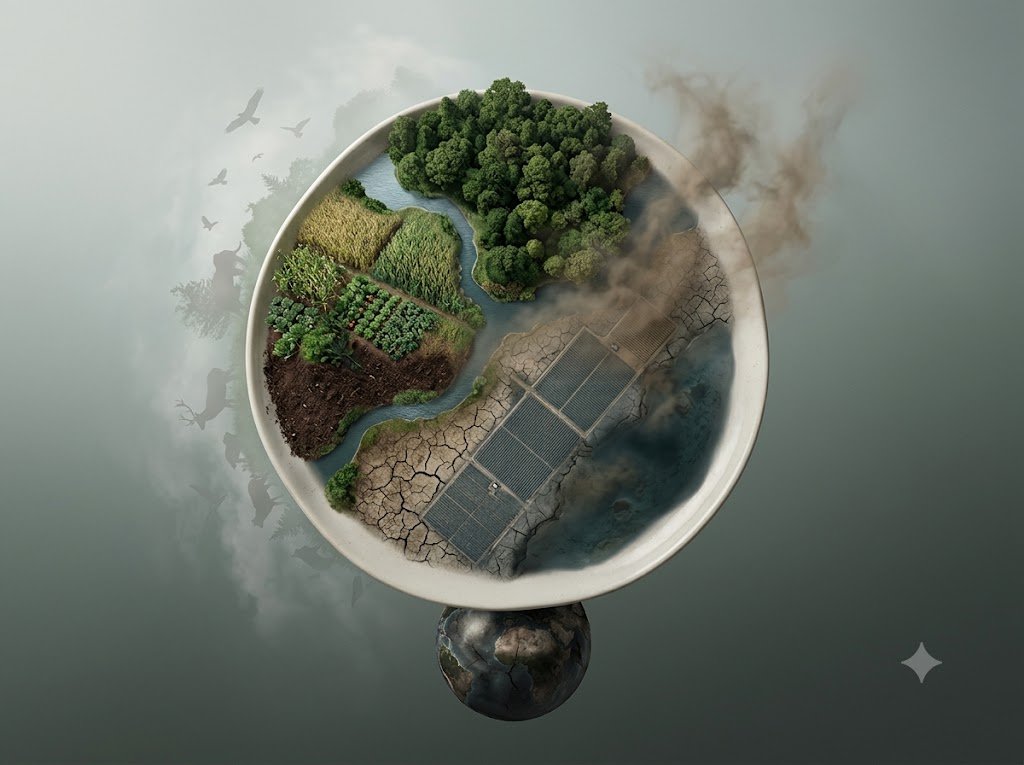
I watched Eating Our Way to Extinction expecting an argument about food. What I found was an argument about the relationship between human preference and planetary limits.
Directed by Otto Brockway and Ludovic Brockway, narrated by Kate Winslet, and featuring contributors including Sir Richard Branson, Tony Robbins and prominent environmental voices, the documentary follows the consequences of modern food production across forests, oceans, grasslands and human communities. Vision Films lists the documentary under its 2022 catalogue, although its initial theatrical release dates to 2021. Its central argument is direct: the way humanity produces and consumes food is contributing substantially to ecological destruction, and moving towards a plant-based diet is one of the most consequential responses available to us.
The film does not approach this argument with much hesitation. Its images are deliberately disturbing, its testimonies emotionally charged, and its conclusion unmistakable. The meal on an ordinary plate becomes connected to deforestation, atmospheric warming, collapsing ecosystems and the depletion of marine life.
That connection deserves attention.
But a documentary can be persuasive without every individual claim being equally precise. A correct statistic can support an exaggerated conclusion. A genuine environmental problem can be presented in a way that overlooks relevant qualifications. And a powerful proposed solution is not necessarily the only solution permitted by the evidence.
After examining the film’s principal claims against scientific literature and institutional data, I reached a conclusion that is both more favourable to its environmental argument and more cautious about its dietary prescription.
The documentary identifies a serious problem. Its proposed direction is supported by substantial evidence. Its strongest weakness is the occasional movement from a well-supported observation to a conclusion more absolute than the observation warrants.
I wanted to know precisely where that movement occurs.
1. The First Question: How Much of the Earth Do We Use to Produce Food?
The documentary’s argument becomes most convincing when it moves away from individual anecdotes and towards resource allocation.
Land is not an abstract number. It is habitat, stored carbon, soil, water retention, vegetation and the physical space within which ecological relationships operate. The problem is not simply that agriculture occupies land. Humanity requires agriculture. The relevant question is how efficiently that land produces food, and what other ecological functions are sacrificed in the process.
A frequently cited statistic states that livestock uses approximately 80% of agricultural land while supplying only around 18% of global calories and 37% of protein.
The underlying research is substantial.
Joseph Poore and Thomas Nemecek’s 2018 study, published in Science, consolidated environmental data covering approximately 38,700 farms and 1,600 processors, packaging types and retailers. Its analysis examined five environmental indicators and compared a wide range of food production systems. The researchers found considerable variation between producers, but also concluded that even relatively low-impact animal products generally had greater environmental impacts than their plant-based substitutes.
The land-use figures are therefore not merely an invention of environmental campaigning.
Our World in Data, drawing on this research, estimates that roughly four-fifths of agricultural land is associated with the production of meat and dairy when pastures and cropland used to produce animal feed are considered together. In a hypothetical global transition to a vegan diet, the estimated agricultural land requirement falls from approximately 4.1 billion hectares to 1 billion hectares—a reduction of about 75%.
The distinction between a measured present and a modelled alternative matters. The current land allocation is an estimate based on the available agricultural data. The four-fifths figure depends on how agricultural land and livestock production are classified. The projected reduction is a scenario, not an observation of a world that has already adopted such a diet.
Nevertheless, the broad result is difficult to dismiss.
Producing food through animals requires land not only for the animals themselves but also for their feed. The additional biological step requires energy, some of which animals use to sustain their own bodies rather than produce edible tissue or other products for human consumption.
The scale of that conversion differs by species and production system. Beef and lamb generally have particularly high land requirements, while poultry and some other animal products are more efficient. That distinction matters when comparing diets, but it does not erase the broader resource-efficiency advantage of many plant foods.
The film is right to make us examine these proportions.
There is, however, one important qualification.
What the headline statistic leaves out
Not every hectare used by livestock could be converted into a field of beans, rice or wheat.
A substantial proportion of grazing land is unsuitable for growing crops. Our World in Data notes that approximately two-thirds of pastureland is unsuitable for crop cultivation. The Food and Agriculture Organization also reports that around 86% of the dry matter in global livestock feed comes from resources that are not edible by humans, with grasses accounting for a significant share. Livestock can therefore convert some materials and landscapes that humans cannot directly use as food into milk, meat and other products.
This does not overturn the land-efficiency argument.
It does, however, prevent a careless interpretation of it.
The fact that a cow eats grass growing on land unsuitable for wheat does not make beef production environmentally cost-free. The animal still occupies land, produces methane and requires water and management. Nor does it follow that every grazing landscape would automatically become a forest if livestock disappeared.
Some grasslands are naturally open ecosystems. Some pastoral systems are adapted to local climates and ecological conditions. The consequences of changing their use would depend on the region.
The strongest conclusion is consequently narrower than the simplest version of the documentary’s message.
Humanity could produce much of its food with substantially less agricultural land if it reduced its dependence on animal products, especially beef and lamb.
That is already a powerful result. It does not need to be converted into the claim that every existing animal-based food system is equally inefficient, or that every pasture should become woodland.
Scientific arguments become stronger when their boundaries are visible.
2. The Amazon, Soy and the Meaning of Deforestation
The documentary also connects food demand to the destruction of forests, particularly in the Amazon.
The connection is real.
Forests are cleared to establish pastures, grow crops and support agricultural expansion. The precise drivers vary between regions, but commercial food production is a major contributor to tropical deforestation.
An analysis discussed by Our World in Data attributed approximately 41% of tropical deforestation during the period it examined to the expansion of pasture for beef production. The study identified the expansion of beef production in Latin America as particularly consequential. It also identified soy and palm oil among the important agricultural drivers of forest loss. These figures relate to specified historical periods, not an immutable percentage for every subsequent year.
The relationship between soy and livestock is frequently misunderstood.
Soy is often associated with tofu, soy milk and other foods consumed directly by humans. Yet only a small share of global soy production goes into products such as these. Our World in Data reports that approximately 77% of global soy is used for livestock feed, while direct human-food products account for around 7%. Much of the remainder is associated with soybean oil production and industrial uses.
This matters because an argument against plant-based eating sometimes begins by identifying soy as a cause of deforestation.
That argument leaves out a critical part of the supply chain.
A crop may be associated with meat production even when the people consuming the meat never see the crop itself. Soybean meal can enter the diet of livestock; the resulting animal product then enters a different market. The connection between the original land and the consumer is indirect, but it remains a connection.
Replacing some animal products with plant foods can reduce demand for agricultural land and the crops cultivated to support animal production.
However, the picture is not uniform. Not all soy comes from recently cleared land. Not every soy-producing region has the same deforestation risk. Other agricultural commodities, including palm oil, can be responsible for considerable forest loss. Land conversion also occurs for reasons outside food production.
Nor does a plant-based diet automatically have a small environmental footprint. The origin of ingredients, agricultural practices, processing, transport and waste still matter.
The correct inference is not that every plant-based product is harmless.
It is that demand for resource-intensive animal products contributes to a production system that places substantial pressure on forests, and that changing the composition of that demand can help reduce the pressure.
That distinction is particularly important for the Amazon. The documentary is justified in identifying cattle expansion as a major concern. Its argument becomes less useful only if the viewer concludes that every hectare of deforestation has one cause or that dietary change alone can prevent illegal clearing.
Land-use regulation, enforcement, supply-chain accountability and protection of remaining forests will still be necessary.
The consumer has influence. The consumer does not control the entire system.
3. Greenhouse Gas Emissions: Is Food Really Worse Than Transport?
One of the documentary’s most striking arguments is that the global food system contributes more to climate change than the transportation sector.
At first glance, this appears counterintuitive. Cars, trucks, aircraft and ships are highly visible sources of emissions. Food production is less visible once the food reaches the kitchen.
The comparison becomes understandable when the whole food system is considered.
The Intergovernmental Panel on Climate Change reported that food systems were responsible for approximately 21–37% of total human-caused greenhouse gas emissions in the assessments underpinning its work on land, food security and climate change. Meanwhile, the IPCC’s Sixth Assessment Report estimated that transport accounted for approximately 15% of global direct and indirect greenhouse gas emissions in 2019.
These figures support the proposition that food systems can have a larger climate footprint than transport as a sector.
But there is a methodological issue.
Food-system estimates include emissions from agriculture, land-use change and parts of the food supply chain. Transport-sector estimates include vehicles and other forms of transport serving numerous activities, including the movement of food. The categories therefore overlap, and their boundaries must be understood before comparing them.
The figures also come from different years and accounting frameworks. They should not be presented as though they were two perfectly separated quantities measured by one instrument at the same moment.
More recent data from the FAO reinforce the central point. Its assessment of global agrifood-system emissions found that these systems generated approximately 16.5 billion tonnes of carbon dioxide equivalent in 2023, or 32% of all anthropogenic greenhouse gas emissions. Livestock emissions were the largest individual component of agrifood-system emissions in that assessment.
The film’s comparison is therefore broadly defensible, but it requires a qualification that a memorable headline can easily obscure.
The more important finding is that food production represents a substantial climate-emissions source, large enough that climate mitigation cannot be treated as a problem of energy and transport alone.
We cannot electrify every vehicle, improve every building and decarbonise every power station while treating the food system as an afterthought.
The methane question
Methane receives considerable attention in the documentary, and rightly so.
Cattle and other ruminants produce methane through enteric fermentation, a biological process occurring during digestion. Methane also originates from manure management and from sources outside livestock farming, including fossil-fuel production, waste and certain agricultural activities.
Its atmospheric behaviour differs from that of carbon dioxide.
Over a twenty-year period, methane has approximately 80 times the warming potential of carbon dioxide when compared on the basis of equal emitted mass. Methane remains in the atmosphere for roughly a decade on average, whereas a substantial fraction of emitted carbon dioxide affects the climate over much longer timescales. The comparison changes with the time horizon used.
The phrase 80 times more potent is therefore meaningful, but incomplete when detached from its timeframe.
It does not mean that every kilogram of methane will have the same effect as precisely 80 kilograms of carbon dioxide under every possible climate-accounting method. Nor does it mean that carbon dioxide becomes unimportant because methane is more powerful in the short term.
The gases behave differently, and climate accounting must reflect those differences.
Methane nevertheless offers an important opportunity.
Because it is comparatively short-lived, reducing methane emissions can slow the rate of warming relatively quickly compared with continued emissions at existing levels. Livestock is a significant source of methane, particularly where cattle and other ruminants are involved.
The FAO’s livestock assessment found that cattle, including meat and milk production, accounted for approximately 62% of livestock-sector emissions in its analysis. Methane represented slightly more than half of the sector’s total emissions.
This supports the documentary’s emphasis on reducing the environmental burden of ruminant production.
But it does not establish that eliminating every animal product is the only way to reduce agricultural methane. Changes in production, herd management, feed, manure handling and demand can all contribute to mitigation, although their effectiveness varies.
The evidence supports urgent action. It does not support treating one proposed intervention as the entire climate strategy.
4. Water: The Numbers Need Context
The film also directs attention towards the water required to produce animal products.
Here, too, the broad argument has a substantial scientific basis.
A global assessment by Mesfin Mekonnen and Arjen Hoekstra found that animal products generally have larger water footprints than crop products. The reported average water footprint per calorie of beef was about twenty times that of cereals and starchy roots. The estimated footprint per gram of protein was also substantially higher for beef than for pulses. The results varied between animal species and production systems.
However, water-footprint statistics require special care.
A water footprint can include rainwater consumed by plants, water withdrawn from rivers and groundwater, and an estimate of the freshwater required to assimilate pollution. These quantities are not interchangeable in practical terms.
Rain falling on a pasture in a humid region is different from groundwater extracted from an aquifer already under severe pressure. Both may appear in a broad water-footprint calculation, but their consequences for people and ecosystems are not identical.
The location of production therefore matters.
A production system that uses mostly rainfall in a water-abundant area may pose a different water-security problem from one that depends on irrigation in a dry region. Conversely, agricultural pollution can threaten local water quality even where total water availability is relatively high.
The film’s concern about water use is justified. A single global number, however dramatic, is insufficient to describe every production system.
A useful environmental comparison must ask not only how much water is associated with a product, but where the water comes from, whether it is scarce, and what happens to the surrounding ecosystem.
This is a recurring theme in the documentary’s claims.
The large-scale direction of the evidence is often clear. Its precise local meaning requires more detail.
5. The Oceans: Dead Zones, Fishing and the Hidden Cost of Seafood
The documentary’s account of ocean degradation extends the argument beyond terrestrial agriculture.
One of the issues it raises is eutrophication: the excessive enrichment of water with nutrients, especially nitrogen and phosphorus. These nutrients can stimulate algal growth. When the algae die and decompose, microbial activity consumes dissolved oxygen, creating hypoxic conditions that can make parts of a water body unsuitable for many forms of marine life.
Such areas are commonly called dead zones.
NOAA has reported more than 400 coastal systems worldwide with dead zones. The problem is not limited to any single agricultural commodity. Nutrient pollution can originate from fertiliser use, livestock manure, sewage and other human activities. Ocean warming and physical conditions affecting water circulation can also influence oxygen levels and the severity of hypoxia.
The documentary is right to connect agricultural nutrient pollution with ocean health.
The qualification is that a dead zone cannot automatically be attributed to animal agriculture alone. Its causes must be examined within the relevant watershed and marine environment.
The broader relationship remains important. Agricultural systems that require substantial quantities of feed crops can contribute to the nutrient flows reaching rivers and coastal waters. Improving fertiliser efficiency, reducing nutrient losses and managing manure are therefore relevant to both agricultural productivity and marine conservation.
What about wild-caught fish?
Fishing presents a different set of problems.
Overexploitation, habitat disturbance, bycatch and lost fishing equipment can damage marine ecosystems. Some forms of fishing impose considerable pressure on particular species and habitats, while the effects of other practices vary by method, location and the condition of the fish stock.
The documentary draws attention to discarded fishing gear, particularly in relation to the Great Pacific Garbage Patch.
A widely cited scientific study published in Scientific Reports in 2018 estimated that fishing nets accounted for at least 46% of the plastic mass in the Great Pacific Garbage Patch. The study estimated that the accumulation zone contained at least 79,000 tonnes of plastic, while microplastics represented a much larger share of the estimated number of pieces than of the total mass.
These findings demonstrate that fishing gear is a serious component of ocean plastic pollution.
They do not, however, establish that fishing gear constitutes 46% of every form of marine plastic pollution everywhere in the Pacific. The study concerned a specific accumulation zone. Its conclusions should not be expanded beyond that scope.
That distinction matters because environmental documentaries sometimes move quickly between a local measurement and a global interpretation.
The local measurement can be valid while the broader statement becomes misleading.
Are fish farms simply another form of overfishing?
The documentary also questions aquaculture, particularly the use of wild-caught fish to produce feed for farmed fish.
This is a genuine concern in some production systems. Fishmeal and fish oil are important ingredients in certain aquaculture feeds, and they depend on marine resources. The FAO continues to monitor their production, trade and supply, which are affected by fishing conditions and environmental variability.
Yet aquaculture is not one uniform industry.
Feed requirements differ between species. Carnivorous farmed fish may depend more heavily on marine ingredients than species that can thrive on feeds containing substantial quantities of plant-derived ingredients. The composition of feeds also changes with technology, cost and environmental pressure.
The argument that every farmed fish consumes a fixed quantity of wild fish is therefore too broad.
Nor does the existence of feed challenges establish that all aquaculture is environmentally unsound. Different production systems have different impacts, and those impacts must be evaluated rather than inferred from the label farmed.
There is nevertheless a valid question beneath the documentary’s criticism: how much wild marine life must be removed to produce the fish we consume, and what other environmental costs accompany that process?
That question is worth asking before treating seafood as an automatically sustainable alternative to other animal products.
6. Biodiversity Loss: Is Agriculture Driving an Extinction Crisis?
The documentary presents food production as a major force behind declining biodiversity.
The scientific evidence supports this concern.
The Intergovernmental Science-Policy Platform on Biodiversity and Ecosystem Services, or IPBES, identified land- and sea-use change as the largest direct driver of negative impacts on nature in terrestrial and freshwater ecosystems since 1970. In marine ecosystems, direct exploitation of organisms, particularly fishing, has had the largest relative impact, followed by land- and sea-use change. Agricultural expansion is a major form of land-use change.
Its 2019 Global Assessment also warned that around one million animal and plant species were threatened with extinction, many within decades, unless the drivers of biodiversity loss were reduced.
These findings establish that the biodiversity crisis is not a rhetorical invention.
Habitats are being converted, ecosystems are being altered, wild populations are being exploited, and climate change is intensifying existing pressures.
Food production intersects with these problems in several ways. Land is cleared for agriculture. Habitats are fragmented by infrastructure. Nutrient pollution affects freshwater and coastal ecosystems. Fishing can remove organisms faster than populations recover. Climate change affects the distribution and survival of species.
Animal agriculture is an important part of this picture, particularly where grazing or feed production drives habitat conversion.
However, the statement that the entire food system is the single cause of extinction would go too far. Biodiversity loss has several interacting drivers, including pollution, invasive species, climate change and direct exploitation of wildlife. Their relative importance varies across ecosystems.
The documentary’s strongest argument is not that every extinction can be traced to a dinner plate.
It is that food demand is deeply embedded in some of the most consequential human pressures on nature.
That is a significant claim. It is also the more defensible one.
The meaning of the sixth mass extinction
The term sixth mass extinction is often used to describe the current biodiversity crisis. It conveys the extraordinary scale and speed of contemporary losses, and it appears in scientific and public discussions of biodiversity decline.
Nevertheless, the term should not be mistaken for a claim that every species is disappearing at the same rate or that all scientific uncertainty has been eliminated.
The IPBES findings establish an accelerating biodiversity crisis and widespread threats to species. They also identify the activities and underlying social drivers contributing to it. The exact trajectory of individual species and ecosystems remains dependent on future conditions and human decisions.
The documentary uses its ecological evidence to argue that the current food system is incompatible with long-term planetary stability.
The broad concern is justified.
The more precise scientific conclusion is that reducing destructive land conversion, overexploitation, pollution and greenhouse gas emissions is essential to protecting biodiversity—and that changes in food production and consumption can make an important contribution.
The distinction is not a retreat from urgency. It is a way of identifying the actual causes that must be addressed.
7. The Carbon Opportunity Cost of Animal Agriculture
One of the more consequential ideas associated with the documentary’s argument is that reducing animal agriculture does not merely avoid emissions. It could also release land for ecological restoration.
This deserves separate consideration.
Matthew Hayek and his colleagues examined the carbon opportunity cost of using land to produce animal-sourced foods. Their research, published in Nature Sustainability, investigated the potential for ecosystem restoration if global food production shifted towards plant-based diets.
Under their modelled scenarios, shifting food production towards plant-based diets by 2050 could allow enough carbon sequestration to remove approximately 332–547 billion tonnes of carbon dioxide. The authors compared this potential with the remaining carbon budget associated with limiting warming to 1.5°C with a specified probability.
The important word is potential.
The estimate is not a promise that these quantities of carbon dioxide will be removed automatically as soon as dietary habits change. It depends on changes in agricultural land use, the availability of land for restoration, ecological recovery and the assumptions underlying the model.
Nor should the result be interpreted as a reason to abandon the direct reduction of fossil-fuel emissions. Restoring ecosystems and reducing emissions are complementary tasks, not substitutes.
The underlying concept is nevertheless important.
Land occupied by a particular form of production carries an opportunity cost. If some of that land can meet human needs in another way, society must consider what ecological functions might be recovered by changing its use.
The potential benefits include carbon storage, habitat restoration and improved ecological connectivity.
This is one reason the environmental implications of dietary change extend beyond the emissions associated with the food itself.
A different food system could change not only what humanity produces, but also how much land production requires.
8. Can Regenerative Grazing Solve the Problem?
A serious analysis must consider the counterargument that better-managed livestock production could produce environmental benefits rather than simply reduce environmental damage.
Regenerative grazing and related approaches aim to improve pasture management, soil health, vegetation and ecological function. Some well-managed systems can increase soil carbon under appropriate conditions.
It would be inaccurate to dismiss these approaches simply because they involve livestock.
The more difficult question is whether soil carbon sequestration can offset the continuing greenhouse gas emissions of the global ruminant sector at the scale required.
A 2023 study published in Nature Communications examined the possibility of relying on grassland soil carbon sequestration to offset emissions from ruminant production. It concluded that the scale of sequestration required to offset the sector’s continuing methane and nitrous oxide emissions would exceed what could feasibly be supplied by increasing soil carbon stocks in managed grasslands alone. The analysis also emphasised that soil carbon sequestration is time-limited rather than an indefinitely expanding sink.
This does not mean that regenerative grazing has no value.
It means that its value should be assessed according to what it can realistically accomplish.
The FAO has identified agroforestry and improved grazing management among potential mitigation measures for livestock production. Its assessment also stresses that emission intensities vary substantially across species, countries and production systems. Different interventions will therefore have different results in different circumstances.
The distinction is between improving a production system and proving that the improved system can sustainably supply the entire world’s current or future demand.
Those are separate questions.
Even a beneficial intervention can be insufficient at global scale. Even a lower-impact production system still has a resource footprint. And even successful soil-carbon sequestration does not eliminate the need to address methane emissions.
The evidence does not require us to choose between dismissing regenerative practices and treating them as a complete solution.
It requires us to distinguish their potential contributions from the limits of what they can achieve.
9. The Most Difficult Question: Must Everyone Become Vegan?
This is where the documentary moves from its environmental diagnosis to its principal prescription.
The film argues for a substantial transition towards plant-based eating. Its message is often understood as a demand for the complete elimination of animal products.
Does the evidence establish that a global 100% plant-based diet is the only mathematically possible way to feed humanity without environmental collapse?
I do not think it does.
The evidence supports a more carefully defined conclusion.
A shift towards plant-based diets can substantially reduce agricultural land requirements and environmental pressures, particularly when it replaces resource-intensive animal products. The research discussed earlier provides compelling reasons to reduce excessive consumption of beef and lamb and to examine the environmental costs of animal production more broadly.
But proving that a plant-based diet is generally more land-efficient is not the same as proving that every animal product must disappear from the global food system.
The distinction becomes important when we consider the actual diversity of human agriculture.
Livestock can use grasslands that are unsuitable for crop cultivation. Some animals consume agricultural by-products and crop residues that would otherwise have limited direct food value. Animal-source foods can provide highly bioavailable nutrients. Some communities rely on animals for livelihoods, food security and established pastoral systems.
None of these observations negates the large environmental burden associated with present patterns of animal production. They do, however, demonstrate why a universal dietary prescription must account for more than the global average land-use statistic.
The World Health Organization and FAO’s guiding principles for sustainable healthy diets explicitly recognise environmental impact alongside nutritional adequacy, economic accessibility and social and cultural acceptability. Their framework does not define a single dietary pattern as universally suitable for every country and population.
A diet must function in the world where it is adopted.
That means accounting for nutritional requirements, food availability, affordability, local crops, regional practices and the consequences for the people whose livelihoods depend on the existing food system.
A substantial reduction in animal-product consumption may be especially consequential in populations where consumption is high and the environmental burden is correspondingly large.
In other settings, the most appropriate transition may look different.
The science supports moving towards more sustainable patterns of consumption. It does not, by itself, establish that a worldwide prohibition on animal foods is the only route to environmental stability.
The food-security question
A related claim is that the world could feed a population of approximately ten billion more easily under a plant-based food system.
The resource-efficiency argument offers strong support for this proposition.
A large proportion of agricultural land is associated with animal production, including the production of feed. Reducing the demand for that feed and redirecting suitable land to other purposes can improve the efficiency with which the global food system uses resources.
Yet the ability to feed a future population depends on several other variables.
Food must be produced reliably, distributed effectively and made economically accessible. Crop yields, climate change, soil degradation, food waste, conflicts, trade and the distribution of purchasing power all affect food security.
The fact that enough food could be produced in aggregate does not guarantee that everyone will obtain it.
Nor should the world’s present food insecurity be attributed exclusively to insufficient agricultural production or animal agriculture. Distribution and access remain fundamental.
A plant-rich food system could improve the resource efficiency of production. It would not automatically resolve the institutional and economic conditions that prevent people from obtaining adequate food.
The conclusion should therefore be proportionate: dietary change can make global food production more land-efficient and improve the possibilities for feeding a growing population, but food security requires wider changes in the food system.
10. Nutrition: What Would a Fully Plant-Based Diet Require?
The documentary’s environmental message should not be confused with a complete nutritional guide.
A well-planned plant-based diet can provide adequate nutrition, but that outcome depends on its composition.
Eating more plant foods is not equivalent to eating exclusively plant foods. A diet centred on vegetables, fruits, pulses, whole grains, nuts and seeds has a different nutritional profile from a diet dominated by refined carbohydrates and highly processed products that happen to contain no animal ingredients.
The distinction between a food’s origin and its nutritional quality matters.
A fully plant-based diet also requires particular attention to nutrients that may not be reliably available from unfortified plant foods.
Vitamin B12 is the clearest example. The US National Institutes of Health’s Office of Dietary Supplements explains that vitamin B12 is not naturally present in plant foods, although fortified foods and supplements can provide it. People following a vegan diet therefore need a reliable source of this vitamin.
Other nutritional considerations include iron, zinc, calcium, iodine, vitamin D and omega-3 fatty acids. Their importance depends on the person’s diet, nutritional status, life stage and individual requirements. Plant-based eating does not automatically lead to deficiencies, but neither does the absence of animal products automatically guarantee nutritional adequacy.
The practical lesson is straightforward.
A fully plant-based diet should be designed rather than improvised. It requires adequate variety, sufficient energy and protein, suitable sources of essential nutrients, and reliable vitamin B12 intake.
Where necessary, fortified foods, supplementation and qualified nutritional advice can help support adequacy.
This is not an argument against a vegan diet. It is a recognition that dietary choices have nutritional consequences which must be addressed alongside their environmental benefits.
The same general principle applies to every dietary pattern: a diet should be evaluated by what it provides, not merely by the category into which it falls.
11. What About the Documentary’s Warnings About Fish and Human Health?
The documentary also uses personal testimony and discussions of contamination to question the safety of seafood.
The underlying issue is legitimate. Fish can contain methylmercury and other environmental contaminants. Methylmercury exposure can harm the brain and nervous system, particularly during development. Concentrations vary among species and are often higher in larger, longer-lived predatory fish.
However, the presence of a contaminant does not establish that all fish are unsafe.
The US Food and Drug Administration and the Environmental Protection Agency advise consumers to choose fish according to species-specific mercury guidance. Their recommendations identify lower-mercury options while advising people to avoid certain fish with particularly high mercury levels. They also recognise that fish provide protein, omega-3 fatty acids and other important nutrients.
This is a useful example of the difference between a genuine hazard and a generalised conclusion.
An individual’s testimony about a possible exposure can be worth hearing. It cannot, on its own, establish the health consequences of eating an entire food category. Establishing causation requires evidence appropriate to the medical question, and assessing risk requires attention to dose, frequency, species and exposure.
The documentary’s environmental critique of fishing does not need a sweeping claim about all seafood being unsafe to remain valid.
Overfishing, habitat damage, discarded gear and the ecological costs of some aquaculture systems can be investigated directly.
Where the film turns those problems into a general warning about the safety of fish consumption, more qualification is necessary.
The environmental argument is stronger when it does not borrow certainty from a separate medical question.
12. What the Documentary Gets Right—and Where It Overreaches
After examining the main claims, I would divide the documentary’s argument into three categories.
The first contains claims that are strongly supported by the scientific evidence.
Animal agriculture, particularly the production of beef and lamb, has substantial environmental costs. Livestock production uses large areas of agricultural land, contributes to greenhouse gas emissions, and can be associated with deforestation, nutrient pollution and biodiversity loss. Shifting towards plant-based foods can reduce many of these pressures. The underlying research is substantial, and the broad direction of the findings is consistent across several major scientific assessments.
The second category contains claims that are broadly correct but depend on context.
These include comparisons between food-system and transport emissions, statements about the proportion of ocean plastic originating from fishing gear, and assessments of the environmental benefits of grazing management. The evidence supports substantial concerns in each case, but the conclusions depend on definitions, geographical boundaries, production systems and the timescale being considered.
The third category contains conclusions that exceed what the evidence alone can establish.
The proposition that a global 100% plant-based diet is the only mathematically possible route to feeding humanity is stronger than the land-use research warrants. The idea that improved livestock management can compensate for the entire environmental burden of animal agriculture is also unsupported. Both conclusions simplify a system in which trade-offs, geographical differences and multiple interventions matter.
These distinctions are particularly important because the documentary uses the urgency of ecological decline to support a specific behavioural prescription.
The urgency may be justified even where a proposed solution is not the only possible one.
A critical review of the documentary published in the Animal Studies Journal in 2023 raised a further objection: although the film confronts the environmental consequences of animal agriculture, it places considerable emphasis on individual consumer decisions and does not fully develop the wider social and political transformation its own argument implies. The reviewer also questioned how the film incorporated Indigenous perspectives into its message.
I find that criticism worth considering.
A food system is shaped by consumers, but also by agricultural subsidies, trade, land ownership, regulation, infrastructure, corporate decisions and the material circumstances of farmers and communities.
It is not enough to tell people that their choices matter. We must also examine the conditions under which those choices are made available and affordable.
A person cannot purchase food that is unavailable locally. A farmer cannot always change production without financial support. A community whose food security depends on existing agricultural systems cannot be expected to absorb a transition without assistance.
This does not make individual choices irrelevant. It makes them one part of a larger process.
The documentary is most convincing when it reveals the environmental consequences hidden behind ordinary consumption. It becomes less complete when the viewer is left with the impression that individual dietary decisions can substitute for the institutional changes required to reshape food production.
The problem is systemic. The response must be capable of operating at that scale.
13. Is a Plant-Based Diet a Silver Bullet?
The metaphor is tempting because the problem is large and the proposed action is tangible.
A person cannot personally redesign global agriculture, regulate an international commodity market or restore an entire forest. Changing a meal is an accessible action. Its accessibility makes it valuable, but also makes it easy to mistake for a complete solution.
The evidence does not support that mistake.
A shift towards plant-based eating can reduce the environmental burden of food production. It can reduce demand for land-intensive animal products, lower many diet-related greenhouse gas emissions and create opportunities for ecological restoration. These are meaningful contributions.
But food systems are not the only source of greenhouse gas emissions. Agricultural production itself must become more efficient and less destructive. Forests must be protected. Fishing must be managed sustainably. Nutrient pollution must be reduced. Food waste must be addressed. Farmers need viable alternatives where production systems must change.
Research into alternative proteins and new production technologies may also contribute to the transition. Their environmental value will depend on actual production methods, energy sources, resource requirements and the scale at which they can be adopted.
A completely plant-based diet can be one route towards reducing the environmental burden of consumption. The evidence does not establish that every other diet or production system is necessarily incompatible with a sustainable future.
The more important distinction is between a food system that continually intensifies its resource demands and one that learns to operate within ecological limits.
Plant-based eating is relevant because it can help move the system towards the latter.
It should not become an excuse to overlook the other changes that remain necessary.
14. My Verdict: A Strong Environmental Argument, but an Absolute Prescription
I began this investigation with a simple question: how truthful is Eating Our Way to Extinction?
My conclusion is that the documentary is broadly credible in its central environmental diagnosis. Its concerns about land use, climate emissions, deforestation, biodiversity and marine ecosystems are supported by substantial evidence. The importance of reducing the environmental burden of animal agriculture is not dependent on accepting every statement made in the film.
Its strongest claims survive scrutiny.
The principal qualification concerns the relationship between those findings and its proposed universal solution.
The evidence strongly supports reducing high-impact animal-product consumption, particularly where present consumption levels are high. It supports more plant-rich diets, more efficient resource use and the restoration of land where ecological conditions make restoration appropriate.
It does not prove that a global 100% plant-based diet is the only possible way to sustain a large human population, nor does it demonstrate that dietary change by itself can prevent ecological collapse.
Those are different propositions.
I would therefore describe the documentary as substantially accurate in its central environmental argument, but more categorical than the evidence warrants when its message is interpreted as a universal dietary requirement.
That judgment does not diminish its value. It clarifies it.
The most important insight is not that one ingredient must become morally forbidden. It is that food has an environmental cost that is often hidden by the distance between production and consumption.
A plate can conceal a pasture, a forest, a river, a supply chain and an atmosphere. The act of eating appears individual, while the consequences accumulate across systems.
The challenge is to make those connections visible without replacing one oversimplification with another.
Humanity does not need a single universal prescription to recognise that its present patterns of production and consumption are exerting substantial pressure on the planet. It needs reliable evidence, clear priorities, practical alternatives and the political capacity to change the systems responsible for that pressure.
A reduction in resource-intensive animal agriculture is one such priority. A transition towards more plant-rich diets is one practical route. Better agricultural management, ecosystem protection and fair support for affected communities remain necessary alongside it.
The case for changing what we eat is strong.
The case for treating that change as the only intervention that matters is not.
After researching the documentary, I no longer regard the central question as whether every person must reach precisely the same dietary conclusion. The more useful question is whether our food systems can meet human needs while consuming less land, placing less pressure on ecosystems and producing fewer emissions.
The evidence suggests that substantial change is possible.
Whether we choose to pursue it is a different question.
And that question cannot be answered by the data alone.