Gamma does not believe in coincidence.
That is the first thing you must understand.
People do. People wrap coincidence in soft words—chance, fate, accident—as though naming a thing dulls its edges. But Gamma has watched too many patterns stitch themselves into existence, too many lies pretend to be random, too many truths rot quietly beneath polite narratives.
And tonight, a butterfly is dead.
That is where this begins.
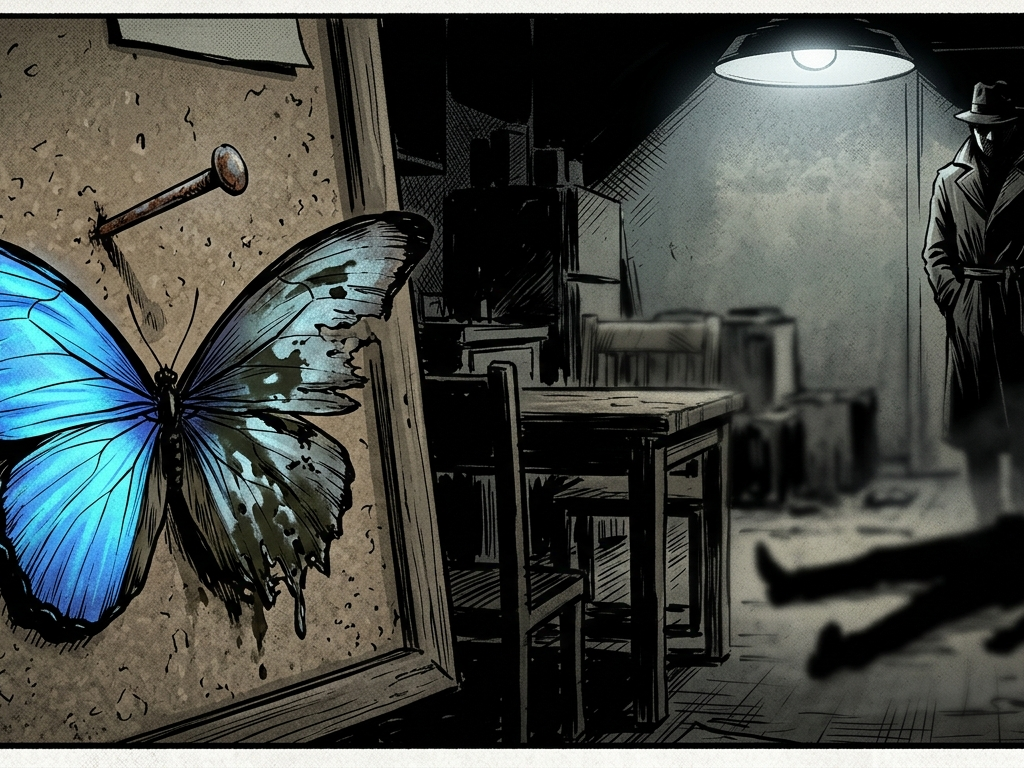
It was found pinned to the corkboard in Room 312 of Aurelian Heights—an apartment building that wore its wealth like a pressed suit and its secrets like unwashed skin.
The butterfly was not part of any collection.
That was the first anomaly.
It had not been mounted with care. No preservation frame. No label. Just a rusted pin, driven through its thorax, wings spread in a crude imitation of symmetry. One wing intact—blue, iridescent, impossibly delicate. The other… damaged. Torn. Smudged with something darker than dust.
Blood, perhaps.
But not the butterfly’s.
Butterflies do not bleed like that.
Humans do.
Gamma arrived late.
Not because he was summoned—he rarely is—but because curiosity has its own gravitational pull, and whispers travel faster than truth in buildings like these.
Three floors up, past a concierge who pretended not to notice him, through a corridor that smelled faintly of jasmine and expensive lies.
Room 312.
Door ajar.
Inside: silence performing innocence.
And one body.
Mr. Sigma Wayfarer lay on the floor, half-turned, as though death had interrupted him mid-thought. His eyes were open, staring not at the ceiling, not at the world—but at nothing. A clean puncture wound rested just beneath his collarbone.
Precise.
Efficient.
Personal.
No signs of struggle. No overturned furniture. No broken glass.
The room was pristine in the way curated spaces often are—nothing out of place, because everything is already displaced from truth.
Except the butterfly.
Pinned to the board above his writing desk.
Watching.
Gamma did not touch the body.
He is not interested in the corpse.
He is interested in the story the corpse interrupts.
There is always a story. And every story leaves fingerprints.
“Police have been informed.”
The voice came from the doorway.
A woman. Mid-thirties. Composed, but not calm. There is a difference.
Gamma did not turn immediately. He prefers voices unaccompanied by faces—it allows the lie to breathe before it is dressed.
“Of course they have,” he said. “People like to outsource their thinking.”
A pause.
Then, sharper: “Who are you?”
Now he turned.
She was elegant. Not extravagantly so—no loud jewelry, no garish colors. Just precision. Every detail measured.
Control, embodied.
“Someone who noticed the butterfly,” Gamma replied.
Her eyes flickered, just for a moment.
Ah.
There it is.
Her name was Delta Wayfarer.
Wife of the deceased.
Of course.
“Do you collect insects?” Gamma asked, almost casually.
“No.”
“Did your husband?”
“No.”
“Then why is there a butterfly pinned to your wall like a confession?”
Her jaw tightened.
“I don’t know.”
Gamma smiled, but not kindly.
“Everyone always says that. It’s a very democratic lie.”
She stepped further into the room.
“Look,” she said, her tone shifting—firmer now, controlled irritation replacing initial uncertainty. “I don’t know who you are, but you shouldn’t be here. The police will—”
“The police,” Gamma interrupted gently, “will look for fingerprints, forced entry, motives with neat edges. They will catalog. They will conclude. They will be wrong.”
“And you won’t be?”
“I rarely am.”
This was not arrogance.
It was inventory.
Gamma moved closer to the corkboard.
The butterfly’s wings shimmered faintly under the room’s light.
Blue.
Too blue.
Artificially perfect.
Except for the tear.
That tear mattered.
“Do you see it?” he asked.
“See what?”
“The asymmetry.”
“It’s a damaged insect. That’s all.”
“No,” Gamma said softly. “It’s a message pretending to be a mistake.”
He leaned closer.
The torn wing had been smeared—not randomly, but deliberately. A thin arc of darkened residue, tracing the edge where the wing had fractured.
Not blood.
Something thicker.
Something… oily.
Gamma inhaled.
Gun oil.
He stepped back.
“Your husband owned a firearm,” he said.
Delta hesitated.
“Many people do.”
“That wasn’t an answer.”
“It’s not illegal.”
“Neither is lying,” Gamma replied. “It’s just inefficient.”
Before she could respond, another voice entered.
Male. Older. Irritated.
“Who let this man in?”
Gamma did not need to turn.
Authority announces itself long before it arrives.
Inspector Theta Thunburg.
Predictable.
“I did not invite him,” Delta said quickly.
“I invited myself,” Gamma corrected.
Theta’s eyes narrowed.
“And you are?”
“Observant.”
“That’s not a profession.”
“It’s a discipline.”
The inspector stepped forward, glancing briefly at the body, then at the butterfly.
“Don’t touch anything,” he said.
“I already haven’t,” Gamma replied.
“Then stay out of the way.”
Gamma tilted his head.
“That depends on where the way leads.”
Theta ignored him.
Good.
Dismissal is a kind of blindness.
And blindness is useful.
“Preliminary observation,” Theta said, crouching near the body. “Single puncture wound. Likely a narrow blade. No signs of forced entry. Victim knew the attacker.”
He stood.
“Robbery doesn’t seem likely. Nothing missing.”
Gamma almost laughed.
Almost.
“Inspector,” Gamma said, “do you like butterflies?”
Theta frowned.
“What kind of question is that?”
“A relevant one.”
“No, I don’t. And neither should you, given the situation.”
“Pity,” Gamma murmured. “They’re excellent liars.”
Theta turned sharply.
“Enough. Either you identify yourself properly, or you leave.”
Gamma considered this.
Then he said, “The butterfly was placed after the murder.”
Theta paused.
Just a fraction.
But enough.
“Explain,” the inspector said.
Ah.
Curiosity.
Even the disciplined are not immune.
“The room is too clean,” Gamma began. “No struggle. No displacement. The killer was precise. Efficient. Controlled.”
Theta nodded slightly.
“Yes.”
“But the butterfly?” Gamma gestured. “It’s crude. Messy. Symbolic. It doesn’t belong to the same behavioral pattern.”
“So?”
“So it’s not part of the act. It’s part of the message.”
“To whom?”
Gamma smiled.
“That,” he said, “is the only interesting question.”
Silence settled.
Thicker now.
Delta spoke.
“Are you suggesting someone staged this?”
“I’m suggesting,” Gamma replied, “that someone wanted to be seen… but only by the right eyes.”
“And you think those are yours?”
“No,” he said. “I think they’re yours.”
The room shifted.
Not physically.
But perceptually.
Like a painting that reveals a second image once you know where to look.
Delta laughed.
Too quickly.
“That’s absurd.”
“Is it?” Gamma asked. “You noticed the butterfly before anyone else did, didn’t you?”
She froze.
Theta’s gaze snapped to her.
“Is that true?”
“I—of course I did. It’s right there.”
“No,” Gamma said softly. “Not ‘it’s right there.’ You saw it first. Before the body, even.”
“That’s ridiculous.”
“Is it?” Gamma stepped closer. “When you entered the room, your eyes went there first. Not to your husband. Not to the floor. To the wall.”
“How could you possibly—”
“Because,” Gamma said, “grief looks for people. Guilt looks for symbols.”
The silence this time was absolute.
Theta’s voice was lower now.
“Mrs. Wayfarer…”
“I didn’t kill him,” she said immediately.
Too immediately.
Gamma tilted his head.
“I believe you.”
Both of them looked at him.
Surprised.
“But you know who did,” he added.
The butterfly watched.
“Let’s simplify,” Gamma continued. “Your husband owned a gun. Recently used. Recently cleaned.”
Theta’s brow furrowed.
“How do you know that?”
“The residue on the wing,” Gamma said. “Gun oil. Fresh. Transferred deliberately.”
Theta looked at the butterfly again.
Closer this time.
“And the tear?” the inspector asked.
Gamma’s smile was thin.
“The tear,” he said, “is the signature.”
He turned back to Delta.
“Who did he kill?”
Her composure cracked.
Not dramatically.
Just enough.
A fracture, like the wing.
“I don’t—”
“Don’t waste it,” Gamma said quietly. “Truth is expensive. Spend it wisely.”
Tears gathered in her eyes.
Not for her husband.
Gamma noticed.
“It was an accident,” she whispered.
There it is.
“Accidents,” Gamma said, “are just intentions that didn’t plan far enough.”
Inspector Theta stepped forward.
“What is she talking about?”
Delta closed her eyes.
“He… he shot someone.”
The words landed like stones.
“Who?” Theta demanded.
“A girl,” she said. “A few weeks ago. He said it was self-defense. That she tried to break in. But… but there was no report. No investigation. Nothing.”
Gamma nodded slowly.
“Of course not.”
“Why not?” Theta asked.
“Because,” Gamma replied, “power edits reality.”
Delta continued.
“I wanted to go to the police. I told him we should. But he said… he said it would ruin everything. That no one would believe me. That he had… influence.”
Theta’s jaw tightened.
“And the butterfly?” Gamma prompted.
Delta looked at it.
Really looked, this time.
“I found it this morning,” she said. “Pinned like that. I thought… I thought it was just some sick joke.”
“From whom?”
“I don’t know.”
Gamma’s eyes sharpened.
“Think.”
She hesitated.
Then—
“There was someone,” she said. “A man. He came to the building a few days ago. Asked about Sigma. The concierge mentioned it.”
Theta pulled out his phone.
“I’ll have security footage checked.”
Gamma nodded.
“Do that.”
He turned back to the butterfly.
Blue.
Torn.
Oiled.
“A girl,” he murmured. “Killed quietly. Erased neatly. But someone remembered.”
He looked at Delta.
“Did she have family?”
“I… I don’t know.”
“Friends?”
“I don’t know.”
“Anyone who would care enough to send a message?”
Delta shook her head.
“I don’t know.”
Gamma sighed.
“People never know,” he said. “Until they do.”
Theta’s phone buzzed.
He answered, listened, then hung up.
“We have a match,” he said. “The man on the footage. He’s been identified.”
“Name?” Gamma asked.
Theta hesitated.
“Lambda Sconlini.”
Gamma’s eyes flickered.
Recognition.
“Ah,” he said softly. “Of course.”
“Who is he?” Theta demanded.
Gamma’s smile returned.
Cold.
Precise.
“Someone who doesn’t believe in coincidence.”
The room seemed smaller now.
Tighter.
“Where is he?” Gamma asked.
“We’re tracking him,” Theta replied. “Shouldn’t take long.”
Gamma nodded.
“It already has.”
They found him two hours later.
On the rooftop.
Waiting.
Lambda Sconlini was younger than expected.
Mid-twenties.
Thin. Angular. Eyes that did not blink enough.
He stood near the edge, looking out over the city—not in awe, but in assessment.
“You took your time,” he said without turning.
Theta stepped forward.
“Mr. Lambda Sconlini?”
“Yes.”
“You’re under arrest for the murder of Mr. Sigma Wayfarer.”
A pause.
Then—
“No,” Lambda said. “I’m not.”
Theta stiffened.
“You confessed?”
“I acknowledged.”
“That’s the same thing.”
“No,” Lambda said calmly. “It isn’t.”
Gamma stepped beside Theta.
“Tell me,” he said, “why the butterfly?”
Lambda turned.
His gaze landed on Gamma.
And something like recognition passed between them.
“You saw it,” Lambda said.
“Yes.”
“Good.”
Theta interjected.
“This isn’t a conversation. You’re coming with us.”
Lambda ignored him.
“Do you know what butterflies mean?” he asked Gamma.
“Transformation,” Gamma replied. “Metamorphosis. Lies wrapped in poetry.”
Lambda smiled faintly.
“Close.”
He reached into his pocket.
Theta tensed.
“Don’t move—”
“It’s not a weapon,” Lambda said, pulling out a small notebook.
He flipped it open.
Inside: sketches.
Butterflies.
Dozens of them.
Each one slightly different.
Each one… damaged.
“My sister,” Lambda said quietly. “She used to draw these.”
Gamma said nothing.
“She said butterflies weren’t beautiful because they were perfect,” Lambda continued. “She said they were beautiful because they survived becoming something else.”
Theta’s voice was sharper now.
“What does that have to do with anything?”
Lambda looked at him.
Everything.
“He killed her,” Lambda said simply.
Silence.
“She went to his apartment,” Lambda continued. “Not to steal. Not to harm. To confront. She knew something about him. Something illegal. She thought she could scare him into confessing.”
He laughed once.
Dry.
“Naive.”
Gamma’s eyes did not leave him.
“He shot her,” Lambda said. “Called it self-defense. Then erased her. Like she never existed.”
Theta’s grip tightened.
“So I made sure he didn’t get to forget,” Lambda said.
“The butterfly,” Gamma said.
Lambda nodded.
“She used to leave drawings everywhere. On walls. On notebooks. On anything she could find. Always butterflies.”
“And the tear?” Gamma asked.
Lambda’s expression hardened.
“That,” he said, “is what he did to her.”
“And the oil?”
Lambda’s smile returned.
Cold.
“He cleaned the gun after he killed her. Carefully. Methodically. I wanted him to see that. To remember.”
Theta stepped forward.
“This ends now. Put your hands behind your—”
“Does it?” Lambda interrupted.
He looked at Gamma.
“Does it end?”
Gamma considered.
Then he said, “Nothing ends. It just changes shape.”
Lambda nodded.
“Exactly.”
He took a step back.
Closer to the edge.
Inspector Theta moved.
“Stop!”
Lambda raised a hand.
“Don’t,” he said. “You’ve already missed the point.”
Gamma watched.
He does not intervene in inevitabilities.
“I didn’t kill him out of anger,” Lambda said. “Not really. I killed him because someone had to balance the equation.”
“Justice isn’t yours to decide,” Theta snapped.
Lambda smiled.
“Neither is truth,” he said. “But here we are.”
He looked at Gamma one last time.
“You understand,” he said.
Gamma did not answer.
He did not need to.
Lambda stepped back.
And disappeared.
Three floors below, the city continued.
Indifferent.
Later, when the statements were written, when the reports were filed, when the narrative was sanitized into something digestible—
Gamma returned to Room 312.
The butterfly was gone.
Taken as evidence.
Catalogued.
Reduced.
But Gamma remembered.
He always does.
He stood where it had been.
Imagining it.
Blue.
Broken.
Honest.
“Justice,” he murmured, “is just another story we tell ourselves to sleep at night.”
Gamma turned to leave.
Then paused.
On the desk, barely visible, was a faint mark.
Graphite.
A sketch.
Half-erased.
A butterfly.
Perfectly intact.
Gamma smiled.
Not kindly.
Not cruelly.
Just… knowingly.
The dead butterfly had never been the message.
It had been the question.
And the answer—
As always—
Was still unfolding.