There exists a quiet but provocative idea that occasionally surfaces in thoughtful conversations: If one understands science deeply enough, the need for God slowly dissolves.
It is not necessarily an attack on faith, nor a dismissal of human spirituality. Rather, it is an observation about how knowledge reshapes the landscape of belief. When the mechanisms of nature become visible, the mysterious spaces where divine explanations once lived begin to shrink.
The statement sounds bold, perhaps even irreverent to some ears. Yet it invites a fascinating inquiry. If science provides coherent explanations for the workings of the universe, what role remains for God? And more importantly, why did humans create gods and religions in the first place?
To explore this idea properly, one must examine it through several lenses: history, psychology, philosophy, and the evolution of knowledge itself.
What emerges is not a simple rejection of religion, but a deeper understanding of why it arose and why science gradually changes our relationship with it.
The Ancient Human Need for Explanations
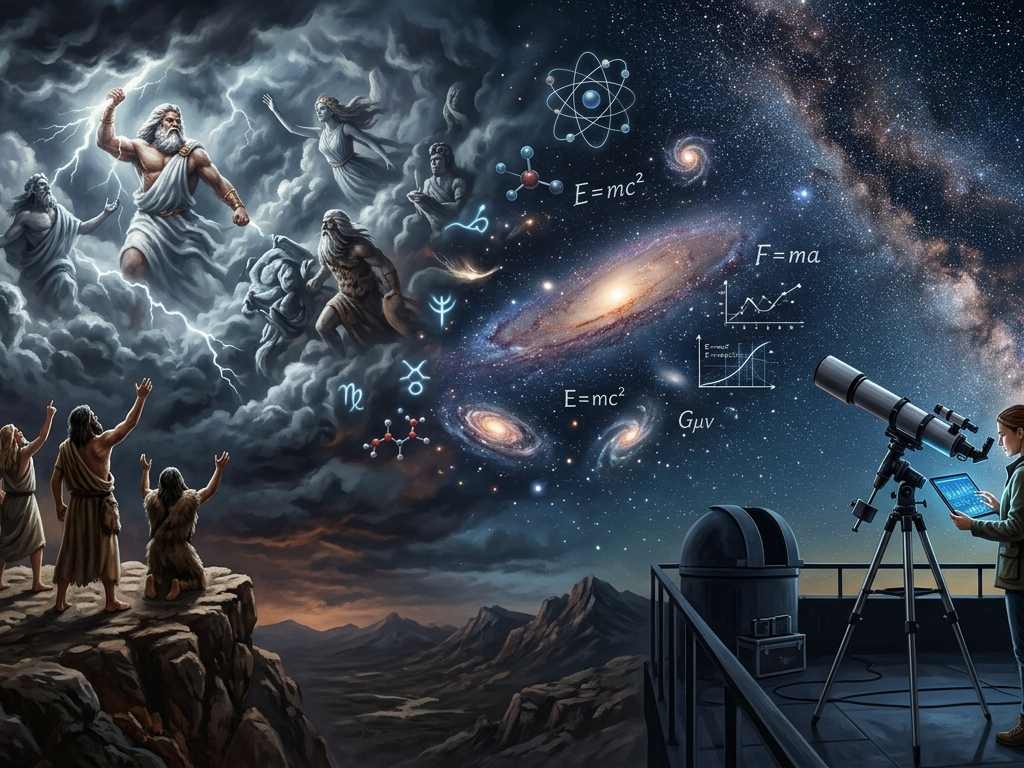
Imagine the earliest humans standing beneath a violent storm.
Lightning tears the sky apart. Thunder shakes the earth like the roar of an unseen beast. Crops fail after a drought. A loved one dies suddenly from an invisible illness. The sun disappears during an eclipse.
For early humans, the world was not merely mysterious; it was overwhelming.
Without systematic knowledge of atmospheric physics, microbiology, or celestial mechanics, these events demanded interpretation. The human brain is wired to search for causes. When the mind cannot find a natural mechanism, it invents intention.
Thus lightning becomes the weapon of an angry god.
Disease becomes punishment from unseen spirits.
The sun and moon become celestial beings locked in cosmic drama.
Religion, in this sense, was one of humanity’s earliest explanatory frameworks.
It was not necessarily fabricated in a cynical or manipulative way. Rather, it evolved organically from storytelling, mythmaking, and collective attempts to make sense of a frightening world.
In the absence of scientific methodology, mythology became humanity’s first cosmology.
It gave shape to the unknown.
Religion as an Intellectual Shortcut
Science is demanding. It requires patience, discipline, skepticism, and the willingness to accept uncertainty for long periods of time.
But most people throughout history did not have the luxury to pursue such intellectual rigor. Survival consumed their lives. Farming, hunting, raising families, protecting communities, and enduring harsh environments left little room for systematic inquiry.
Religion offered something simpler.
Instead of investigating the physics of thunder, one could say that a deity caused it. Instead of studying planetary motion, one could imagine gods pulling the sun across the sky. Instead of understanding disease through pathogens, one could attribute illness to curses or divine displeasure.
These explanations required no laboratories, no mathematical models, and no centuries of accumulated knowledge. They were accessible narratives that even a child could grasp.
In this way, religion functioned as an intellectual bridge for societies that lacked scientific infrastructure.
It was not necessarily false in intention; it was simply a cognitive tool suited to its time.
The Scientific Revolution and the Collapse of Divine Explanations
The rise of scientific inquiry began slowly but decisively reshaped humanity’s worldview.
Once thinkers began asking systematic questions about nature, the mysterious curtain started to lift.
Astronomy revealed that planets move according to predictable gravitational laws. Physics showed that lightning is an electrical discharge between regions of different charge in the atmosphere. Biology demonstrated that diseases are caused by microorganisms rather than supernatural curses.
With every discovery, one more piece of the universe slipped away from the domain of divine intervention and into the domain of natural law.
Consider the work of Isaac Newton. His laws of motion and universal gravitation explained the motion of celestial bodies with astonishing precision. Planets no longer needed divine shepherds guiding them through the heavens. Gravity was enough.
Centuries later, thinkers like Charles Darwin provided an explanation for the diversity of life through natural selection. The complexity of living organisms no longer required direct supernatural design.
The process continued.
Electricity, magnetism, chemistry, genetics, quantum mechanics, and cosmology gradually replaced mythological narratives with testable models.
Each scientific discovery functioned like a lantern illuminating another dark chamber of the universe.
The Psychological Engine Behind Belief
To understand why religion emerged so naturally, one must examine the architecture of the human brain.
Humans evolved as pattern-seeking organisms. Detecting patterns in nature helped our ancestors survive. If a rustle in the bushes might indicate a predator, assuming intentional movement was safer than assuming randomness.
This survival mechanism produced what psychologists call agency detection.
We instinctively attribute events to agents with intentions.
When lightning strikes, it feels intuitive to imagine someone causing it. When a sudden disaster occurs, we instinctively search for purpose or punishment behind it.
Science, however, requires the opposite mental habit.
It asks us to resist the impulse of agency detection and instead investigate mechanisms. Instead of asking who caused this, science asks what process produced this effect.
Developing that mindset requires training. It demands skepticism toward our own instincts.
For many people, religious explanations align more comfortably with the brain’s natural tendencies. Scientific reasoning, by contrast, requires conscious discipline.
Religion as Social Architecture
Religion did more than explain nature. It also helped societies organize themselves.
Early civilizations needed moral codes, shared rituals, and collective identities. Religion provided all three.
Sacred narratives defined acceptable behavior. Rituals reinforced social bonds. Temples and sacred spaces became centers of community life.
In societies where centralized governments or formal legal systems were weak, belief in divine oversight acted as a powerful moral regulator. If people believed that a higher power observed their actions, they might behave ethically even when human authorities were absent.
Science, on the other hand, does not automatically provide moral frameworks. It can explain how ecosystems function or how stars are born, but it does not directly tell humans how they ought to live.
Thus religion maintained a powerful sociological role even as scientific explanations expanded.
When Science Removes the Need for Supernatural Causes
As scientific literacy grows, the explanatory power of religion gradually diminishes.
If lightning is understood through atmospheric electricity, invoking a thunder god becomes unnecessary. If diseases are understood through microbiology, divine punishment becomes an implausible explanation.
In this sense, science functions like a universal translator for nature.
The more fluently we read the language of natural laws, the less we require supernatural interpretation.
Some scientists have articulated this perspective explicitly.
The physicist Richard Feynman often expressed wonder at the beauty of nature while emphasizing that understanding its mechanisms does not diminish that wonder. In fact, he argued that knowledge enhances the sense of awe.
One does not need a divine painter to appreciate the colors of a sunset when the physics of light scattering itself is astonishing.
Science replaces mystery not with emptiness, but with deeper curiosity.
Yet Many Scientists Still Spoke of God
The story is not entirely one-sided.
Some scientists maintained religious or spiritual beliefs even while advancing scientific knowledge.
For instance, Albert Einstein frequently spoke about a “cosmic religious feeling.” He did not believe in a personal God who intervenes in daily events, but he felt profound reverence for the elegant order of the universe.
Others, like Newton, believed that scientific laws revealed the structure placed in nature by a creator.
This diversity of views suggests that science does not automatically erase spiritual interpretation. Rather, it changes the context in which such beliefs exist.
God becomes less of a direct explanation for natural phenomena and more of a philosophical or metaphysical concept.
The Difference Between Explanation and Meaning
At its core, science answers the question of how.
How do stars form?
How does gravity operate?
How does life evolve?
Religion traditionally addressed a different set of questions.
Why are we here?
What gives life meaning?
What moral principles should guide society?
Science excels at explaining mechanisms, but meaning is a more elusive territory.
Some people derive meaning through philosophy, art, and human relationships rather than religion. Others continue to find existential comfort within spiritual traditions.
Thus the disappearance of supernatural explanations does not automatically eliminate humanity’s search for purpose.
It simply shifts that search into new intellectual and philosophical territories.
God as a Cultural Creation
One interpretation of religion views gods as cultural artifacts.
They are symbolic figures created by human societies to encode moral values, explain natural events, and unify communities.
Different civilizations produced different gods because each culture shaped its mythology according to its environment and social needs.
Desert societies envisioned stern sky deities controlling rain. Agricultural societies developed fertility gods linked to seasonal cycles. Maritime cultures imagined sea gods governing storms and tides.
In this sense, gods mirror human concerns.
They reflect our fears, hopes, and attempts to understand a chaotic world.
As science gradually explains the mechanisms behind natural events, these mythological explanations become less necessary.
The Expanding Horizon of Scientific Wonder
Ironically, scientific knowledge often deepens rather than diminishes our sense of awe.
Consider the scale of the cosmos revealed by modern astronomy.
Billions of galaxies stretch across unimaginable distances. Stars are born in vast clouds of interstellar gas. Black holes bend spacetime itself. Quantum particles behave in ways that defy classical intuition.
Understanding these phenomena does not make the universe feel smaller.
It makes it infinitely more astonishing.
A scientifically informed mind does not require supernatural embellishment to feel wonder. Reality itself becomes the grand narrative.
So Is God Unnecessary?
The answer depends on what one expects from the concept of God.
If God is meant to explain lightning, earthquakes, disease, or planetary motion, then science has largely replaced that role. Natural laws provide far more precise and testable explanations.
If God represents cultural identity, moral symbolism, or existential comfort, the situation becomes more complex.
Science does not necessarily erase those human needs.
However, it changes the foundation upon which beliefs rest.
A person deeply trained in scientific thinking may find it unnecessary to invoke divine intervention in understanding the universe. Natural laws become sufficient.
The universe operates according to principles that can be discovered, tested, and refined through observation.
In that sense, science gradually replaces supernatural explanation with intellectual clarity.
The Quiet Transformation of Belief
Perhaps the most accurate conclusion is not that science destroys religion, but that it transforms the way humans relate to belief.
As knowledge expands, humanity moves from mythological explanations toward empirical understanding.
The thunder god becomes atmospheric electricity.
The divine plague becomes a bacterial infection.
The cosmic chariot becomes orbital mechanics.
What once required divine narratives now unfolds through natural laws.
For a scientifically literate mind, the universe no longer needs supernatural scaffolding to stand upright.
Reality supports itself through the elegance of its own mechanisms.
Final Reflection
The idea that understanding science eliminates the need for God is not simply an argument about belief. It is a reflection on the evolution of human knowledge.
Religion once served as humanity’s earliest attempt to explain the unknown. Science emerged later as a far more powerful method for uncovering truth.
As the scientific lens grows sharper, many of the mysteries that once inspired divine explanations dissolve into elegant natural processes.
And yet, the human sense of wonder remains.
Perhaps the greatest discovery of science is that the universe does not require supernatural decoration to be extraordinary.
Its laws, its structures, and its vast cosmic history are already more fascinating than any myth humanity could invent.