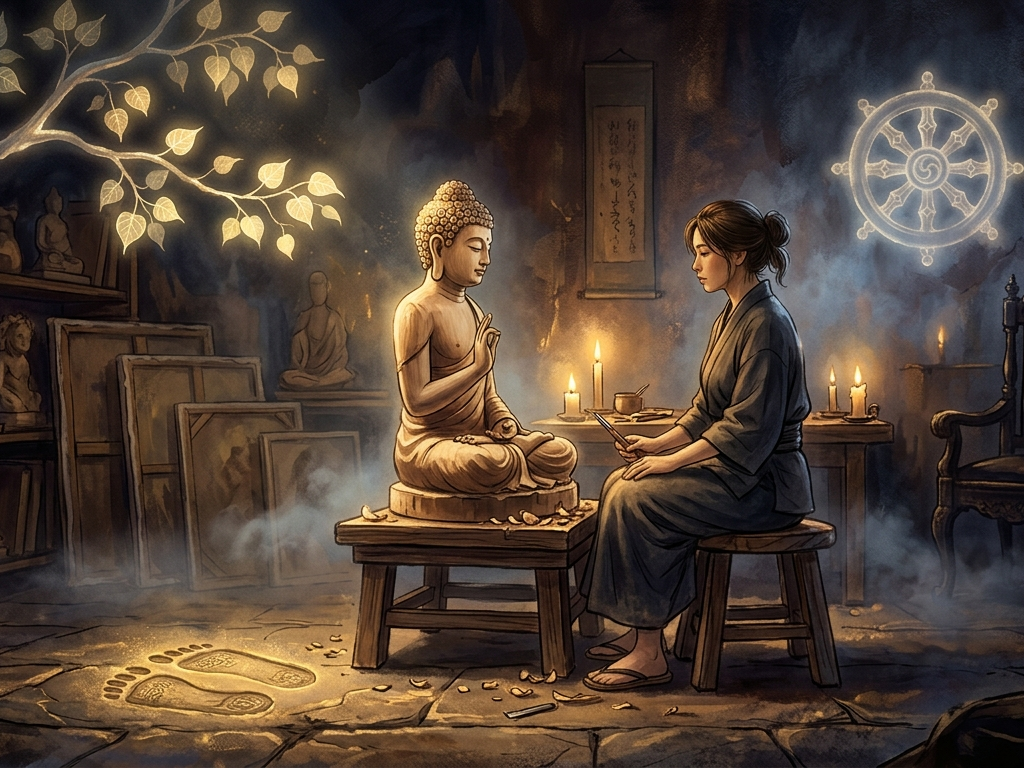
I begin not with a face,
but with a tree.
The Bodhi tree rises on my canvas,
its branches patient with centuries.
Each leaf trembles like a quiet thought
that someone, long ago, dared to finish.
I paint its shadow wider than the earth,
because enlightenment, I feel,
must have cast a very long shade.
There are footprints below it.
Not feet, only the memory of walking.
Two gentle hollows in stone
where a human weight once rested
before dissolving into teaching.
I run my fingers over the carving.
In the studio dust
they feel like warm ash.
Someone passed this way,
and the ground learned to remember.
An empty throne waits in the corner of my sculpture room.
Not absence, exactly.
More like a breath
held by the universe.
I have carved its arms smooth,
as though silence itself had been sitting there
for centuries.
Then the wheel.
Ah, the wheel refuses stillness.
Eight spokes turning quietly
like thoughts finding their way home.
When I paint it,
my brush begins to move in circles
even after the canvas ends.
Perhaps truth moves like that,
never stopping,
only widening.
When I dare finally
to shape the body,
I remember a posture the Greeks once loved:
a soft shifting of weight,
one hip carrying the gravity of the world,
the other forgiving it.
Contrapposto, the scholars say.
But in my hands
it becomes a pause between steps,
as if the Buddha
might walk again at any moment.
And the hair.
Little spirals.
Small patient whorls
like sleeping galaxies.
Some say they are snails,
creatures that once gathered
to shield his head from the burning sun.
I smile when I sculpt them.
Imagine devotion so quiet
that it moves only an inch at a time,
carrying its house of silence on its back.
By evening my studio fills with symbols:
a tree that thinks,
footprints that remember,
a throne that waits,
a wheel that turns without sound,
a body leaning gently into balance,
and a crown of tiny spirals
holding the sky away from a waking mind.
Sometimes I wonder
if I am painting the Buddha.
Or if I am simply learning
how emptiness itself
takes form.