For billions of years, life remained small and patient.
The oceans were filled with cells that divided and adapted, altering the atmosphere, reshaping chemistry, and preparing conditions without any sense of preparation. The world had been rewritten at the microscopic scale. Oxygen accumulated. The ozone layer thickened. Nutrient cycles matured into interlocking systems. Stability, though never absolute, became sufficient for new experiments.
Eventually, some cells began to stay together.
Multicellularity did not appear as a sudden proclamation. It emerged through cooperation. Single cells that divided sometimes failed to separate completely. Adhesion proteins held them in clusters. Communication molecules allowed them to coordinate. Over time, certain clusters discovered that specialization conferred advantage. Some cells could focus on movement, others on feeding, others on reproduction.
Cooperation introduced hierarchy and vulnerability. A cell within a multicellular organism relinquished some autonomy. It no longer lived solely for itself. It performed a role within a collective body. This transition required genetic regulation capable of orchestrating differentiation, instructing identical genomes to express different functions.
Such regulation evolved gradually. Gene networks became more intricate. Developmental pathways emerged. Cells learned to read positional information, to respond to gradients of signaling molecules, to activate specific genes in specific contexts.
The oceans, once ruled entirely by microbes, now hosted organisms composed of many cells working in concert.
The fossil record from the late Precambrian reveals enigmatic forms known as the Ediacaran biota. Soft-bodied, often flattened organisms left impressions in ancient sediments. Their exact relationships to later animals remain debated. Some may represent early branches of animal life. Others may belong to lineages that vanished without descendants.
They foreshadowed a transition.
Around 541 million years ago, a period known as the Cambrian began. Within a relatively short geological interval, the diversity of animal forms expanded dramatically. This event, often called the Cambrian explosion, did not create life from nothing. It amplified complexity already present, revealing it in hard parts that fossilize readily.
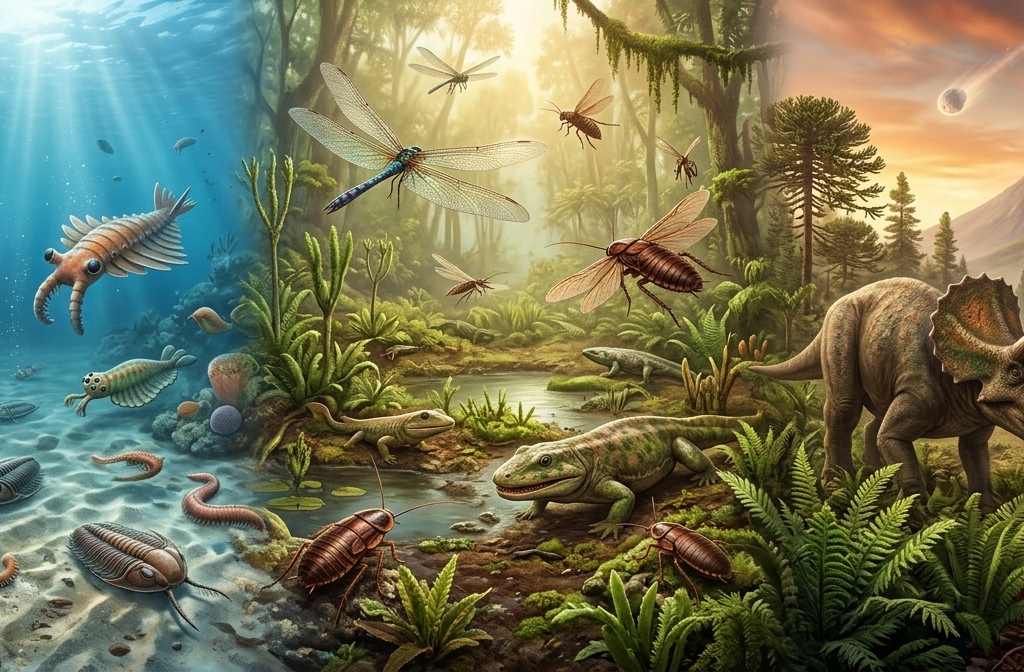
The oceans filled with unfamiliar shapes. Arthropods with segmented bodies and jointed appendages scuttled across seafloors. Anomalocaridids, with grasping limbs and circular mouths, hunted in open water. Early chordates swam with primitive backbones. Shelled organisms evolved mineralized exoskeletons, providing protection and structural support.
Predation intensified evolutionary pressures. Hard shells, spines, and burrowing behaviors emerged in response to new threats. Eyes evolved, improving detection of prey and predators alike. Vision altered ecological dynamics profoundly, introducing feedback between sensory systems and behavior.
Complexity breeds complexity.
The Cambrian diversification was not an isolated burst but the visible threshold of earlier genetic and developmental innovations. The genes responsible for body patterning, such as Hox genes, had evolved prior to this radiation. Their deployment in new combinations generated diverse body plans.
Marine ecosystems grew layered and interactive. Food webs lengthened. Energy flowed from photosynthetic plankton through multiple trophic levels. Ecosystems became structured networks rather than loose assemblies.
Life, once restricted to oceans, eventually approached the boundary between water and air.
Plants were among the first to colonize land. Descended from green algae, early terrestrial plants evolved adaptations to prevent desiccation, including waxy cuticles and specialized tissues for water transport. Fungi likely formed symbiotic relationships with plant roots, aiding in nutrient acquisition from barren soils.
The colonization of land transformed planetary surfaces. Roots fractured rock, accelerating weathering. Organic matter accumulated in soils. The carbon cycle shifted as plants drew carbon dioxide from the atmosphere and stored it in biomass and sediments.
As plant cover expanded, oxygen levels increased further. Terrestrial ecosystems developed. Arthropods, including early insects and arachnids, followed plants onto land, feeding on them or on each other. Their exoskeletons provided structural support in air and protection against dehydration.
Vertebrates soon joined the terrestrial transition. Lobe-finned fish, inhabiting shallow waters, possessed robust fins capable of supporting weight. Over evolutionary time, these fins transformed into limbs. Amphibians emerged, tethered still to water for reproduction but capable of venturing onto land.
The Carboniferous period saw vast forests of towering lycophytes and ferns. High oxygen concentrations supported giant insects, some with wingspans exceeding half a meter. Swamps accumulated thick layers of plant material that would eventually become coal.
Reptiles evolved amniotic eggs, freeing reproduction from water. With this adaptation, vertebrates spread into drier habitats. Diversification continued through the Permian period, culminating in complex terrestrial ecosystems dominated by synapsids and other reptilian lineages.
Then came catastrophe.
Approximately 252 million years ago, the end-Permian mass extinction eliminated a majority of marine species and a significant portion of terrestrial life. Volcanic eruptions in what is now Siberia released vast quantities of greenhouse gases, altering climate, acidifying oceans, and disrupting ecosystems. The precise mechanisms remain under investigation, but the scale of loss was unparalleled.
Mass extinctions do not erase evolution. They redirect it.
After the Permian crisis, surviving lineages radiated into newly vacant ecological niches. Among these were the ancestors of dinosaurs. During the Mesozoic era, dinosaurs diversified into myriad forms, from small bipedal predators to massive long-necked herbivores.
The oceans, too, hosted large reptiles. Pterosaurs took to the skies. Flowering plants evolved in the later Mesozoic, introducing new dynamics between plants and pollinating insects. Angiosperms diversified rapidly, reshaping terrestrial ecosystems and accelerating coevolutionary relationships.
Throughout these eras, the tectonic plates continued their migrations. The supercontinent Pangaea assembled and later fragmented, altering ocean currents and climate patterns. Continental drift influenced isolation and speciation, creating geographic barriers that shaped evolutionary pathways.
Life expanded not only in form but in interaction. Ecosystems became increasingly intricate. Predator and prey coevolved. Parasites emerged. Symbiotic relationships multiplied.
Then, approximately 66 million years ago, another catastrophic event reshaped the biosphere. An asteroid impact near present-day Yucatán, combined with volcanic activity, triggered environmental upheaval. The non-avian dinosaurs, dominant for over 150 million years, vanished.
Again, extinction reset the board.
Mammals, previously small and often nocturnal, diversified into ecological roles left vacant. Birds, descendants of theropod dinosaurs, continued to evolve. Flowering plants and insects flourished. The Cenozoic era unfolded as a tapestry of radiations and adaptations.
The pattern repeated across geological time. Diversification followed innovation. Catastrophe pruned diversity. Survivors adapted. New forms emerged.
Evolution proved neither gentle nor malicious. It operated without foresight, responding to environmental pressures and genetic variation. It generated extraordinary structures, from compound eyes to wings to complex brains, yet it also eliminated entire clades when conditions shifted beyond tolerance.
The age of complex life did not replace the microbial world. Microbes remained foundational, cycling nutrients, decomposing organic matter, inhabiting extreme environments. Multicellular organisms built upon that base, adding layers of ecological interaction.
Complexity brought advantages and vulnerabilities. Large bodies require more energy. Specialized tissues depend on coordinated development. Disruption to a single component can imperil the whole organism. Yet complexity also allows flexibility. Nervous systems enable rapid responses. Immune systems defend against pathogens. Social behaviors enhance survival.
Over hundreds of millions of years, natural selection sculpted forms that would have been inconceivable during the microbial era. Forests rose, reefs accumulated coral skeletons, grasslands spread under shifting climates. Continents bore the imprint of roots and burrows, of herds and predators.
Mass extinctions punctuated this unfolding narrative. The end-Ordovician, late Devonian, end-Permian, end-Triassic, and end-Cretaceous events each eliminated substantial portions of biodiversity. Causes ranged from volcanic outgassing to asteroid impacts to shifts in sea level and climate.
Extinction is not failure. It is part of evolutionary dynamics. It reduces diversity, but it also opens ecological space. Lineages that survive often radiate in response to diminished competition.
Through all these cycles, one principle persisted: adaptation to local conditions determined survival. There was no predetermined trajectory toward complexity or intelligence. There was only variation filtered by environment.
Yet, over time, nervous systems grew more intricate. Sensory organs became refined. Social behaviors emerged among various lineages. Primates evolved grasping hands and binocular vision, adaptations to arboreal life. Within this lineage, brain size increased relative to body size.
The eventual emergence of a species capable of reflecting on this history was not an inevitability encoded in the Cambrian. It was a contingent outcome of countless prior events, each dependent on environmental context and genetic variation.
The age of complex life reveals evolution’s dual character. It is creative, generating diversity beyond anticipation. It is ruthless, eliminating forms without sentiment when conditions demand.
The Earth’s surface today bears the cumulative imprint of these processes. Mountain ranges formed by tectonic forces host forests shaped by biological evolution. Coral reefs constructed by tiny polyps alter ocean currents. Grasslands maintained by grazing mammals influence atmospheric carbon.
The long microbial reign established the chemical foundations. The age of complex life elaborated upon them, weaving intricate ecological networks.
If one observes this history without preference, a pattern emerges. Stability allows diversification. Disruption tests resilience. Survivors inherit opportunity.
The Cambrian explosion was not an explosion in the human sense. It was a geological acceleration of diversification, visible because organisms acquired hard parts that fossilize. Similarly, the colonization of land was not a conquest but a gradual adaptation to new gradients.
Dinosaurs did not fail when they went extinct. They thrived for an immense duration. Their disappearance resulted from environmental perturbation beyond their capacity to adapt rapidly enough.
Evolution does not guarantee permanence. It rewards fit within context.
From the first multicellular clusters to vast terrestrial ecosystems, life expanded in form and function. It colonized nearly every habitat, from deep oceans to arid deserts. It altered atmospheric composition, influenced climate, and shaped geology.
The age of complex life is not separate from earlier chapters. It is their extension. The oxygen produced by ancient microbes enabled aerobic metabolism. The ozone layer permitted terrestrial expansion. The genetic innovations of early eukaryotes made multicellularity feasible.
Each chapter builds upon the previous.
The oceans that once held only single cells became arenas for predators and prey. The continents that once bore only microbial films hosted forests and reptiles. The sky that once carried volcanic ash carried wings.
Evolution proved capable of generating beauty and terror, delicacy and scale. It produced organisms that glow in darkness and others that weigh as much as small buildings. It generated symbioses that bind species together and competitions that drive relentless adaptation.
The age of complex life is ongoing. It has not reached a conclusion. The present biosphere reflects a transient state within a dynamic system.
If the long microbial reign was the foundation, this era is an elaboration, a layering of complexity upon stability. It demonstrates that, given time and energy flow, life explores the space of possibility.
Not with intention.
With persistence.
From cooperating cells to Cambrian seas, from forests to dinosaurs, from extinction to renewal, the narrative unfolds without pause.
Complex life did not replace simplicity. It emerged from it, dependent upon it.
And in that dependence, the earlier chapters continue to echo, beneath every leaf and within every breath.