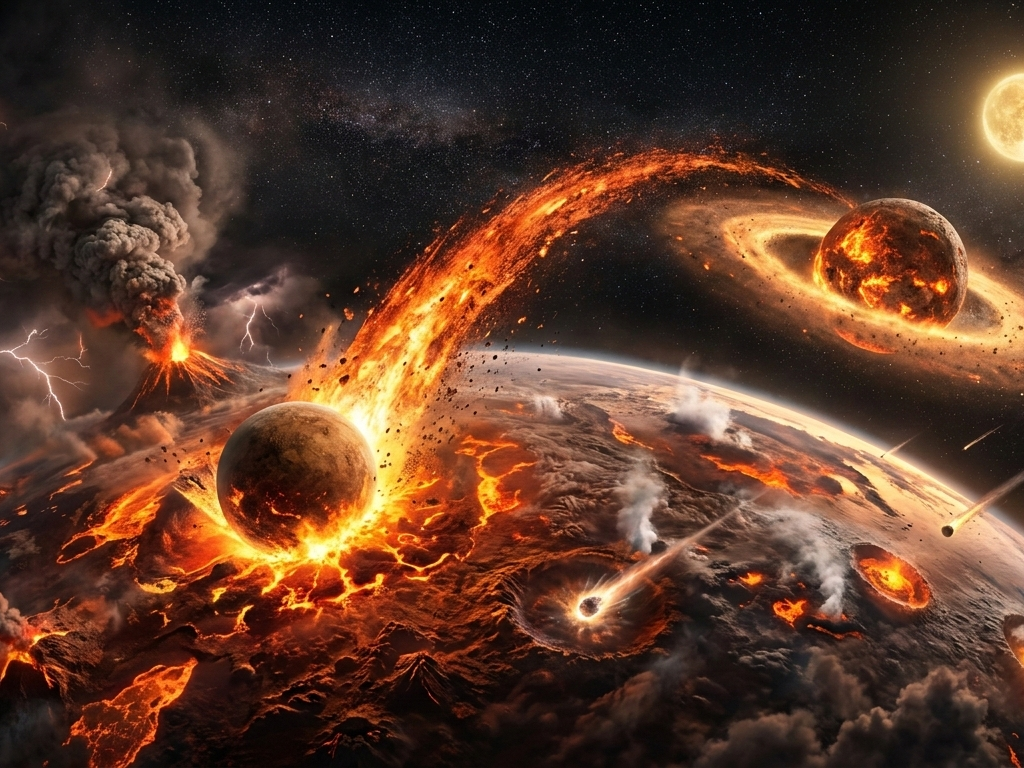
There is a tendency to imagine beginnings as gentle. A cradle. A quiet glow. A slow unfolding into order. That tendency is understandable, but it is incorrect.
The early Earth did not begin in stillness. It began in heat so absolute that solidity itself was a temporary rumor. What would one day be continents existed then as currents of molten rock, folding and refolding in an incandescent ocean. The planet rotated beneath a sky that could not yet be called a sky, because there was no clarity above it, only vapor, ash, and the luminous residue of recent impacts.
About 4.6 billion years ago, in the aftermath of the Sun’s ignition and the settling of the protoplanetary disk, Earth assembled from collisions. Dust had become pebbles. Pebbles had become planetesimals. Planetesimals had become protoplanets. Gravity had insisted, repeatedly, that fragments surrender their independence. Earth was the result of that insistence, a growing sphere gathering mass and momentum from everything that strayed too close.
Each collision delivered energy. Each impact translated motion into heat. The accumulating mass increased gravitational compression within the planet’s interior, generating still more heat. Radioactive decay contributed further. The young Earth was not merely warm; it was molten through much of its volume. Heavy elements such as iron and nickel migrated inward under gravity’s command, sinking toward the center to form a dense metallic core. Lighter silicates rose toward the exterior, beginning the slow differentiation between core, mantle, and crust.
Differentiation is not a peaceful process. It is a reorganization under pressure.
The surface, if one could have stood upon it, would have offered no ground to stand on. It was a churning magma ocean, its glow visible even from space. Above it, debris still circled the Sun in unstable orbits. The solar system was young and crowded, and its architecture had not yet been cleared of excess.
It was within this unstable environment that one of the most consequential events in Earth’s history occurred.
A protoplanet, roughly the size of Mars, approached on a trajectory that intersected Earth’s orbit. The mechanics of its path were not malicious, nor were they merciful. They were gravitational. Orbital resonances, perturbations, and the evolving mass distribution of the young solar system had arranged a meeting that neither body could avoid.
The collision was oblique rather than head-on, but it was immense in scale. The impact released energy equivalent to billions of nuclear detonations. Rock vaporized. Mantle material was excavated and thrown into space. The incoming body was largely destroyed, its matter blending with Earth’s outer layers or being ejected into orbit.
For a brief interval, Earth was partially unmade.
A vast cloud of debris surrounded the planet, composed of molten droplets, vaporized rock, and shattered fragments. Some of this material escaped entirely, joining the wider solar system as wandering remnants. Much of it, however, remained gravitationally bound. Over time, through countless smaller collisions and gravitational interactions, that debris began to coalesce.
From the wreckage, the Moon formed.
Its origin in violence is not speculation but the prevailing scientific model, supported by isotopic similarities between lunar rocks and Earth’s mantle. The Moon is not an alien capture; it is kin, composed largely of material that once belonged to Earth and to the impactor that nearly destroyed it.
In the aftermath of the collision, Earth’s surface was once again molten. The impact had reset much of the planet’s crustal history. If any early crust had formed before, it was obliterated. The planet glowed with renewed intensity, its outer layers reshaped and homogenized by the energy of the event.
The Moon, newly assembled, orbited far closer than it does today. It would have loomed enormous in Earth’s sky, its gravitational pull exerting strong tidal forces on the molten surface below. Those tides did not yet move oceans, because oceans did not yet exist, but they influenced the distribution of magma and the dynamics of the early crust as it began, again, to solidify.
In time, the frequency of large impacts decreased, though they did not cease entirely. The inner solar system still contained substantial debris, and Earth’s gravitational cross-section made it an efficient collector. This era, often referred to as the Late Heavy Bombardment, saw repeated asteroid strikes that reshaped the surface, excavated basins, and delivered additional material to the planet.
Among that material were volatiles, including water-bearing minerals and possibly ice. The origin of Earth’s water remains an active area of research, involving contributions from volcanic outgassing, carbonaceous asteroids, and perhaps cometary impacts. What is clear is that water was not absent from the early Earth system. It was present, though often in vapor form due to high surface temperatures.
Volcanism dominated the planet’s early surface expression. As the interior cooled gradually, partial melting within the mantle generated magma that rose through fractures, erupting onto the surface. These eruptions released gases trapped within the planet’s interior. Carbon dioxide, nitrogen, water vapor, methane, ammonia, and other compounds accumulated in the atmosphere.
This first atmosphere bore no resemblance to the one that now sustains life. There was no free oxygen. The sky, thick with volcanic gases and particulate matter, would have been opaque and hostile. Solar radiation penetrated unevenly through the cloud cover. Lightning, generated within turbulent atmospheric systems, likely flashed across the sky.
Yet this atmosphere, toxic by present standards, was a critical development. It represented the beginning of atmospheric retention. Earth’s gravity was sufficient to hold onto these gases, unlike smaller bodies such as the Moon, whose lower escape velocity allowed most volatiles to be lost to space.
As the planet radiated heat into space, surface temperatures gradually declined. The magma ocean solidified from the top downward, forming a primitive crust. This crust was thin and unstable, frequently broken by impacts or re-melted by upwelling magma. Still, it marked a transition from global liquidity to localized solidity.
Above this forming crust, water vapor continued to accumulate. When temperatures fell below the critical point for condensation, the atmosphere could no longer retain all of its water in gaseous form. Clouds thickened. Precipitation began.
Rain fell onto a planet still warm enough to produce steam upon contact. For long intervals, precipitation and evaporation formed a cycle dominated by extremes. But over time, as cooling progressed, liquid water began to persist on the surface.
Oceans formed not in a single event but through accumulation. Water filled low-lying basins created by impacts and tectonic activity. The surface, once defined by molten flow, became increasingly shaped by erosion, sedimentation, and the interaction between water and rock.
The presence of liquid water altered Earth’s chemistry profoundly. Water is a solvent of exceptional capability. It facilitated chemical reactions at rates and in combinations that would not have occurred in dry conditions. Minerals dissolved and reprecipitated. Chemical gradients developed between hydrothermal vents and surrounding seawater. The stage was being set for processes that would eventually lead to life, though life itself had not yet emerged.
Meanwhile, deep within the planet, the core continued to differentiate. The outer core remained liquid, composed primarily of iron and nickel. Convection within this electrically conductive fluid, combined with Earth’s rotation, generated a magnetic field through the dynamo effect.
This magnetic field extended outward into space, forming a magnetosphere that deflected charged particles from the solar wind. Without this protective envelope, high-energy particles could have eroded the atmosphere significantly, as appears to have happened on Mars. The magnetosphere did not eliminate solar influence, but it moderated it, preserving atmospheric integrity over geological timescales.
The Moon’s gravitational influence contributed further to stability. By exerting a steady torque on Earth’s equatorial bulge, it helped stabilize the planet’s axial tilt. Without such stabilization, chaotic variations in tilt could have produced extreme climatic swings, potentially hindering the long-term development of stable surface conditions.
The interaction between Earth and Moon also generated tides in the newly formed oceans. These tides created dynamic coastal environments, cyclically exposing and submerging mineral surfaces. Such environments may have played a role in concentrating organic molecules in later epochs, though that future remained distant in this early chapter.
Plate tectonics likely began during the Hadean or early Archean eons, though the exact timing remains debated. The movement of lithospheric plates, driven by mantle convection, created zones of subduction and spreading. Continents, initially small and scattered, began to form from lighter crustal material that resisted subduction. These proto-continents would have been volcanic and unstable, but they marked the first steps toward the complex geology that now characterizes Earth.
Over tens of millions of years, the rate of catastrophic impacts decreased. The solar system’s architecture stabilized as giant planets like Jupiter cleared much of the remaining debris through gravitational scattering. Earth, though still subject to occasional impacts, experienced longer intervals between major disruptions.
The violent youth of Earth did not end abruptly. It faded gradually, replaced by relative stability. Relative is the operative word. Volcanism persisted. Tectonic shifts reshaped the crust. The atmosphere evolved in composition as chemical reactions proceeded between gases and surface minerals.
But the extremes of the earliest epoch diminished. Surface temperatures fell within ranges that allowed liquid water to remain stable over broad regions. Oceans deepened and interconnected. The atmosphere, though still devoid of oxygen, became a more consistent envelope rather than a fluctuating plume of volcanic exhalations.
By approximately 4.0 billion years ago, Earth had transitioned from a molten world under constant bombardment to a planet with oceans, crust, atmosphere, magnetic shielding, and a stabilizing moon. The conditions were no longer perpetually reset by global sterilization events.
Stability, in this context, does not imply serenity. It implies persistence.
The early Earth’s violence was not an aberration. It was a consequence of formation. Planetary accretion in a young solar system is inherently energetic. Collisions are not accidents; they are the mechanism by which mass aggregates and differentiates. Heat is not incidental; it is the price of assembly.
What distinguishes Earth is not that it experienced violence, but that it survived it in a configuration conducive to further complexity.
The molten surface solidified without permanently losing its volatiles. The atmosphere formed and was retained. The magnetic field emerged and endured. The Moon stabilized the axial tilt. The solar luminosity, though lower in the distant past than it is today, was sufficient to sustain liquid water under a greenhouse atmosphere rich in carbon dioxide.
These factors combined to create a planet that, after immense upheaval, did not remain in perpetual crisis.
The scars of that youth remain embedded in geology. Ancient zircon crystals, dating back over 4.3 billion years, provide evidence of early crust and possibly even early water. Impact basins, though often obscured by later tectonics, testify to a history of collision. The Moon’s heavily cratered surface preserves a more visible record of the same era, unmodified by atmosphere or plate tectonics.
In contrast, Earth’s active geology has recycled much of its earliest record. Subduction and erosion have erased many traces of the Hadean epoch. The planet’s memory is dynamic rather than static.
Yet the narrative can be reconstructed from fragments, isotopic signatures, and comparative planetary science. The picture that emerges is not one of immediate habitability, but of gradual transformation through sustained physical processes.
By the end of its violent youth, Earth was no longer a molten sphere beneath a suffocating cloud. It was a world of oceans and crust, with energy gradients and chemical diversity. It had become capable of supporting stable liquid water across geological timescales.
It had become a platform.
Nothing in its early history guaranteed that life would emerge. But nothing in the physics or chemistry of its stabilized state prohibited it either. The planet had crossed a threshold from perpetual disruption to sustained continuity.
Continuity allows accumulation. Accumulation allows complexity.
The violent youth of Earth was not an error in its story. It was the necessary preface. Without differentiation, there would be no core. Without the core, no magnetic field. Without impacts, perhaps no Moon. Without volcanism, no atmosphere. Without cooling, no oceans.
Each phase, destructive in isolation, contributed to a configuration that could endure.
From a distance, the modern Earth appears tranquil. Blue oceans reflect sunlight. White clouds drift across continents. The surface seems composed, self-contained.
That appearance conceals a history written in fire and collision.
The planet’s core remains hot. Mantle convection continues. Tectonic plates drift at rates measured in centimeters per year, reshaping the surface over millions of years. The magnetic field fluctuates and occasionally reverses polarity. The Moon slowly recedes, carried outward by tidal interactions.
The violence has not vanished. It has become structured.
Stability is not the absence of energy. It is the management of it.
In its earliest epoch, Earth had not yet learned that management. It was subject to forces it could not moderate. Over time, through cooling, differentiation, and orbital dynamics, those forces reached a balance compatible with persistence.
From molten sphere to ocean world, the transition was neither swift nor gentle. It was measured in tens and hundreds of millions of years. It required impacts that nearly destroyed the planet and processes that reshaped it from within.
Yet from that furnace emerged a world capable of sustaining liquid water under a stable sky.
The violent youth of Earth was not a contradiction of its future. It was the foundation of it.
Every stable surface carries beneath it a history of upheaval. Every enduring system is assembled from phases of instability. Earth’s early chaos was not purposeless. It was formative.
In time, within those oceans and along those mineral surfaces, new processes would begin, ones that operate not merely on physics and chemistry but on replication and selection. That chapter belongs elsewhere.
For now, it is enough to recognize that before there was life, there was survival. Before there was biology, there was geology. Before there was calm water reflecting sunlight, there was molten rock reflecting the violence of assembly.
The Earth did not begin as a sanctuary.
It became one.