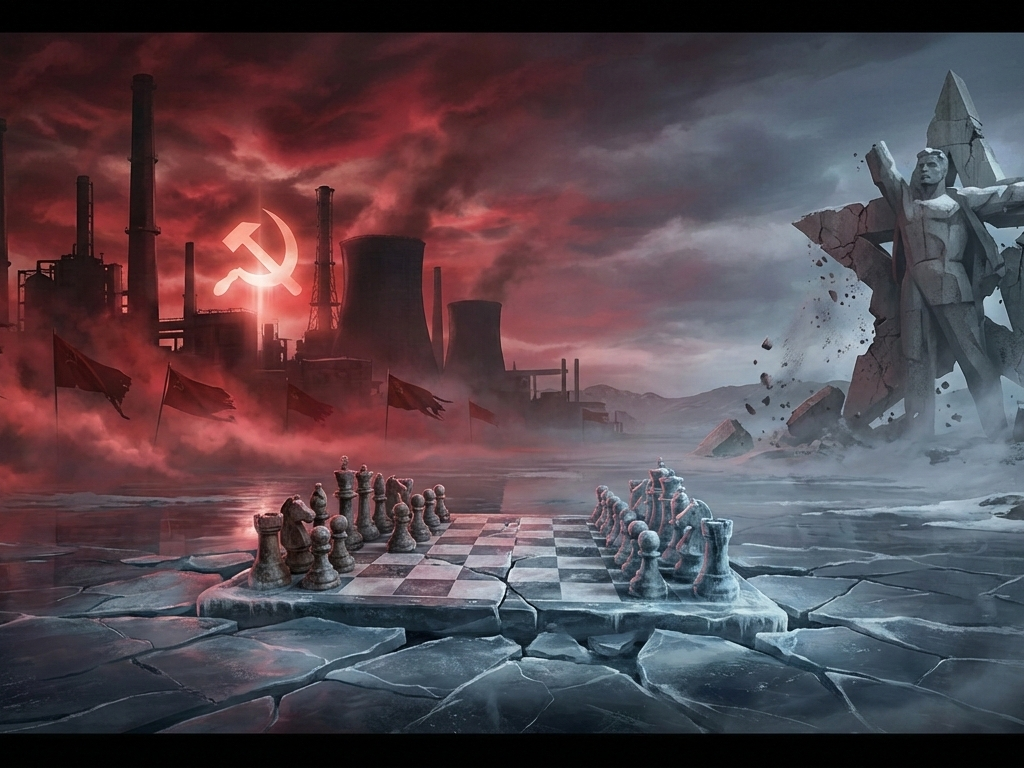
There are empires that roar like wildfire and empires that hum like distant machinery. The Soviet Union belonged to the second kind. It did not simply rise; it assembled itself, bolt by ideological bolt, out of hunger, fury, intellectual conviction, and a promise whispered into the frost. It was less an accident of power and more an act of belief, constructed by men and women who were certain that history itself had a direction and that they had discovered its map.
The revolution of 1917 was less a political event and more a psychological earthquake. The old imperial order collapsed under the weight of war, economic breakdown, and moral exhaustion. In its place emerged a state that claimed not just territory, but destiny. It promised a world unshackled from aristocracy and capital, a new grammar of equality in which workers and peasants would no longer orbit around inherited privilege. For millions battered by the First World War, by inequality, by hunger, that promise felt oxygen-rich. It carried the intoxication of moral clarity.
Yet revolutions do not govern; they ignite. Governance required structure, and structure required authority. Under Lenin, the idea of a disciplined vanguard party took root, justified by the belief that history needed guidance. Civil war, foreign intervention, and internal chaos hardened the young state. Survival demanded centralization. Emergency measures became habits.
Under Stalin, those habits crystallized into a system of command that reached into every field and factory. Rapid industrialization transformed a largely agrarian society into an industrial power within a single generation. The Five-Year Plans mobilized labor, resources, and imagination on a scale the world had rarely seen. Entire cities rose from steppe and snow. Steel output soared. Dams, railways, and mines appeared as monuments to willpower.
The transformation was real. So was the suffering. Forced collectivization tore through rural life. Famine followed in its wake. Political purges devoured not only rivals but loyalists. Labor camps spread across vast territories, binding human endurance to state ambition. The state demanded obedience and delivered fear alongside progress. It cultivated loyalty through ideology and enforced compliance through surveillance.
This duality unsettles me. How does one hold in the same thought the undeniable scale of modernization and the equally undeniable scale of repression? The Soviet Union industrialized at breathtaking speed, educated millions, expanded scientific research, and redefined gender participation in the workforce. Yet it did so while constricting speech, flattening dissent, and narrowing the space in which individuality could breathe.
The Second World War sealed the Soviet Union’s global stature. The invasion by Nazi Germany was catastrophic, and the cost on the Eastern Front was almost incomprehensible in its magnitude. Entire cities were besieged. Millions perished. Yet the eventual defeat of Nazi forces gave the Soviet project moral weight and strategic authority. Victory sanctified sacrifice. The narrative of resilience became part of national identity.
From the ruins of war emerged a bipolar world order. The Cold War that followed was not merely a contest of missiles and alliances; it was a rivalry of metaphors. One system framed freedom through markets and pluralism. The other framed justice through planning and collective ownership. Each claimed universality. Each viewed the other not simply as a competitor, but as an existential contradiction.
For a time, the Soviet experiment seemed formidable and forward-driving. It launched the first satellite into orbit, signaling technological audacity. It sent the first human beyond Earth’s atmosphere, transforming the sky into a stage of ideological prestige. Scientific achievement became proof that centralized planning could rival, even surpass, capitalist dynamism in critical arenas. To many newly decolonized nations across Asia, Africa, and Latin America, it represented an alternative path to modernity, one that promised rapid development without dependence on Western capital.
The Soviet model also expanded through influence in Eastern Europe, where satellite states aligned politically and economically with Moscow. This expansion created a buffer zone, but it also embedded tension. Maintaining ideological cohesion across diverse cultures required constant pressure. Reform movements in Hungary, Czechoslovakia, and elsewhere revealed the fragility beneath imposed unity.
Beneath the triumphs, structural weaknesses deepened. Central planning proved highly effective at mobilizing heavy industry and defense production, but far less agile in fostering consumer goods, technological flexibility, and decentralized innovation. Bureaucracy thickened. Decision-making slowed. Incentives dulled under uniformity. Managers aimed to fulfill quotas, not to refine quality. Shortages became common features of daily life.
An economy designed for scale struggled with subtlety. When global markets shifted, particularly with fluctuations in oil prices that affected export revenues, vulnerabilities sharpened. Meanwhile, the arms race with the United States consumed vast resources. Military parity became a psychological necessity, even when it strained economic resilience.
Political rigidity compounded economic strain. Dissent was suppressed rather than absorbed into adaptive reform. Information flowed upward in filtered forms, protecting leadership from uncomfortable truths. The system that had once thrived on discipline now found that discipline hardening into stagnation.
When reforms finally arrived under Gorbachev through policies of restructuring and openness, they were attempts to renew rather than dismantle. Yet transparency exposed accumulated contradictions. Public discourse widened. Historical grievances resurfaced. Citizens confronted the gap between official narrative and lived experience. Reform revealed not merely inefficiencies, but fractures of trust.
National identities long constrained within the union resurfaced with urgency. The Baltic republics pressed for sovereignty. Eastern European governments loosened their alignment. The Berlin Wall fell, symbolizing not just the end of division in Germany but the unraveling of a geopolitical architecture. By 1991, the Soviet Union dissolved into independent republics. A superpower ended not with foreign conquest, but with internal disintegration and negotiated separation.
What lingers for me is neither celebration nor nostalgia. The Soviet Union rose because it harnessed collective will with extraordinary discipline and offered a compelling narrative of justice to a population weary of hierarchy. It fell because discipline ossified into inflexibility, because economic architecture resisted adaptation, and because narrative drifted too far from lived reality.
Its collapse reshaped the world in profound ways. The United States emerged as the sole superpower for a time, inaugurating a unipolar moment. Liberal capitalism expanded rapidly across former socialist territories. Globalization accelerated. Yet the transition within post-Soviet states brought economic shock therapy, unemployment, inequality, and the rapid rise of oligarchic wealth in some regions. The ideological clarity of the Cold War gave way to a more ambiguous global landscape marked by regional conflicts, shifting alliances, and renewed questions about governance models.
In Russia, the 1990s became a decade of disorientation and wounded pride, shaping political currents that would influence decades to follow. Across Eastern Europe, integration with Western institutions redefined economic and security frameworks. Internationally, the absence of a bipolar structure altered diplomatic calculations and intervention patterns.
The Soviet experiment feels, in retrospect, like a vast wager: that equality could be engineered from above, that human complexity could be organized with mechanical precision, that belief reinforced by state power would remain indefinitely coherent. It sought to compress centuries of development into decades, to sculpt society through planning and conviction.
History resists such neat architecture. Systems that aspire to permanence often underestimate the quiet evolution of expectations. People adapt, compare, imagine. They measure promises against experience.
Empires do not fall only because of enemies massing at their borders. They fall when their internal logic loses persuasive force among their own citizens. The Soviet Union remains a monument to ambition, to sacrifice, to intellectual daring, to repression, and to the enduring tension between idealism and power.
Its rise tells us that ideas can mobilize continents, reorganize economies, and redraw maps. Its fall reminds us that ideas must breathe, adapt, and remain accountable to the lives they claim to elevate.