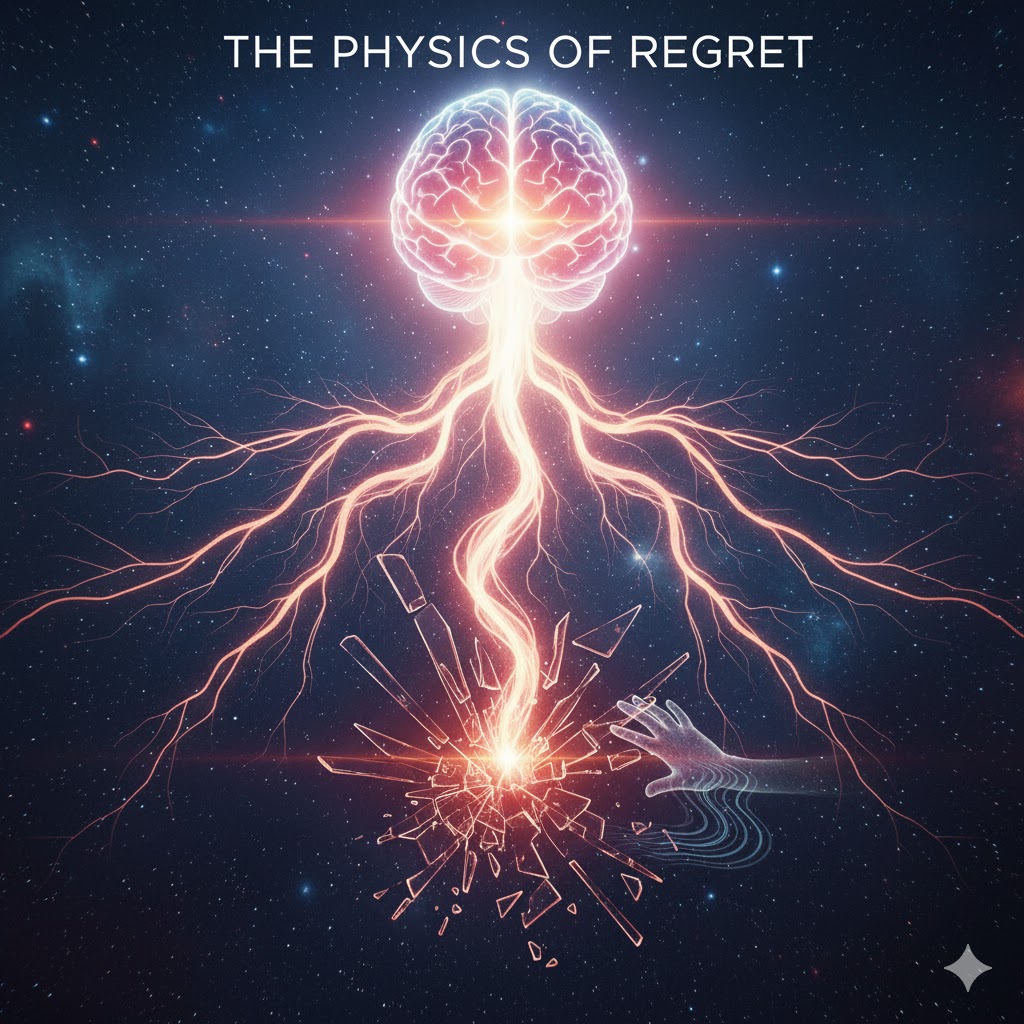
The Physics of Regret
Entropy, irreversible processes, and the mind’s stubborn habit of replaying what cannot be undone
Regret arrives quietly, like a faint background hum. It’s the mental equivalent of cosmic microwave radiation: always there, faint but measurable, a leftover from some past explosion we thought we had escaped. A moment we handled poorly, a choice we abandoned, a sentence we shouldn’t have spoken—or should have. There is no such thing as a universe without regret, not because humans are tragic, but because physics, in its unfussy honesty, tells us that the past is a one-way corridor. Once a thing happens, it sinks into the growing library of irreversible events. Our minds, clever creatures that they are, keep trying to reverse the arrow of time. They fail every single time, and the failure echoes as regret.
If this sounds dramatic, it isn’t. It’s thermodynamics.
Entropy—the measure of disorder, the tally of possibilities—only grows. Not metaphorically, not poetically, but as a fundamental law of the universe. Everything tends toward configurations that are more probable: shattered glass instead of pristine goblets, diffused perfume instead of neat packets of scent, cooling tea instead of steaming cups. What we call “regret” is the psychological imprint of entropy’s dominion. Once a configuration becomes the past, it is locked inside a pattern too improbable to reassemble.
We don’t regret only because we are emotional. We regret because the physics of the world forbids a do-over.
A decision is like a glass bowl. Before it’s made, the bowl is intact: all possibilities contained, all futures still reversible. After the decision—after the bowl slips, hits the ground, fractures into uniqueness—there is no path back. You could glue the pieces together, but it will never again be the same bowl. The molecular bonds won’t re-form in the same exact pattern. The atomic positions won’t be identical. Even the pattern of fractures becomes an irreversible historical fingerprint.
Regret begins where reversibility ends.
Every choice fractures the timeline in its own way. Some cracks are hairline, barely visible; some split the floorboards. But all of them obey the same principle: the universe is allergic to going backwards.
This is why your brain replays a past moment as if you could slip back into it and nudge things differently. “If only,” you say, as your neurons—these tiny electrochemical creatures—simulate versions of scenarios that will never be realized. The simulation is vivid, but the physics is non-negotiable. Neural networks run on energy gradients. Memory retrieval itself increases entropy. Even thinking about the past is a process that moves the universe forward, not backward.
Strange, isn’t it? We try to reverse time, and in the attempt, we push it further ahead.
The mind, in this sense, is an engine for making peace with irreversibility. But engines generate heat. And heat, in thermodynamics, is the signature of entropy’s rise. Regret is simply one of the byproducts.
—
Humans talk about regret as if it is a moral issue, a failing, a sign of weakness or sensitivity or overthinking. But if you strip the emotion from it—just for a moment—you glimpse its bones. It is not moral. It is mechanical. The mind revisits a moment that cannot be re-entered. The emotional ache is secondary to the cognitive impossibility.
Inside the brain, “regret” is constructed through predictive coding—your neural system tries to align what actually happened with what could have happened. When there is a discrepancy, the system fires error signals. These signals flood the prefrontal cortex and limbic structures. The machinery tries to minimize prediction error, but it can’t, because the data is fixed; the past is a locked dataset. Unlike future scenarios, which have room for accommodation, the past is rigid, perfectly solid, invariant.
It’s the ideal conditions for catastrophic mismatch.
The brain likes malleability. It thrives when events are fluid enough to model. The past is granite. So it keeps poking at the same unyielding statue, the error persists, and what you experience is an ache you call regret.
You are not failing. You are obeying physics.
This is why regret doesn’t fade quietly; it decays slowly, like radioactive material. Not because you enjoy the pain, but because the system keeps testing the memory against new patterns, checking if revisions are possible. The result is predictable: the event remains irreversible, and the error signal flares up again.
Eventually, through synaptic pruning or through meaning-making, the memory becomes less active. Not healed. Just quietened. What’s really happening is that the brain learns that revisiting the memory yields no new information. So it reduces the priority of that loop, much like a thermostat that stops reacting once it learns that the room will never reach the desired temperature.
Consider how strange this is. We pride ourselves on free will, yet the mechanics of regret operate like a thermostat and a heat engine dancing inside your skull. It makes a person humble. It should.
—
Thermodynamic irreversibility is not only about time; it is also about paths. Once a process occurs—once energy flows, once molecules interact, once your body moves—it creates a chain of microstates so special, so improbable, that the precise configuration is practically impossible to reconstruct. You could record the event with the finest camera, but you cannot recreate its microscopic details.
Regret often stems from imagining that the exact same moment could simply be replayed and optimized. But that is not how complex systems behave. A moment is not a file you load. It is a statistical fluctuation in the vast ocean of possibility. Asking the world to return that moment is like asking water to unmix from wine after they blend.
Even if it could, you wouldn’t be the same observer. You are not the same person you were ten minutes ago. Neurons have fired, synapses have altered, thoughts have folded and unfolded. You are a dynamic system moving through possibility space, never pausing long enough to be identical.
Regret assumes sameness where physics guarantees change.
This is why the idea of “If I went back, I’d do things differently” is comforting but fundamentally flawed. If you went back, you would not be you anymore. The act of remembering alters brain structure; the very regret that motivates your imagined correction is born from experiences you did not have at the time. The self that made the regrettable decision did not have access to the updated version of you.
Regret is the echo of two selves trying to occupy the same point in spacetime. Physics doesn’t allow that, either.
—
Still, one might ask: if the universe is so committed to irreversibility, why doesn’t the mind accept it? Why does it run simulations that defy the laws governing reality?
The answer is evolutionary, not philosophical. Simulation of alternate pasts and futures is a survival mechanism. Being able to imagine alternative outcomes gives us strategic flexibility. It helps us learn. It helps us predict. A creature that does not mentally revise the past is a creature that repeats its mistakes.
The trouble is that our imagination—this engine of foresight—is indiscriminate. It applies its machinery both to the future (which is flexible) and to the past (which is inert). When applied to the future, imagination is a guide. When applied to the past, it is friction against immovable stone.
We feel the heat of that friction as regret.
It is, in a way, the psychological cost of having a mind capable of modeling the unactualized. We pay for imagination with the agony of impossibility.
Even here, thermodynamics whispers its quiet truth: every ability comes with energy expenditure. Every function of the mind costs heat, and heat is entropy’s signature. Regret is not a bug; it is the thermodynamic price we pay for being counterfactual beasts.
—
But the universe is not cruel, only consistent. If it locks away past microstates, it also floods the present with new degrees of freedom. Entropy increases, yes, but increased entropy means increased possibility. There are more directions to move in, not fewer. Regret tends to focus on the single lost path, but the physics of entropy tells a different story: paths proliferate ahead of you.
The past becomes rigid, while the future becomes expansive.
This is not spiritual comfort; it is statistical mechanics.
When entropy increases, systems explore larger regions of phase space. In simple terms, as time moves forward, the number of future states available expands. Irreversibility traps the past, but it frees the future. The more the universe unfolds, the more possibilities arise. Regret narrows your attention to one impossibility; physics widens your reality to countless possibilities.
The key is alignment. When your mind tries to move backward, it creates suffering. When it moves with the arrow of time, it becomes a navigation instrument.
There is a quiet grace in that recognition.
Entropy is not a wall. It is a wind.
—
Here is a curious thing: regret feels heavy, but it is mathematically tied to increasing disorder. Disorder, paradoxically, has a lightness to it. The more ways something can be arranged, the more freedom it has. But the human mind is not built to feel statistics. It feels narratives. A life is not a probability distribution; it is a story stitched in chronological order. Regret interrupts the story.
Narratives want arcs. Physics gives us gradients.
The mind wants symmetry. The universe offers asymmetry.
The mind wants reversibility. The laws of thermodynamics shake their heads softly.
Regret is what happens when a narrative creature tries to inhabit a physical world.
This mismatch doesn’t make you flawed. It makes you human. The entire human condition is a negotiation between story and structure, between desire and law. Where they meet, we find meaning. Where they diverge, we find longing.
Regret lies precisely at that fault line.
—
There is another layer: memory is not a recording. Memory is reconstruction, a dynamic recalibration every time it is accessed. When you recall a moment you regret, you are not replaying the past; you are generating a past. The version in your head is more vivid than reality because it is curated, enhanced, sharpened.
This gives regret an unfair advantage. The past you remember is not the past you lived. It is a high-resolution hallucination. You compare your imperfect once-self to a perfected alternate-self, and naturally the comparison hurts.
The physics of regret is also the biology of unfairness.
And yet, this is the same mechanism that allows forgiveness, reinterpretation, and wisdom. Because memory is plastic, we can reshape our relationship with what happened. We cannot change the event, but we can change the meaning. Entropy blocks us from rearranging the past, but nothing stops us from rearranging how we carry it.
The universe disallows reversal, not reinterpretation.
Meaning is the loophole in thermodynamics.
Entropy dictates that heat dissipates, structures break, time flows forward. But meaning is not a thermodynamic variable. It belongs to a different order of description: the symbolic, the personal, the reflective. Physics governs what happens; meaning governs what it becomes to us.
You cannot undo a moment, but you can outgrow it. You can metabolize it. You can extract its energy and put it to use in the present.
In that sense, regret can be recycled.
—
A fascinating idea in statistical mechanics is that irreversible processes produce entropy, but they can also create structure under the right conditions. Chemical gardens, convection cells, crystal growth—all arise from energy flowing in one direction. Life itself is a phenomenon born from systems driven by gradients. Irreversibility is the engine of complexity.
There is a parallel in the psychology of regret. The moments you wish you could undo often become pivot points. They create gradients—emotional differences that push you into new choices, new behaviors, new clarity. Without gradients, there is stagnation.
Regret is a gradient. It creates direction.
Here physics offers not comfort, but perspective: entropy-producing processes are the ones that create patterns worth noticing. Not everything structured is reversible. Many beautiful things—snowflakes, branching trees, human personalities—are shaped by irreversible events.
Your regrets are not obstacles. They are part of your branching architecture.
Irreversible, yes. But also generative.
—
At some point, one realizes that regret is simply one of the ways a mind feels time. Just as we feel gravity as weight, we feel irreversibility as ache. Neither sensation is wrong; both are translations. The universe speaks through equations; the body translates through emotion. The language may differ, but the message is the same: forward is the only direction with meaning.
You cannot tilt the arrow of time backward, but you can move with it in a way that transforms the weight of the past. Regret becomes lighter when understood not as a punishment but as a byproduct of being alive in a universe that evolves.
Time is not a loop. It is a current. Swim with it, and the past stops feeling like an anchor.
The glass bowl breaks. You sweep the shards. You learn something about your hands, your reflexes, your limits. The brokenness doesn’t define you; the movement after does.
Physics does not ask you to redeem the past. It asks you to participate in the future.
—
What remains, then, is not a sharp conclusion but a quiet clarity.
Regret is the mind’s attempt to perform an impossible computation: reversing entropy. It is the emotional signature of irreversibility, the psychic noise generated by a system trying to inhabit two incompatible states. It feels personal, but it is universal. It feels like failure, but it is physics.
The world moves forward, always. You move with it, whether you notice or not.
Entropy rises. Possibility expands.
The past seals itself.
The future unfurls.
The mind aches for what cannot be undone, but that ache is itself proof that you are alive inside a universe that flows—unceasingly, indifferently, beautifully—toward what comes next.
And what comes next is not a narrowing. It is an expansion.
Entropy guarantees it.
Where the past collapses into one fixed configuration, the future opens into millions.
The physics of regret is not the story of what you have lost. It is the story of how the universe keeps creating space for what you can still become.