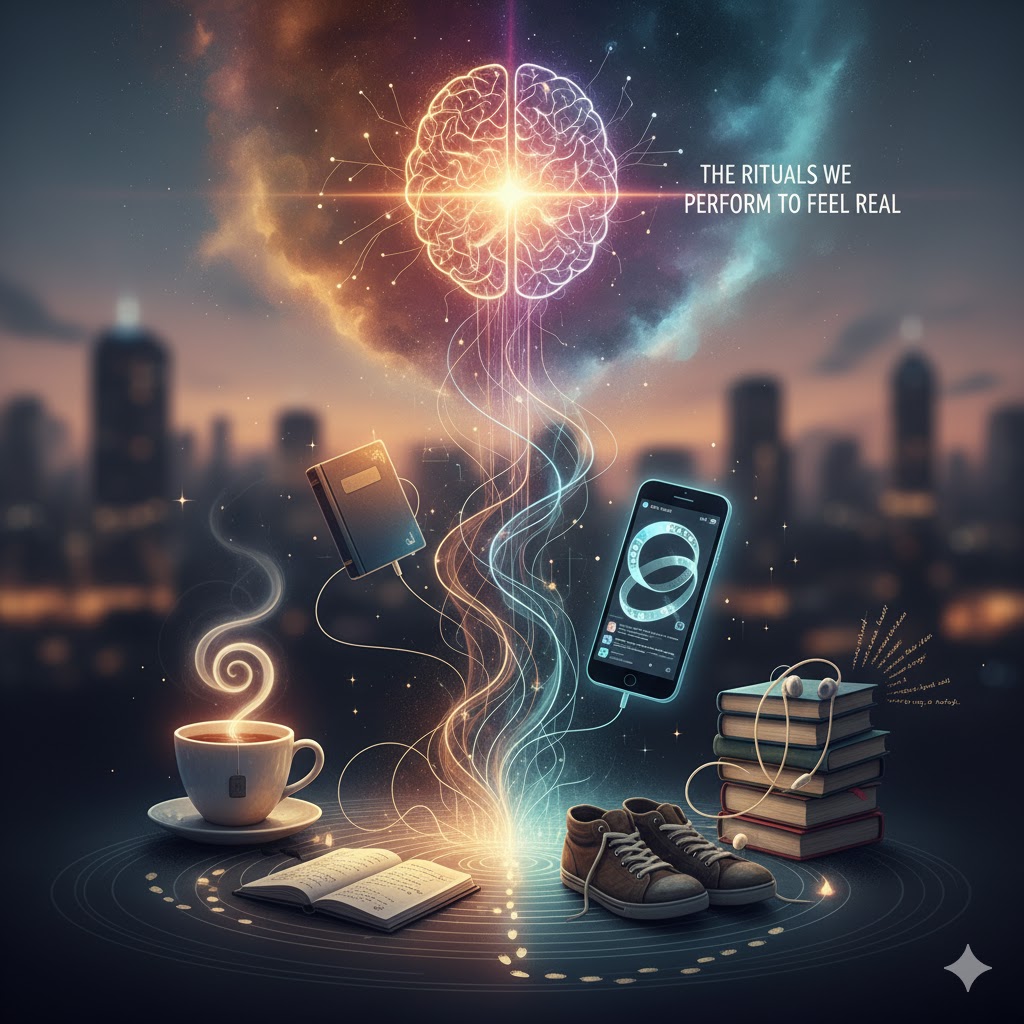
THE RITUALS WE PERFORM TO FEEL REAL
From morning routines to doomscrolling, an exploration of tiny habits that tether the mind to the body.
There is an odd tenderness in the way human beings try to hold themselves together. Nobody teaches us explicitly, yet each of us assembles a peculiar toolkit of gestures, habits, loops, and micro-ceremonies that help us stay intact. Some we inherit unknowingly from our families; some we pick like lint from the world around us; some grow out of our own psychological soil, sprouting quietly until they become part of the architecture of our days.
Call them rituals. Not the heavy ones that require incense or temples or ancestral obligations. The smaller kind. The ones that look embarrassingly trivial but feel strangely essential. The ones that convince us, in a faint but reassuring way, that we exist.
A cup of tea brewed the same way every morning.
A compulsive inbox refresh.
A walk taken along the same path, even if the scenery bores us.
A silent check of the phone before bed.
A playlist that must play in the same order.
A glance into the mirror at the exact same angle.
This is the choreography of modern existence. It looks mundane, but inside it is humming with psychology, memory and biology. Quiet rituals are often survival strategies wearing everyday clothes.
This essay tries to slip into these rituals like a curious guest. Not to judge or romanticize them, but to understand how they help us feel real when the world often feels vaporous, digitized, slippery. How, in an age where identities can be copied, opinions outsourced, and attention scattered across a thousand screens, the body still pulls us back toward itself through simple repetitive acts. How these tiny anchors remind us of our own boundaries.
And maybe, somewhere in this gentle investigation, we may notice that our rituals are not weaknesses. They are the scaffolding of our interior life.
1. The Body Remembers What the Mind Forgets
Scientists studying habits often sound unintentionally poetic when describing their findings. They talk about procedural memory—the part of the brain that stores actions so well-practiced they become subconscious. Brushing teeth. Tying shoelaces. The route you take to school. Neuroscience names it “automaticity,” but it might as well be called “muscle faith.” The body learns the world in loops.
When we repeat something often enough, the prefrontal cortex—the decision-making region—steps aside. Its job is done. The basal ganglia take over, storing the action like a well-worn path.
This shift matters more than it appears. Decisions are cognitively expensive. Habits, once formed, are energetically cheap. They conserve our limited mental resources. That’s why rituals often emerge during stressful or emotionally unstable times: the mind tries to outsource certain actions to preserve energy for more uncertain tasks.
A ritual is the body saying:
Let me carry this part for you.
Which might explain why rituals are comforting even when they don’t make rational sense. A person may not be convinced that checking the door four times is necessary, yet the gesture soothes the anxiety with a strange precision. It’s not logic that is being comforted—it is the nervous system.
A routine is practical.
A ritual is emotional.
The line between them is thin, blurry, and often irrelevant.
2. The Strange Consolation of Predictability
Human beings are creatures of pattern. We do not merely recognize patterns—we depend on them. Predictability is a quiet stabilizer. Life is chaotic, people are unpredictable, economies oscillate, political landscapes shift like dunes. In contrast, a ritual is wonderfully loyal.
Your cup of tea will never ghost you.
Your morning walk will never suddenly change its opinion.
Your night-time scrolling may disappoint you, but it will always be available.
This predictability is not shallow; it is neurobiological. The brain’s reward system thrives on small doses of certainty. When something expected occurs, dopamine rises slightly—not the dramatic surge associated with novelty, but a steady signal of safety. Predictability is a calm rather than a thrill.
The anthropologist Dimitris Xygalatas, who studies ritual scientifically, describes rituals as “low-cost, high-benefit machines for reducing uncertainty.” He explains that rituals decrease stress markers like cortisol and calm the sympathetic nervous system. In his research involving athletes, exam-takers, and performers, even simple pre-task rituals improved performance by lowering anxiety.
The brain dislikes chaos. Rituals are the grammar of stability.
This explains why sensory rituals—touching beads, tapping surfaces, arranging items symmetrically—emerge more strongly when external life feels unstable. These gestures are attempts to carve order into personal space, reclaiming a sense of agency even when the larger world feels ungovernable.
Predictability is the quietest form of self-protection.
3. Digital Rituals: The New Sacred Grooves
We live in an age where many of our rituals have migrated to devices. Whether these rituals make us better or worse humans is a debate for philosophers; whether they shape us is a matter of fact.
Consider the morning unlock of the smartphone—the upward swipe, the quick check for messages, the glance at notifications. It is no longer just information-seeking. It is a ritual of orientation. The digital clock asserts time. The notifications assert relevance. The world of others asserts its existence. Without this ceremony, the day feels slightly off-kilter.
Doomscrolling is another ritual—one we love to criticize, but can rarely resist. It is a compulsive hunt for novelty mixed with threat detection, an evolutionary impulse to gather information about danger stretched into the infinite scroll of algorithms. Studies from MIT and the University of Pennsylvania show that negative news spreads 70% faster than neutral news online. This hijacks the brain’s survival circuits, making doomscrolling feel like vigilance rather than self-destruction.
But even this habit carries ritualistic traits:
same posture,
same thumb movement,
same late-night timing,
same slight dissociation.
The ritual doesn’t soothe anxiety; it mirrors it. It tethers the mind to a stream of stimuli when the internal world feels too loud.
In earlier eras, people kept worry-stones in their pockets. Today, the glow of a small screen has become the new worry-stone.
Digital rituals are not inherently harmful. What matters is their emotional payload. Some anchor us gently—nightly journaling apps, meditation timers, slow-paced podcasts. Some deepen our fragmentation. Most are neither demonic nor divine; they are simply the habits of a species adapting faster than it can understand itself.
4. Why Tiny Habits Feel Like Identity
Identity is not a grand sculpture carved once in youth. It is accumulated in gestures repeated so often they become invisible. Psychologists studying embodied cognition argue that the body plays a larger role in identity formation than previously assumed. Our posture, breathing habits, walking rhythm—even our preferred coffee mug—carry subtle psychological signatures.
There is a reason people feel disoriented when their daily rituals are disrupted. When someone suddenly stops writing in their notebook, or no longer plays music while commuting, or loses the habit of evening silence, they feel vaguely less themselves.
It isn’t melodrama. Identity is context-dependent. When the context changes abruptly, the self feels temporarily unanchored.
Rituals are identity cues.
The writer Joan Didion famously said she kept certain habits “to maintain the sliver of control that separated me from going under.” She wasn’t being dramatic; she was being accurate. Research confirms that self-regulation improves when small consistent actions structure the day. Without these micro-pillars, the mind drifts.
Tiny habits are like timestamps on the self. They give continuity. They remind us that we are something more stable than our thoughts, which flicker with the speed of electricity.
5. The Psychology of Feeling Real
Reality is measurable, but the feeling of being real is subjective. Philosophers call this “ontological security”—the sense that the world is stable and the self is continuous within it. People lose this sense when they go through trauma, depression, or prolonged uncertainty.
Rituals patch the leak.
When someone feels unreal or dissociated, they often use grounding rituals: snapping a rubber band on the wrist, touching cold surfaces, repeating a phrase, organizing objects by shape or color. These actions signal to the brain: you’re here, you’re in the body, the world is solid.
Neuroscience explains this through interoception—the awareness of internal bodily sensations. Rituals strengthen interoception by creating predictable sensory input. Whether it is the warmth of morning tea or the click of a pen cap repeatedly opened and closed, each action is a conversation with the nervous system.
This is my body.
This is my day.
This is my life.
The rituals do not solve deeper problems. They simply prevent the self from scattering when life pulls too hard in too many directions.
6. Why Repetition Feels Meaningful
Meaning is not always found in grand experiences. Often, meaning hides in repetition. The philosopher Byung-Chul Han writes about the rhythm of life as the hidden architecture of meaning—a concept he calls “temporal sovereignty.” To repeat something intentionally is to reclaim time from the chaos of the world.
Repetition does not diminish meaning; it enriches it.
Consider the act of lighting a candle each evening. The candle itself is trivial. Yet the repetition of lighting it turns the moment into a gateway—a slow descent into night, a small announcement to the mind that the day is ending.
In religious traditions, repetition creates sanctity. In psychological traditions, it creates stability. In personal traditions, it creates identity. Somewhere in the middle, meaning emerges.
Maybe that is why people maintain odd rituals even when they admit they are irrational. These rituals are constellations of meaning scattered across the mundane.
To give up a ritual is sometimes to give up a piece of meaning.
7. Doomscrolling: The Ritual That Pretends Not to Be One
It is tempting to treat doomscrolling as purely harmful. But psychologically, it carries the same structural properties as a ritual: regularity, pattern, predictability, emotional payoff (even if negative). Studies show that people use doomscrolling especially at night, when their sense of control feels lowest.
It offers:
information (even if alarming),
distraction (even if draining),
continuity (even if shallow).
But beneath the surface, doomscrolling is ritualized anxiety. The same thumb movement, the same hunt for the next micro-tragedy. The brain receives small jolts of uncertainty followed by small jolts of understanding—an unpredictable sequence that activates reward circuitry similarly to slot machines.
It is a ritual that imitates vigilance but provides no relief.
It makes us feel “plugged into the world,” but only superficially. It is a ritual that tries to simulate feeling real, without engaging the body.
The problem is not the ritual itself; it is the absence of grounding. A ritual that never touches the body never truly touches the self.
8. Rituals as Personal Mythology
Every person builds a quiet mythology through their rituals. Not myths of gods or origins, but myths of selfhood. The mug used every morning becomes a symbol of continuity. The place at the dinner table becomes a throne of familiarity. The evening walk becomes a pilgrimage through mundane geography.
These rituals tell a subtle story:
I am someone who returns.
I am someone who continues.
I am someone who is still here.
Children instinctively create rituals. They line up toys, repeat certain words, insist on the same bedtime routine. They do it to feel safe in a world too large for their understanding. Adults do the same—but disguise it beneath productivity or preference.
The story hasn’t changed. Only the scenery has.
9. When Rituals Become Too Heavy
Not all rituals are gentle. Some transform into compulsions—rigid, punitive, exhausting. Obsessive-Compulsive Disorder, for instance, is not a collection of charming quirks but a neurological loop of fear and relief, repeated endlessly. The ritual demands sacrifice: time, energy, mental freedom.
A healthy ritual feels like a familiar path.
An unhealthy one feels like a command.
The difference lies in flexibility. If a ritual can be paused, modified, or skipped without psychological collapse, it is benign. If breaking it creates panic, shame, or spiraling anxiety, it has crossed into compulsion.
We often underestimate how thin the line is. The same neural circuits that protect us can imprison us if misfired. The mind prefers safety; sometimes it overcorrects.
But to blame oneself for this is misguided. Rituals are ancient tools. The brain does what it must to survive.
10. Why We Need Rituals in an Age of Infinite Content
In earlier eras, people lived within natural rhythms—seasons, harvests, festivals, day-night cycles. Life itself provided ritual contours. Today, time is algorithmic. Days blur into each other under the blue-white glow of devices. Work bleeds into leisure. Entertainment is endless. Choice is infinite but grounding is scarce.
Rituals are the counterweight.
They carve small islands of intention in the ocean of overstimulation.
A morning routine shields the self from the digital deluge.
A quiet tea ritual slows the clock.
A journaling ritual reintroduces interiority in a world obsessed with exteriority.
A nightly reading ritual retrieves attention from algorithms.
Even doomscrolling, for all its flaws, attempts to bind the self to something predictable.
The modern world is frictionless. Rituals create friction. Friction gives shape. Shape gives reality.
Without rituals, life dissolves into pure reaction.
11. The Gentle Art of Choosing Rituals Consciously
Rituals do not have to be spiritual to be meaningful. They have to be intentional. When chosen consciously, they function like tuning forks for the inner world.
A ritual may be as small as:
touching sunlight first thing in the morning;
sitting with silence before opening a screen;
writing one unfiltered sentence in a notebook;
folding clothes slowly;
watering plants with presence;
taking three deep breaths before major decisions.
These are not productivity hacks. They are methods of re-entering the body. They remind the senses that existence is tactile, not merely conceptual.
To choose a ritual is to choose a doorway into oneself.
12. The Rituals That Keep Us Human
There is a beauty in observing people engaged in their small rituals. The man who polishes his bicycle every Sunday, as if offering gratitude. The woman who arranges her books with quiet care. The student who rewrites notes in neat handwriting because it calms the storm inside. The stranger who sits at the same café seat every day for no particular reason.
These rituals are the poetry of ordinary life. They are not extraordinary acts; they are faithful ones.
A ritual is a rebellion against the erosion of selfhood.
In a world that constantly demands speed, availability, and performativity, a ritual says:
Here is a moment that belongs to me.
Here is something I do not rush.
Here is a space where the world cannot enter.
That is what makes us human—not grand innovations, but small acts of deliberate presence.
13. To Feel Real Is Not the Same as To Be Real
Everyone is real. But not everyone feels real all the time. Dissociation, stress, anxiety, depression, information overload—these distort the subjective sense of existence. Rituals restore it.
They are the bridges between mind and body, attention and presence, self and world. They are the ways we whisper ourselves back into being.
The question is not whether we need rituals. The question is whether we recognize the ones we already perform.
And perhaps, whether we can shape them into forms that nourish us rather than drain us.
Because in the end, every ritual—whether it is the calm of morning tea or the compulsion of doomscrolling—is a search. A search for grounding. A search for coherence. A search for something solid in a world increasingly made of vapor.
To perform a ritual is to declare:
I am still here. I am not yet erased. I am returning to myself.
And as long as that declaration continues, even in the smallest of gestures, the self remains intact.